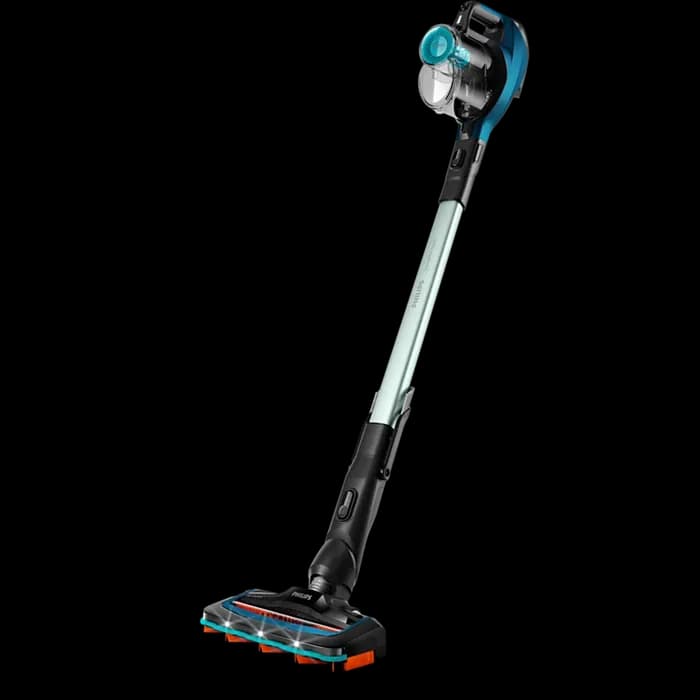
The suction architecture of this unit relies on a 1600 W brushless DC motor that prioritizes consistent static pressure. While 1600 Pa is tuned for handheld efficiency, the motor-to-airway ratio ensures that airflow remains laminar, preventing turbulence that typically reduces debris pickup in smaller devices. This specific pressure rating is optimized for surface-level agitation on wood flooring and tiles, though it serves as a secondary support for deep carpet cleaning. The brushless design reduces internal friction, allowing for a higher sustained RPM without the thermal throttling often seen in cheaper brushed alternatives, making it reliable for daily Indian dust management.
Filtration is handled by a 3-stage HEPA system that focuses on multi-layered particle separation. The first stage captures larger debris like hair and grit, while the subsequent HEPA layers target particles as small as 0.3 microns. Because the filters are designed to be washable, the engineering focuses on hydrophobic material integrity that does not degrade after contact with water. This is critical for Indian users who face high humidity and greasy kitchen dust, as it allows for frequent deep cleaning of the filtration media without losing the efficiency required to trap microscopic allergens and PM2.5 particles.
The power system utilizes a 25.2 V lithium-ion configuration designed for a balanced discharge rate. The 45-minute runtime is achieved through a controlled current draw that prevents the cells from overheating during continuous use. Charging is managed by a CC-CV (Constant Current-Constant Voltage) protocol that takes 4 hours to reach full capacity, protecting the battery's chemical lifecycle over hundreds of cycles. This engineering choice reflects a commitment to long-term durability, ensuring that the battery does not suffer from premature capacity fade even when used in the high-ambient temperatures common across most Indian states.
Liquid management in this wet and dry model utilizes a baffle-based separation mechanism within the 600 ml bin. To protect the 1600 W motor from moisture ingress, the internal airflow path is redirected through a series of chambers that force liquid to settle while allowing air to bypass. This mechanical separation is vital for cleaning spills on kitchen tiles or managing damp floor debris during the monsoon season. Maintenance involves a simple rinse of the internal components, ensuring that no residue remains to cause odors, which is a common failure point in poorly engineered wet-dry hybrids.
Ergonomics and chassis construction utilize high-grade ABS plastic to maintain a 2 kg total weight, ensuring the device remains maneuverable for overhead cleaning. The handle is positioned to align the center of gravity directly under the user's grip, reducing wrist strain when cleaning AC vents or high shelves. This structural design includes reinforced mounting points for the crevice tool and multi-surface roller brush, preventing air leaks at the attachment interface. By maintaining a tight vacuum seal at all connection points, the system maximizes the effective suction delivered to the surface being cleaned, regardless of the attachment used.
The acoustic profile is dampened to 72 dB through internal sound-absorbing chambers surrounding the motor housing. This engineering prevents the high-pitched whine associated with high-wattage motors, making it suitable for use in smaller 1BHK apartments without causing significant noise disturbance. The integration of the pet hair tool features a motorized brush roll that works in tandem with the suction inlet to mechanically lift fibers from fabric. This dual-action approach ensures that the Quantum Clean R5 remains effective against stubborn pet dander, providing a comprehensive cleaning solution that justifies its position in the competitive Indian home appliance market.