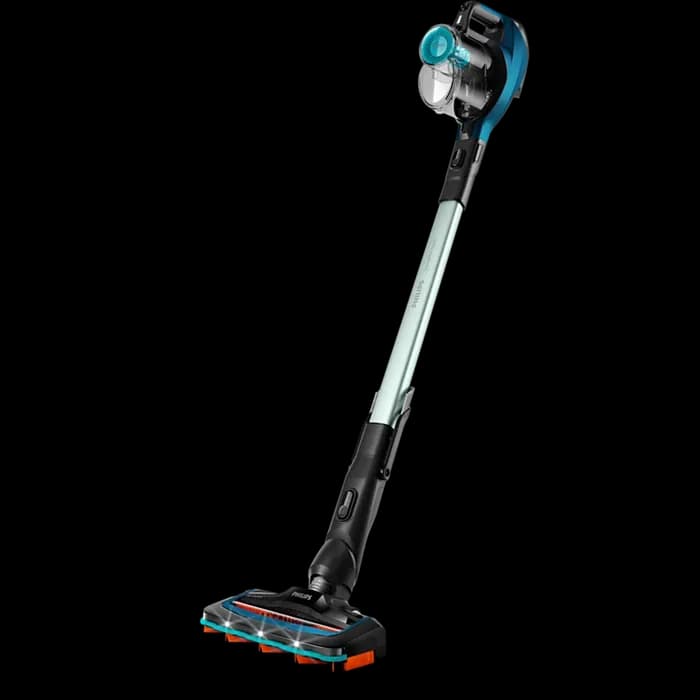
The suction pressure engineering of this unit relies on a 120 W brushless DC motor that spins at high RPMs to achieve 21000 Pa. This specific motor-to-airway ratio is tuned to prioritize static pressure over raw volume airflow, which is critical for lifting dense particles like road salt or fine sand from floor mats. While the 120W draw is optimized for a handheld form factor, the engineering ensures that the suction force remains consistent even as the battery voltage drops during the discharge cycle. This makes it ideal for heavy lifting on localized spots but less suited for broad-floor sweeping where a wide nozzle would dissipate the localized pressure.
The filtration architecture employs a 3-stage HEPA system designed to handle the high-particulate environment of Indian cities. The first stage uses a structural mesh to block large debris, protecting the sensitive HEPA media from premature clogging. The secondary and tertiary stages capture particles down to 0.3 microns, including pollen and fine soot. Because the filter is washable, the airflow resistance can be reset to factory levels by the user, which is vital for maintaining the 21000 Pa peak performance. This washable construction reduces the total cost of ownership significantly by extending the life of the internal filtration components.
The power system uses a lithium-ion cell configuration that supports a 20-minute runtime, balanced against a 3-hour charging window. The engineering team utilized CC-CV (Constant Current-Constant Voltage) charging protocols to maximize the longevity of the cells in the heat-intensive Indian climate. While 20 minutes may seem short for a house-wide clean, the 120W motor draw is calibrated for high-intensity bursts where maximum torque is required to extract pet hair from fibers. Practical use suggests that the 7.4V system provides a stable current flow, ensuring that the motor does not throttle down during the middle of a cleaning session.
A specialized wet/dry separation mechanism protects the internal electronics from moisture ingress during liquid recovery. The internal baffle design routes liquid into a dedicated section of the 0.18 L bin, using centrifugal force to keep droplets away from the brushless motor's intake. This 0.18 L capacity is sufficient for spot-cleaning spilled beverages or damp mud tracked into a vehicle during the monsoon season. Maintenance after wet use is critical; the engineering allows for easy disassembly so the bin can be dried, preventing mold growth or odors which are common issues in bagless handheld vacuum designs.
The inclusion of a blower function utilizes the motor's exhaust side by redirecting high-velocity air through a tapered air blast nozzle. This is a technical departure from suction-only models, allowing the device to clear dust from intricate surfaces like AC vent grilles and electronics where physical contact is discouraged. In the Indian context, this blower is particularly effective for dislodging the fine dust that settles on window tracks and mosquito meshes. By utilizing the reverse airflow, the device provides a dual-use case that maximizes the utility of the 120W motor without increasing the overall weight or footprint.
The chassis is constructed from high-grade ABS plastic, achieving a total weight of only 0.5 kg. This ergonomic design focuses on a centered center of gravity, which reduces wrist fatigue during overhead cleaning of curtain rods or high shelves. The parking position and handle geometry are designed for a neutral grip, accommodating different hand sizes for comfortable use. Every component, from the plastic tube to the brush nozzle, fits via a friction-lock system that maintains airtight integrity to ensure no suction loss at the joints. Ultimately, the Handheld Car Vacuum with Batteries represents a well-engineered balance of portability and high-pressure performance.