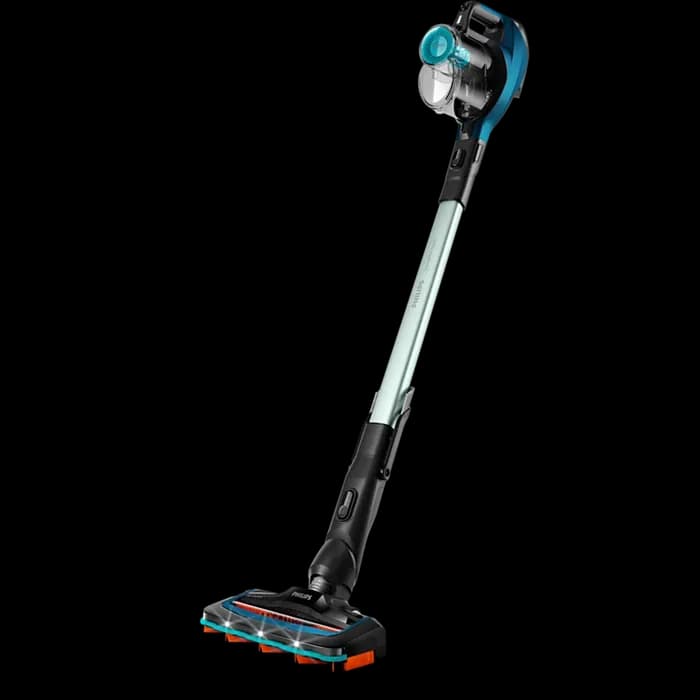
The suction pressure engineering of this unit relies on a 120 W brushless DC motor that spins at high RPMs to create a vacuum delta of 21000 Pa. This specific motor-to-airway ratio is optimized for high static pressure rather than sheer volume, which is essential for pulling heavy grit from car floor mats or fine dust from mattress fibers. Unlike brushed motors, the brushless design reduces internal friction and heat, allowing the compact 0.5 kg chassis to maintain peak performance without thermal throttling. This makes it ideal for targeted, high-intensity cleaning tasks but less suitable for covering large floor areas.
The filtration architecture employs a 3-stage HEPA system designed to manage the heavy particulate load found in Indian urban environments. The primary stage uses a physical mesh to stop hair and larger debris, while the second and third HEPA stages capture particles down to 0.3 microns. Because the filter is entirely washable, users can maintain the pressure differential required for 21000 Pa suction without purchasing replacement cartridges. This engineering choice is vital for cost-efficiency, ensuring that fine silt and construction dust do not permanently clog the filter media or damage the internal motor components.
Power management is handled by a 7.4 V lithium-ion cell configuration that utilizes CC-CV charging protocols to reach a full 100% state in approximately 3 hours. The 20-minute runtime is a calculated trade-off between battery weight and motor draw; at 120 W, the motor pulls significant current to maintain its suction rating. Practical usage in India suggests that this window is sufficient for spot-cleaning a 5-seater sedan or a standard sofa set. The power delivery is stabilized by a control PCB that prevents voltage sag as the battery depletes, ensuring cleaning power remains consistent throughout the session.
The wet and dry separation mechanism utilizes a mechanical baffle within the 0.18 L bagless bin to divert liquid away from the motor assembly. While the capacity is limited, the design allows for the immediate recovery of spilled beverages on car seats or damp kitchen crumbs. Engineering-wise, this requires a sealed motor housing and a moisture-resistant exhaust path to prevent short circuits. After wet use, it is critical for users to rinse and dry the internal components to prevent odors. This dual-capability is a significant engineering advantage over dry-only handheld units used in high-humidity regions.
The blower function operates by redirecting the motor's exhaust through a narrowed nozzle, converting high-pressure suction into a high-velocity air stream. This technical mechanism is particularly useful for dislodging dust from recessed areas like mechanical keyboards or deep AC vents where suction alone cannot reach. It operates on the same 120 W motor, providing a forceful blast that replaces the need for compressed air cans. This dual-direction airflow engineering makes the unit a complete maintenance tool for electronic devices and intricate automotive dashboards common in modern vehicles.
The chassis is constructed from high-impact ABS plastic, which provides structural rigidity while keeping the total weight at 0.5 kg for one-handed operation. The ergonomic handle is balanced around the center of gravity of the battery cells, reducing wrist strain during extended cleaning of ceiling fans or curtains. A specialized parking position allows the unit to stand vertically during storage, saving space in compact 1BHK apartments. Every component, from the nozzles to the plastic tubes, is friction-fitted to prevent air leaks, ensuring the Portable Car Vacuum Cleaner with Air Blower delivers maximum cleaning efficiency.