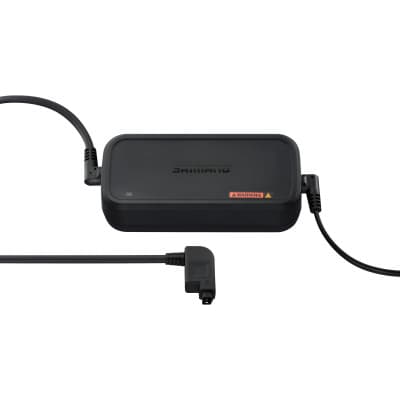
The Shimano EC-E8004's robust engineering begins with its versatile electrical input stage, accepting a global 100V-240V AC (50/60 Hz) single-phase supply. This wide voltage tolerance is critical for international compatibility and robust operation across varying grid conditions. The charger’s output stage delivers a precisely regulated 42V DC, which is the optimal terminal voltage for a 36V nominal Li-Ion battery pack, typically configured as a 10S array (10 cells in series, each charging to 4.2V). With an adaptive output current ranging from 4A to 4.6A, the EC-E8004 achieves a substantial rated power of 193W, enabling fast charging capabilities.
The core of its charging technology lies in the industry-standard 2-stage Constant Current / Constant Voltage (CC/CV) algorithm. In the initial Constant Current (CC) phase, the charger delivers its maximum current (4A-4.6A) to rapidly elevate the battery's State of Charge (SOC), typically up to 80%. Subsequently, the Constant Voltage (CV) phase maintains a steady 42V, gradually tapering the current as the battery approaches 100% SOC. This meticulous control prevents overcharging and thermal stress, crucial for maximizing Li-Ion battery lifespan. The observed charging times, such as 0-80% in 2.5 hours for a 418Wh battery, demonstrate the efficacy of this high-current CC phase.
Thermal management is passively achieved through a fan-less design, minimizing noise and improving reliability by eliminating moving parts and dust ingress. This allows for silent operation within a 0°C to 40°C charging environment. A comprehensive suite of protection features, including Over-Voltage Protection (OVP), Under-Voltage Protection (UVP), Over-Current Protection (OCP), Short-Circuit Protection (SCP), and Over-Temperature Protection (OTP), ensures operational safety for both the charger and the connected Shimano STEPS battery. While featuring a waterproof rating, the unit's design prioritizes indoor, portable use. Electrical isolation further enhances user safety against potential ground faults.