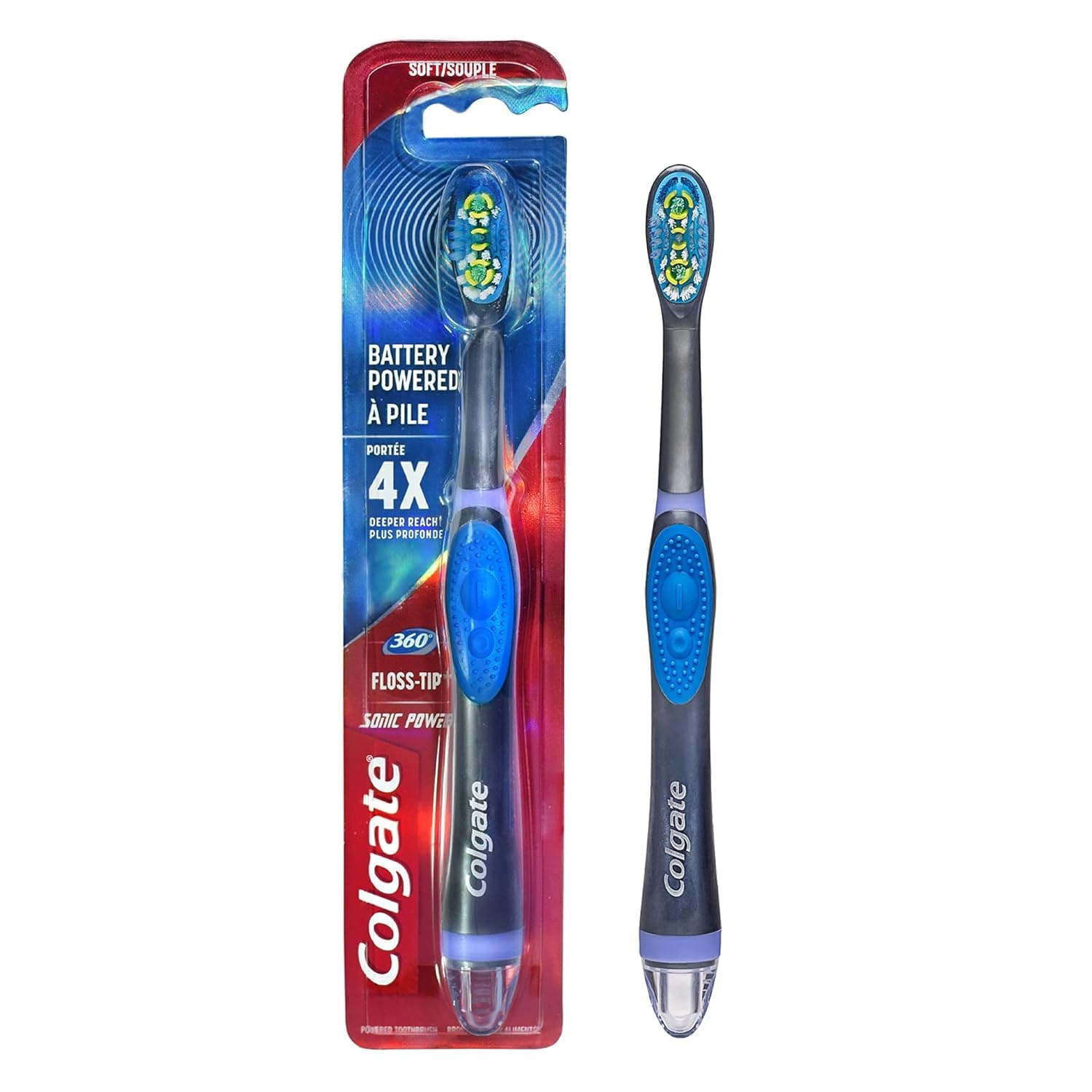
The Colgate 360 Sonic employs a focused engineering philosophy, prioritizing core sonic cleaning efficacy and user convenience. The 'Sonic motor' drives the bristle action through high-frequency vibrational energy, which, while specific vibration frequency data is 'NA', is inherently designed to create micro-bubbles in the toothpaste and saliva, aiding in plaque dislodgement beyond direct bristle contact. This mechanism, distinct from oscillating-rotating or purely vibrational brushes, is optimized for 'High plaque removal efficiency' and the advertised '4X deeper reach'. The absence of an 'oscillation mode' confirms its dedication to a pure sonic operation.
Critically, the 'brush head type' is 'Replaceable' and features 'Floss-tip bristles'. These slender, tapered bristles are engineered to navigate tight interdental spaces and along the gumline more effectively than conventional round-cut bristles, complementing the sonic action. The 'Soft' bristle softness is a deliberate choice to accommodate users with sensitive gingival tissues while still providing robust cleaning.
From a power systems perspective, the reliance on a 'Replaceable AA battery' is a key design differentiator. This choice prioritizes portability and immediate operational readiness over a rechargeable system, which would necessitate a charging cradle and specific charging times ('NA'). While offering significant travel advantages and avoiding issues of battery degradation inherent in fixed rechargeable units, it implies ongoing consumable costs. The absence of 'wireless charging' or 'USB-C charging' further underscores this design choice.
Environmental resilience is addressed by its 'IPX7 water resistance rating', indicating the device can be submerged in up to 1 meter of water for 30 minutes, ensuring operational integrity and hygiene in typical bathroom environments. The deliberate omission of a 'pressure sensor', 'timer type', 'quad pacer', or any 'smart features' (Bluetooth, Wi-Fi, app control, AI feedback) streamlines the device, reducing complexity and potential points of failure, thereby focusing engineering resources on fundamental cleaning performance.