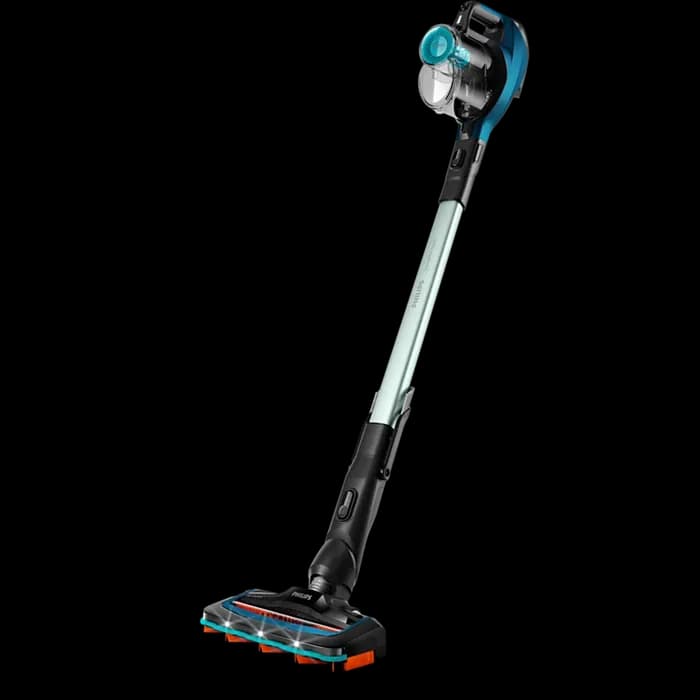
The suction profile of this unit is driven by a 700 W universal motor designed to generate 14 Pa of static pressure. In vacuum engineering, this pressure rating reflects the motor’s ability to move air through the 0.6 L bagless chamber against resistance. The motor-to-airway ratio is tuned to prioritize high-velocity air movement rather than pure static lift, which is why it performs effectively on loose debris like fine sand and crumbs. While the 14 Pa figure is lower than industrial extractors, the 700 W power draw ensures that the impeller maintains consistent RPM even as the dust bin fills, preventing the suction drop-off common in lower-wattage handhelds.
Filtration is handled by a 1-stage WASHABLE_HEPA_FILTER assembly located immediately behind the primary intake. This system is engineered to capture particles down to 0.3 microns, including common Indian pollutants like cement dust and pollen. The washable nature of the filter is a critical design choice for the Indian market, where high ambient dust levels would otherwise lead to frequent and expensive filter replacements. By allowing the user to rinse the pleated media, the airflow remains unobstructed, ensuring the motor does not overheat during extended 30-minute sessions. The seal integrity around the filter housing prevents secondary pollution during operation.
Power management relies on a rechargeable battery array that supports a 30-minute continuous runtime. The charging circuit utilizes a CC-CV (Constant Current-Constant Voltage) protocol to protect the cells during the 3-4 hour replenishment cycle. The 700 W motor draw is balanced by the internal discharge rate, ensuring that the voltage stays stable until the final minutes of the cleaning cycle. For Indian users, this means the suction remains predictable rather than fading gradually. The heat dissipation fins integrated into the motor housing manage the thermal load generated by the high-wattage motor within the compact 1.8 kg chassis.
The dust management system uses a 0.6 L bagless container with a simplified separation mechanism. Unlike cyclonic towers, this model uses a direct-path design where the air enters the chamber and hits a baffle before passing through the HEPA media. This reduces internal turbulence, allowing the suction to act more directly on the surface being cleaned. The transparent bin allows for immediate visual confirmation of the fill level, which is essential because the performance of a 700 W motor is sensitive to volume constraints. The lack of a wet-extraction valve means the motor is strictly protected from moisture ingress.
Attachment engineering focuses on the friction-fit detachable wand and floor brush. The crevice tool is designed with a narrow aperture to artificially increase the air velocity, compensating for the pressure rating when cleaning deep gaps like car seat rails or sliding window tracks. The pet hair tool uses stiff bristles to mechanically agitate fibers on sofas, lifting embedded hair into the airflow. Since there is no blower function, the entire 700 W of energy is dedicated to the intake side, maximizing the efficiency of the primary vacuuming task. Each attachment is molded from high-impact ABS for long-term durability.
Ergonomics are defined by the 1.8 kg total weight and a balanced center of gravity located near the handle. The chassis construction uses lightweight polymers to ensure that the 700 W motor does not make the unit top-heavy during overhead cleaning of AC vents or fans. The handle design allows for a natural grip that reduces wrist strain during the full 30-minute runtime. While it lacks a formal parking position, the compact dimensions allow for easy storage in 1BHK or 2BHK cupboards. Ultimately, the 3 in 1 Convertible Vacuum Cleaner provides a technically sound architecture for users seeking a nimble handheld cleaning solution.