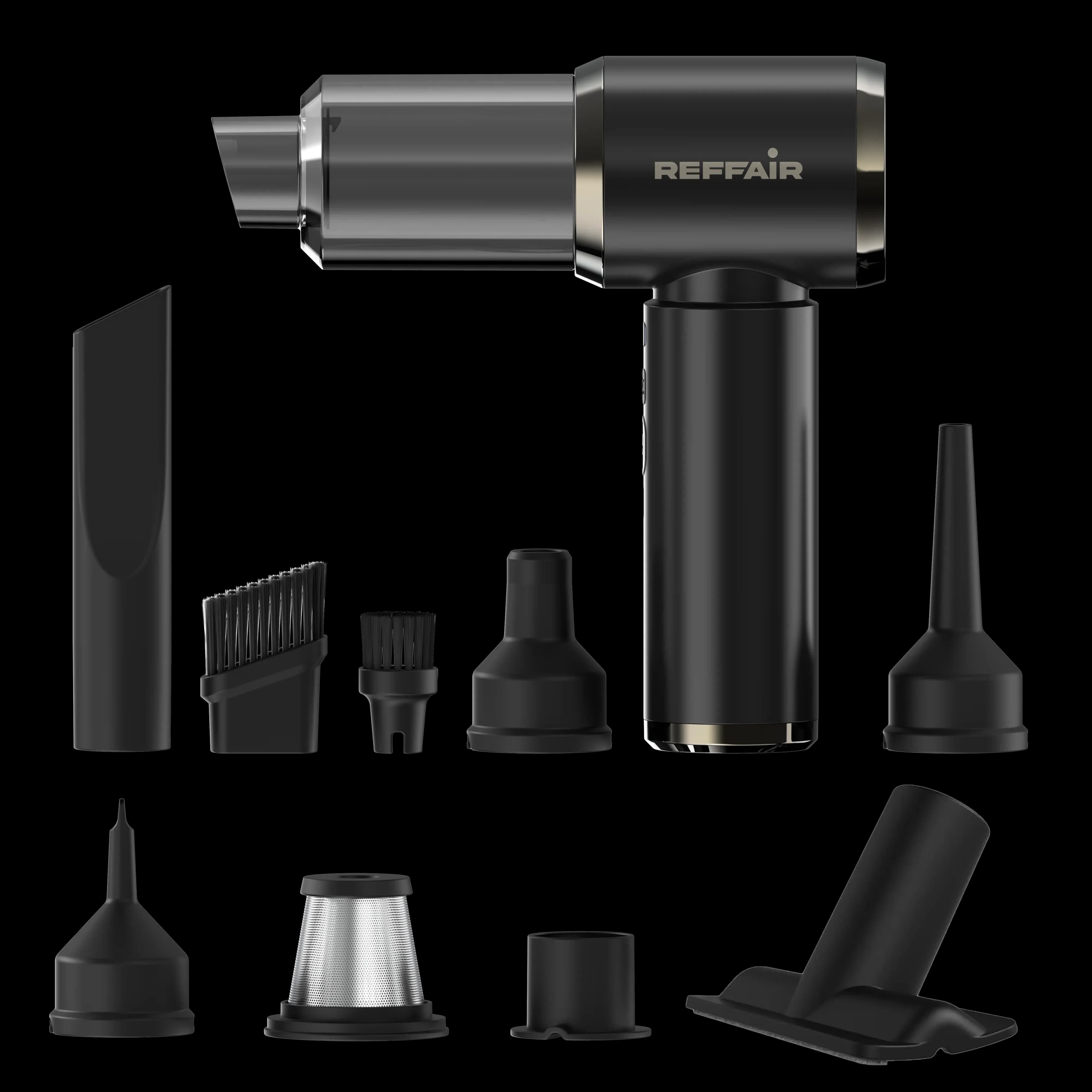
The engineering of the suction system focuses on high static pressure within a confined nozzle diameter. Generating 12000 Pa from a high-speed motor requires a precise impeller design that optimizes the motor-to-airway ratio. This pressure is sufficient for lifting dense particulates like silica-rich road dust found in Indian cities, though it prioritizes velocity over massive air volume (CFM). In practical application, this means the device excels at surface extraction on hard surfaces and tight weaves rather than deep carpet agitation. The motor is calibrated to maintain this pressure consistently throughout the battery discharge cycle.
The filtration architecture utilizes a single-stage High-Efficiency Particulate Air (HEPA) system. Unlike multi-cyclonic industrial units, this 1-stage configuration reduces air resistance, allowing the compact motor to achieve higher peak suction. The HEPA media is rated to capture particles as small as 0.3 microns, which includes common Indian allergens like pollen and fine PM2.5 soot. The washable nature of the filter is a critical engineering choice for the Indian market, where high ambient dust loads would otherwise lead to frequent and expensive filter replacements, maintaining long-term airflow efficiency without extra costs.
The power system relies on a lithium-ion cell configuration designed for a 20-minute high-drain discharge. Charging is managed via a CC-CV (Constant Current-Constant Voltage) protocol over a 3-hour window to preserve cell longevity. The trade-off between the 0.7 kg total weight and battery capacity is calculated to ensure the unit remains maneuverable for overhead cleaning, such as ceiling fan edges or top-shelf dusting. For the Indian user, this runtime is sufficient for targeted 'tactical' cleaning sessions, such as refreshing a car's interior or sanitizing a sofa before guests arrive, rather than whole-house vacuuming.
The bagless dust management system utilizes a direct-path airflow design. By eliminating the need for bags, the internal architecture reduces turbulence, which helps in maintaining the suction force as the bin fills. The absence of a complex wet/dry baffle system allows for a larger effective dust capacity within the small chassis. Maintenance is streamlined through a twist-and-release mechanism that minimizes user contact with the collected grime. This design is particularly beneficial for Indian households where fine dust can become clumpy in humid conditions, necessitating a bin that is easy to wipe down and sanitize.
The inclusion of a blower function is a significant engineering pivot from standard suction-only models. By utilizing the motor's exhaust air through a secondary rear-facing port, the device can generate a concentrated stream of air. This is mechanically ideal for dislodging 'stuck' dust in AC vents or intricate keyboard switches where suction alone cannot break the surface tension of the dirt. In the Indian context, this is invaluable for cleaning electronics that are frequently exposed to fine dust, providing a dual-action cleaning cycle that most entry-level handhelds lack in their primary design.
The chassis is constructed from high-grade ABS plastic, selected for its impact resistance and lightweight properties. The ergonomics focus on a balanced center of gravity, preventing wrist strain during extended use on vertical surfaces like curtains or window mesh. The 0.7 kg weight is distributed towards the handle, making the crevice tool and dust brush attachments feel nearly weightless during operation. This structural integrity ensures the unit can withstand the rigors of daily use in busy Indian homes. Ultimately, the CX50 represents a refined approach to localized cleaning, prioritizing portability and high-pressure suction over bulk.