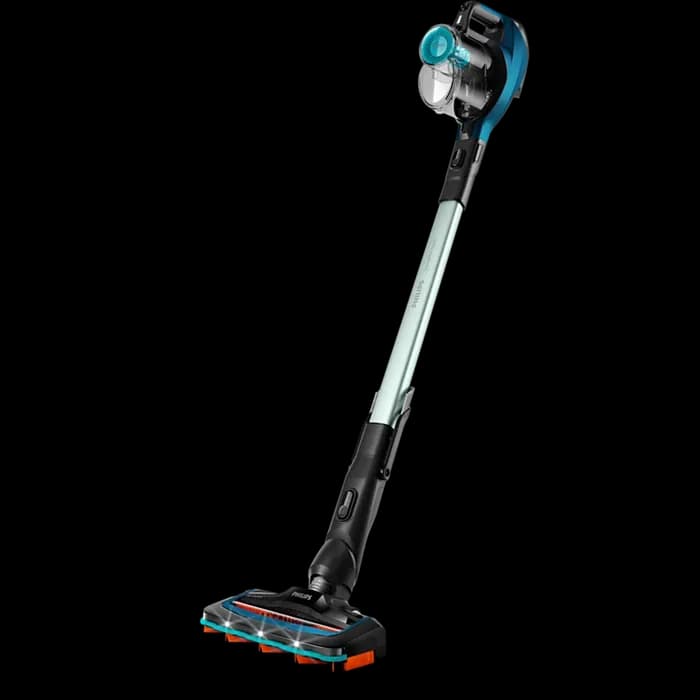
The suction pressure engineering of this unit utilizes a 55 W motor configured to generate a focused 21000 Pa of static pressure. This high pressure-to-wattage ratio is achieved through a tight impeller housing that minimizes air leakage, though it prioritizes lift over high cubic feet per minute (CFM). This design is ideal for extracting fine silt from crevices or pulling debris from fabric weaves but is less suited for large debris on open floors. The motor maintains consistent rotational speed throughout the discharge cycle, ensuring that suction remains stable until the battery reaches its low-voltage cutoff point.
Filtration architecture is built around a 3-stage HEPA system that progressively filters air to prevent motor clogs. The initial stage uses a centrifugal baffle to spin out heavy dust, while the second stage employs a fine mesh to catch hair and larger fibers. The final HEPA stage is rated to capture particles as small as 0.3 microns, making it vital for Indian homes facing high PM2.5 levels. Since the entire assembly is washable, users can maintain high airflow without the static pressure drop usually associated with clogged, non-washable paper filters common in cheaper handheld models.
The battery system uses a 7.4 V cell configuration optimized for high current discharge to support the 55 W motor draw. Utilizing CC-CV charging protocols, the unit reaches full capacity in approximately 3 hours, which is standard for lithium-ion portable devices in this class. While 20 minutes of runtime may seem modest, the energy density is calculated to provide maximum torque during the cleaning window. For Indian users, this means the device provides peak performance for intense spot-cleaning rather than tapering off slowly, ensuring that the last minute of cleaning is as effective as the first.
This unit features a specialized wet/dry separation mechanism within the 0.45 L bin to handle liquid spills alongside dry dust. A mechanical baffle prevents moisture from entering the motor housing during suction, provided the unit is held at the correct ergonomic angle. This is particularly useful for cleaning tea spills on desks or wet footprints in car interiors. However, the bagless bin requires thorough drying after wet use to prevent mold growth on the HEPA element. This engineering choice adds significant utility for busy households where spills and road dust coexist on the same surfaces.
The blower function operates by redirecting exhaust air through a secondary nozzle port, converting the unit into a compressed air duster. Mechanically, this bypasses the filtration resistance to provide a high-velocity stream of air for dislodging dust from AC vents or PC motherboards. In the Indian context, where fine dust cakes onto fans and electronics due to humidity, this dual-mode capability provides a technical advantage over suction-only models. It essentially replaces the need for disposable canned air, offering a sustainable and repeatable solution for delicate electronic maintenance in dusty urban environments.
The chassis is constructed from high-impact ABS plastic, keeping the total weight at a remarkable 0.5 kg for superior ergonomics. The handle design is balanced to prevent wrist strain during overhead cleaning, such as reaching ceiling fans or top-shelf corners. A variety of attachments, including a long air blast nozzle and small floor brush, utilize a friction-fit coupling that maintains airtight seals under high vacuum pressure. This engineering focus on weight reduction without compromising structural integrity ensures the Electronic Compressed Air Flesh Portable Rechargeable Cordless Vacuum Cleaner provides long-term durability for daily residential use.