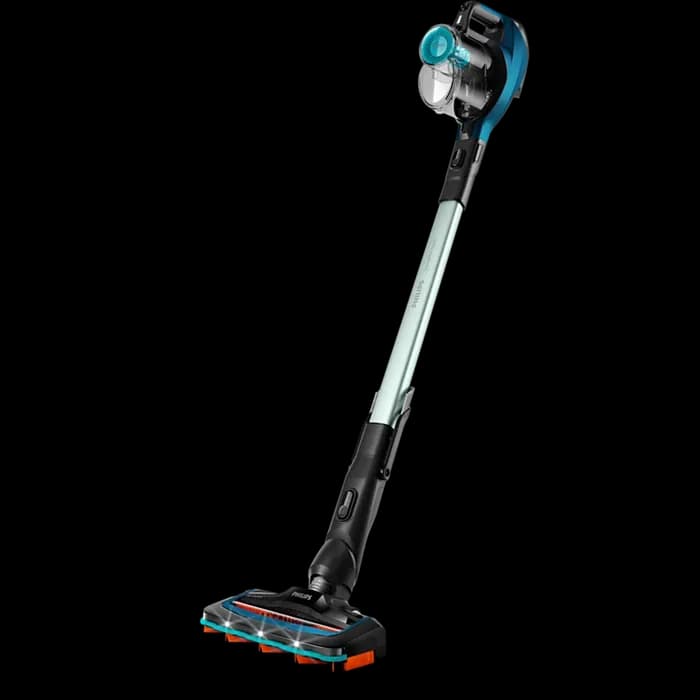
The vacuum's performance originates from a 120 W DC motor specifically tuned to generate a vacuum pressure of 8000 Pa. This pressure is achieved by optimizing the motor-to-airway ratio, focusing on static pressure rather than high-volume airflow. While this makes it less effective for deep-pile carpets, it is ideal for high-resistance tasks like pulling dust through upholstery fibers or mattress weaves. The motor architecture ensures that power draw remains consistent throughout the battery discharge cycle, preventing a drop in suction performance as the cells deplete, which is a common failure point in unbranded handheld alternatives.
The filtration architecture utilizes a 1-stage HEPA system that captures 99.97% of particles down to 0.3 microns. Unlike multi-stage systems that can impede airflow in low-wattage motors, this single-layer design provides a balance between particle retention and motor longevity. The washable construction is a critical engineering choice for the Indian market, where high ambient dust loads would otherwise saturate a non-washable filter within weeks. By allowing for regular rinsing, the system maintains its airflow integrity and prevents motor overheating caused by backpressure from a clogged filter element.
Powering the unit is a lithium-ion battery configuration that supports a 30-minute continuous runtime, which is superior for a 0.45 kg device. The charging circuit employs a CC-CV (Constant Current-Constant Voltage) protocol, requiring only 2 hours to reach full capacity. This rapid turnaround is essential for households that perform multiple spot-cleans throughout the day. The battery management system is designed to handle the thermal fluctuations typical of Indian summers, ensuring the cells do not degrade prematurely when stored in non-air-conditioned environments or inside warm vehicles during car cleaning sessions.
The wet and dry separation mechanism utilizes an internal baffle design to protect the motor from liquid ingestion. While the total bin capacity is 1 L, the effective wet capacity is limited to prevent splashing into the impeller housing. The bagless 1 L bin uses a centrifugal separation technique to keep heavier debris at the bottom, away from the HEPA intake. This ensures that even when the bin is half-full with kitchen spills or wet mud, the 8000 Pa suction remains unhindered, provided the user follows post-wet-use maintenance by drying the filter.
The technical utility of the crevice tool and brush attachments is optimized for high-velocity narrow-bore airflow. By constricting the suction into a smaller aperture, the crevice tool increases the air speed to dislodge stubborn grime found in window tracks or sliding door channels common in Indian balconies. The brush attachment utilizes nylon bristles to mechanically agitate fine dust on AC vent louvers and mesh filters, allowing the suction to capture debris before it re-circulates. These attachments are pressure-fitted to maintain a seal, ensuring that the motor's output is not wasted through air leaks at the connection point.
The chassis is constructed from high-grade ABS plastic, achieving a feather-light weight of 0.45 kg without sacrificing structural integrity against accidental drops. The handle is ergonomically balanced to place the center of gravity near the palm, reducing wrist strain during extended 30-minute cleaning sessions. While the unit lacks a vertical parking position found in stick vacuums, its compact profile allows it to be stored easily in kitchen drawers or car glove boxes. The integration of a 1 L bagless bin into such a small frame requires precise internal spatial management to avoid airflow obstruction. These engineering choices result in a highly maneuverable device, establishing the EV 241 as the buying conclusion.