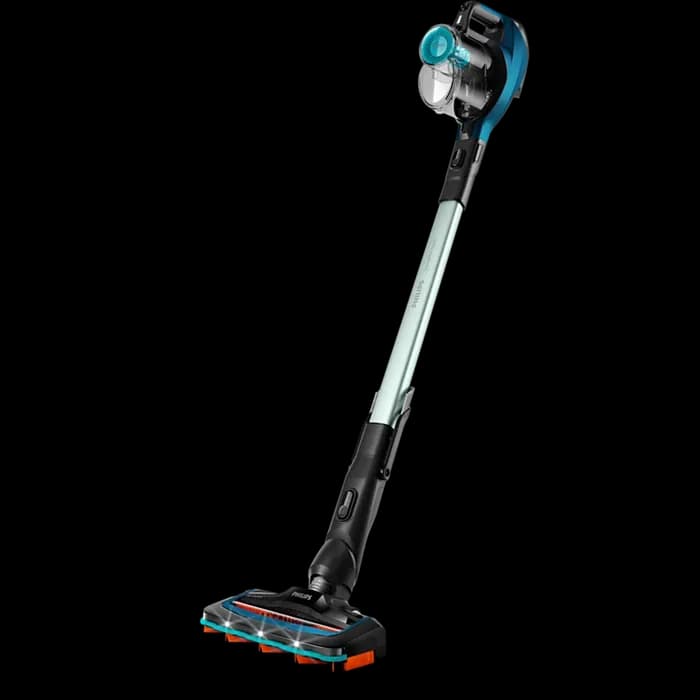
The suction pressure engineering of this unit is centered around a 120 W DC motor that balances current draw with air displacement. Achieving a vacuum pressure of 8000 Pa requires a high motor-to-airway ratio, where the internal fan speed is optimized to create a strong static pressure zone. This specific pressure level is ideal for lifting fine road dust and pet hair from fabric weaves without the excessive heat generation found in higher-wattage corded models. While it sacrifices the extreme airflow of 1000W uprights, its localized suction is far more effective for the high-density debris found in Indian homes.
Filtration architecture consists of a single-stage HEPA system designed for durability and airflow efficiency. This filter captures particles as small as 0.3 microns, including common Indian allergens like pollen and PM2.5 dust. The washable construction is particularly relevant for the Indian climate, where high humidity and fine silt can quickly clog disposable filters. By allowing the user to rinse the filter under tap water, the device maintains its performance over hundreds of cycles. This 1-stage design ensures that the air resistance remains low enough to maximize the output of the compact DC motor.
Power management is handled by a 12 V cell configuration optimized for a 30-minute runtime. The system utilizes CC-CV charging protocols to ensure the battery reaches full capacity in just 2 hours, which is remarkably fast for this category. The engineering team has balanced the motor draw to prevent thermal throttling, allowing for a consistent power curve until the battery is nearly depleted. For Indian users, this means the device can handle a full car interior or a 2BHK upholstery cleaning session on a single charge, provided the trigger is used strategically for focused spot cleaning.
Regarding the wet/dry separation mechanism, the unit features a clever internal baffle design. This physical barrier prevents liquids from entering the motor housing during wet suction tasks, such as cleaning spilled tea or rainwater on windowsills. The 1 L bagless bin is divided to manage both dry debris and fluid volume, though users must empty the container immediately after wet use to prevent moisture from reaching the HEPA stage. This dual-purpose architecture is achieved without increasing the 0.45 kg footprint, making it a highly sophisticated example of fluid-dynamic engineering in a portable chassis.
While this model lacks a blower function, it compensates with an optimized attachment set comprising a crevice tool and a brush. These tools are engineered to focus the 8000 Pa suction into narrow channels, which is essential for cleaning AC vent grime and deep keyboard grooves. The attachment interface uses a friction-lock system that prevents air leakage, ensuring that the vacuum pressure at the nozzle tip is maximized. This focus on pure suction efficiency makes it more effective at extracting embedded dirt from hard-to-reach corners than multi-function models that spread their power across too many different internal paths.
The chassis and ergonomics reflect a commitment to lightweight ABS construction, bringing the total weight to a mere 0.45 kg. This low mass is achieved through a high-strength plastic shell that protects the internal motor and battery while remaining easy for seniors or children to operate. The handle design is ergonomically curved to reduce wrist strain during overhead cleaning of curtain rods or ceiling fans. The parking position is stable, allowing the unit to be stored upright in small kitchen cabinets or car glove boxes. Ultimately, the EV 264 represents a masterclass in portable engineering for daily Indian household maintenance.