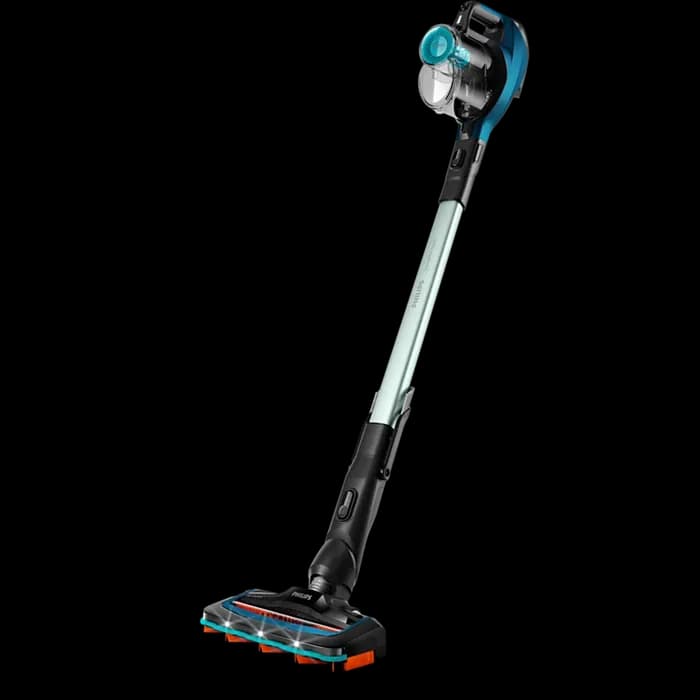
The 120 W DC motor is calibrated to produce 8000 Pa of static pressure, a specific engineering choice for a 0.45 kg chassis. This motor-to-airway ratio optimizes the velocity of incoming air, ensuring that heavy particles like sand and fine road dust are lifted into the primary chamber. Unlike AC-powered corded motors that prioritize high raw wattage, this DC configuration focuses on instantaneous torque to overcome the inertia of debris. This makes the unit highly effective for surface-level pickup on hard floors and upholstery, though it lacks the deep-pile agitation of high-voltage industrial extractors.
The filtration architecture utilizes a 1-stage HEPA system designed to capture 99.97% of particles as small as 0.3 microns. In the context of Indian homes, this is critical for managing PM2.5 pollutants and dust mites that accumulate in mattresses. The HEPA media is constructed from densely pleated synthetic fibers that allow for washing, which is essential given the high dust loading in tropical climates. This washable nature prevents the filter from becoming a bottleneck for airflow, maintaining consistent suction levels over the product's lifespan without requiring frequent and expensive replacement components.
Powering the 120 W motor is a multi-cell 12 V battery array that utilizes a CC-CV (Constant Current-Constant Voltage) charging protocol. This system achieves a full 100% charge in just 2 hours, minimizing downtime between cleaning sessions. The discharge curve is engineered to provide a steady 30 min runtime, preventing the fade effect common in cheaper nickel-cadmium alternatives. For Indian users, this means the device operates at peak performance until the battery is nearly depleted. Managing the thermal profile during high-draw tasks ensures the lithium-ion cells remain stable over hundreds of charge cycles.
The wet and dry separation mechanism employs an internal baffle design that redirects liquid away from the motor housing. By creating a vortex within the 1 L bagless bin, the device can ingest small liquid spills without risking an electrical short. This functionality is particularly useful for cleaning damp mud or kitchen spills. However, users must maintain the effective liquid capacity limit to prevent overflow. Post-wet use, the bin and HEPA filter must be thoroughly dried to prevent mold growth, a simple but vital maintenance step for longevity in humid regions.
Operating at a noise level of 65 dB, the device is significantly quieter than 1000 W corded vacuums, making it suitable for use in apartments without causing significant disturbance. The engineering of the crevice tool and brush attachment focuses on airtight seals at the point of contact, which maximizes the effective 8000 Pa at the nozzle. The crevice tool concentrates airflow for high-velocity extraction in tight gaps like car door pockets, while the brush attachment agitates fibers to release trapped pet hair. This mechanical synergy ensures energy from the battery is translated into cleaning work.
The chassis is molded from high-impact ABS plastic, selected for its strength-to-weight ratio which keeps the total mass at 0.45 kg. The handle is ergonomically positioned at the center of gravity, reducing wrist strain during extended overhead cleaning of AC vents or high shelves. The parking position is integrated into the base, allowing the unit to stand or be stored vertically in tight cupboards common in 2BHK layouts. This focus on physical architecture makes the EV 291 a highly maneuverable tool compared to traditional drag-along canisters. It represents a refined approach to localized household cleaning.