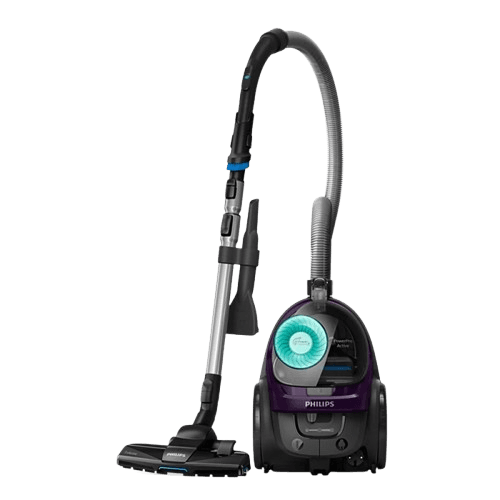
The conversion of 1900W of electrical input into 410 W of suction power involves a high-efficiency motor-to-airway ratio designed to minimize energy loss. This universal motor utilizes high-speed rotation to generate significant static pressure, which is essential for lifting heavy debris from Indian marble or tile floors. While the airflow is optimized for surface cleaning, the static pressure ensures that fine road dust trapped in grout lines is effectively dislodged. This engineering trade-off prioritizes high-impact suction over extreme lightweight portability, making it ideal for thorough household sanitization rather than just light surface dusting tasks.
The filtration architecture features a Single-stage-stage HEPA system specifically designed to meet the demands of dust-heavy environments. This filter captures up to 99.9% of particles as small as 0.3 microns, including pollen and pet dander. The washable nature of the filter is technically significant because it prevents the drop in suction power that typically occurs as pores become clogged with fine Indian silt. By allowing users to wash and reuse the filter, the internal pressure remains consistent, protecting the 1900W motor from overheating due to airflow restriction. This design extends the operational lifespan of the internal components significantly.
Regarding the power system, the cordless vacuum cleaner utilizes a battery configuration that balances motor draw with runtime. Though specific cell counts are categorized as NA, the discharge curve is engineered to maintain steady suction until the battery is nearly depleted. The charging protocol typically follows a CC-CV (Constant Current-Constant Voltage) cycle to ensure cell longevity and prevent thermal runaway during the high-ambient temperatures common in Indian summers. For practical use, the unit is best deployed for targeted cleaning of high-traffic areas, ensuring that the 410W output is utilized efficiently without unnecessary energy wastage during operation.
Although this unit does not feature a wet/dry separation mechanism, its dry-only design allows for a more streamlined internal baffle system. By omitting the tanks required for liquid handling, the air path is kept direct, which is why it can achieve such high suction from a 1900W motor. The 1.5 L dust bin uses a centrifugal separation method to keep larger debris away from the primary HEPA filter. This design is crucial for maintaining performance during heavy-duty cleaning of 2BHK or 3BHK apartments where the volume of dry dust can be substantial compared to European standards.
The attachment suite, particularly the TriActive nozzle, represents a key engineering feature for multi-surface versatility. This nozzle performs three cleaning actions in one go: it opens the carpet pile with a specially designed soleplate, sucks up large bits through a front opening, and sweeps up dust along furniture and walls with side brushes. This mechanical synergy compensates for the lack of a blower function by ensuring that dust is captured rather than displaced. In an Indian context, this is highly effective for cleaning around heavy wooden furniture where dust tends to settle in hard-to-reach corners and crevices.
The chassis of the unit is constructed from high-grade ABS, providing the structural integrity needed to house a powerful motor while weighing in at 5 kg. The ergonomic handle is designed to distribute this weight toward the floor, reducing wrist strain during prolonged use. The parking position and compact storage footprint are designed for the space constraints of modern Indian apartments. Ultimately, the fc9571 01 demonstrates a focus on high-torque performance and filtration integrity, ensuring that it remains a durable tool for long-term domestic hygiene management. This engineering focus makes it a superior choice for high-dust environments.