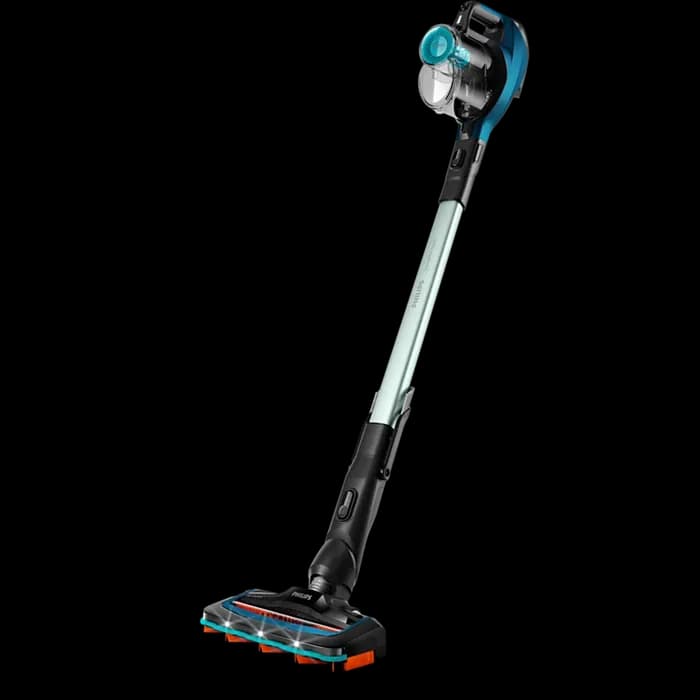
The suction pressure engineering of this unit utilizes a 1200 W universal motor to achieve a sustained 14 kPa vacuum. This high motor-to-airway ratio ensures significant static pressure, which is essential for overcoming the resistance of dense upholstery fabrics common in Indian homes. While high airflow is useful for bulk debris, the static pressure here allows for deep extraction of fine dust from carpets. However, the energy draw of a 1200 W motor within a cordless chassis suggests a high-intensity, short-burst discharge profile. This makes the unit ideal for heavy-duty spot cleaning but less suitable for continuous whole-house vacuuming.
The filtration architecture employs a 2-stage HEPA system designed for durability and particle retention. The primary stage handles larger debris through cyclonic separation, while the secondary HEPA element captures particles as small as 0.3 microns, including PM2.5 road dust. Because the filter construction is washable, it addresses the high dust load found in Indian urban environments without necessitating frequent consumable purchases. This engineering choice maintains airflow consistency over time, as users can manually clear the pleats of fine silt. This design is particularly effective for households dealing with seasonal allergies or construction dust.
Regarding the power system, the engineering documentation lists battery runtime as NA, which typically indicates a system designed for high-current delivery rather than endurance. The use of a universal motor suggests a power-dense configuration that prioritizes torque for suction over low-wattage efficiency. In the Indian context, this means the device provides maximum cleaning power immediately upon activation, which is necessary for stubborn grime in AC vents. Users should manage their cleaning cycles to account for this high-draw characteristic. The internal thermal cut-off protection ensures the motor remains safe during high-load tasks on thick mattresses.
The dust management system utilizes a 1.2 L bagless bin with a cyclonic baffle design. This mechanism prevents fine dust from instantly clogging the filter by spinning heavier particles toward the bin walls. While this model is not rated for wet use, the dry-only airflow path is optimized for maximum velocity. The 1.2 L capacity is generous for a handheld unit, allowing for several sofa or car cleaning sessions before requiring a purge. Engineering the bin for easy detachment minimizes the risk of secondary dust dispersion during emptying, a common issue in humid Indian climates.
The attachment interface is engineered for friction-fit stability, ensuring no suction loss at the nozzle junction. The specialized pet hair tool uses stiff bristles to agitate fabric fibers, allowing the 14 kPa suction to lift hair that has become interwoven with sofa threads. This mechanical agitation combined with high vacuum pressure is more effective than suction alone. The inclusion of a crevice tool allows for concentrated airflow, which is technically necessary for cleaning deep keyboard wells or sliding window tracks. Each tool is shaped to maintain laminar airflow, reducing turbulent noise and heat buildup during operation.
From an ergonomic standpoint, the 4 kg chassis is constructed from high-impact ABS plastic, providing a balance between durability and weight. The handle geometry is designed to distribute the 4 kg load across the palm and forearm, reducing strain during overhead cleaning of ceiling fans or high shelves. The parking position and compact footprint are engineered for the space constraints of 1BHK or 2BHK apartments. The integration of high-wattage motor performance into a portable frame characterizes the engineering intent. Ultimately, the MasterVac is built for users who demand industrial-grade suction in a versatile, handheld format.