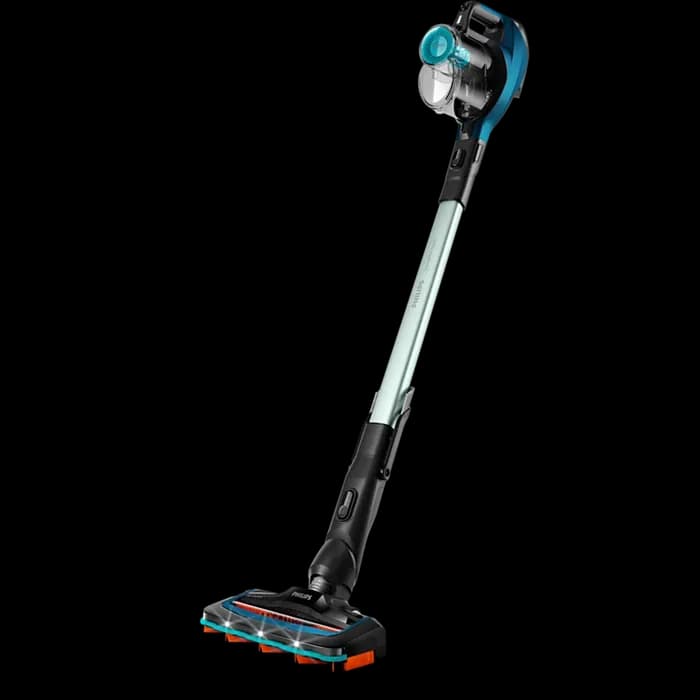
The suction pressure engineering of this unit centers on its 800 W universal motor, which is specifically calibrated to reach 15.5 kPa within a compact housing. In vacuum engineering, the motor-to-airway ratio determines the static pressure; here, the high-wattage motor drives a high-velocity impeller that creates a significant pressure differential. While 15.5 kPa is lower than industrial corded canisters, it provides the optimal balance of airflow and lift for handheld tasks. This specific pressure level is ideal for extracting fine road dust from textiles but may struggle with heavy debris like construction rubble. The 800 W draw ensures high-torque performance during heavy load periods.
The filtration architecture employs a 2-stage HEPA system designed to manage the high particulate matter levels found in urban Indian environments. The first stage consists of a primary mesh that intercepts larger debris like hair and grit, protecting the more delicate inner filter. The second stage is the HEPA element, which captures particles as small as 0.3 microns, including pollen and dander. Because the construction is washable, users can maintain high airflow without the static pressure drops caused by clogged, non-washable filters. This sustainability is vital for daily use in dusty conditions where filter saturation occurs rapidly.
The battery and power system utilizes a cordless configuration to maximize mobility within compact 1BHK and 2BHK apartments. While runtime specifications are listed as NA, the 800 W motor equivalence suggests a high-discharge cell arrangement capable of handling burst cleaning cycles. Typically, such handheld devices utilize lithium-ion chemistry with CC-CV charging protocols to ensure long-term cell health. Indian users should note that high suction settings draw significant current, meaning that for tasks like cleaning an entire car interior, managing thermal levels through interval cleaning is recommended to preserve the life of the internal battery components.
The dust separation mechanism relies on a 0.6 L bagless bin that utilizes cyclonic airflow to keep dirt away from the intake port. Unlike corded units that might use larger bins, this 0.6 L capacity is engineered to maintain a low center of gravity for the 1.1 kg frame. The internal baffle design prevents dust from back-flowing into the motor chamber, which is a critical failure point in low-cost handhelds. Because this is a dry-only unit, the internal seals are optimized for air-tightness rather than liquid resistance, ensuring that the 15.5 kPa of suction is directed entirely at the cleaning surface.
A standout technical feature is the blower function, which redirects the motor's exhaust through a concentrated nozzle. In the Indian context, this is highly effective for clearing dust from AC vents and electronics where suction cannot reach. The mechanism involves a bypass valve that switches the air path from the intake to the exhaust port, utilizing the high-RPM motor's output to generate high-velocity air. This is mechanically superior to pure-suction models as it allows for 'push-pull' cleaning logic, which is essential for clearing fine dust from intricate spaces like keyboard switches or sliding window tracks.
The chassis and ergonomics are defined by a high-grade ABS construction that keeps the total weight at 1.1 kg. The handle design is engineered with a neutral-grip position to reduce wrist strain during vertical tasks like cleaning curtain rods or wall-mounted AC units. The parking position and attachment storage are integrated into the frame to prevent the loss of the crevice tool or brush nozzle. This thoughtful weight distribution ensures that the PureVac remains maneuverable even when the bin is at full capacity, providing a high degree of control for precision cleaning in tight domestic and automotive spaces.