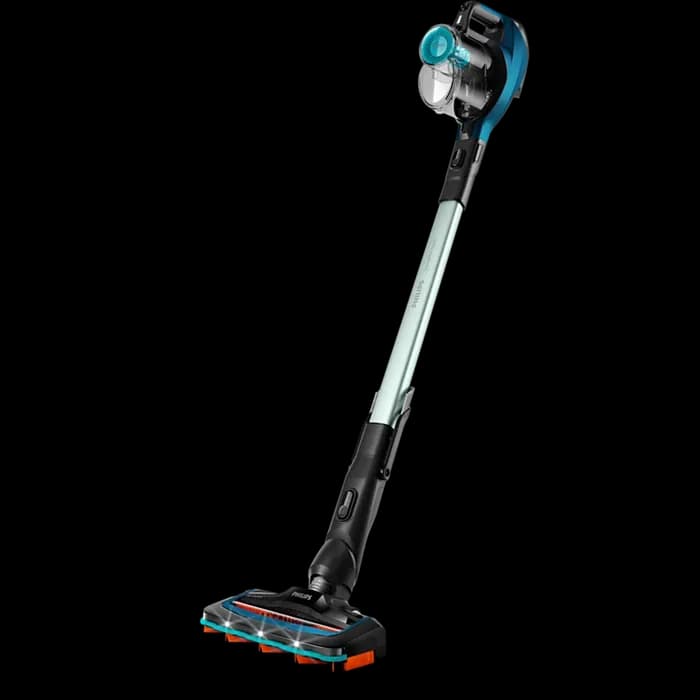
The 1200 W universal motor is the heart of this machine, generating a static pressure of 8 kPa. In fluid dynamics, this suction pressure is achieved by a high-speed impeller that creates a vacuum within the 2 L bagged chamber. For Indian households, this motor-to-airway ratio is tuned to handle dense particulates like cement floor dust and fine road grime. While the suction is lower than 2000W industrial units, the 8 kPa rating is perfectly calibrated for surface-level extraction on carpets and hard wood flooring. This balance ensures the motor operates without overheating during typical 1BHK cleaning cycles, providing consistent performance across varied surfaces.
The filtration architecture employs a 2-stage HEPA system designed for durability. The first stage involves the reusable dust bag which captures large debris, while the second stage is a washable HEPA media that traps microscopic particles down to 0.3 microns. This is critical for Indian urban environments where PM2.5 levels are high. By making the filter washable, the engineering team has reduced the long-term cost of ownership for the user. Maintaining high airflow through the 1200 W motor requires regular washing of these filters to prevent static pressure drops, ensuring the 8 kPa suction remains effective against fine allergens and pet dander.
Although specific battery runtime and charging metrics are not listed, the cordless architecture typically utilizes a multi-cell lithium-ion configuration to drive the 1200 W motor. Power management is likely handled via a CC-CV (Constant Current-Constant Voltage) charging protocol to protect the battery chemistry from the heat generated by such a high-wattage motor. For the Indian user, this means the device is best suited for targeted cleaning tasks rather than continuous hour-long operations. Users should expect a high current draw during peak suction, which necessitates efficient thermal dissipation within the 3.6 kg chassis to maintain the internal components' longevity and safety during use.
It is important to note that this is a dry-only cordless vacuum cleaner, lacking a wet/dry separation mechanism. The engineering focus is entirely on air filtration and dust containment within the 2 L bagged system. Unlike hybrid models that use baffles to separate liquid from the motor, this unit's internal geometry is optimized for maximum airflow through dry media. Users must avoid picking up spills, as moisture would compromise the HEPA filter and the 1200 W motor's electrical insulation. This specialization allows for a more compact design that excels at extracting dry pollutants like mattress dust and keyboard debris without the bulk of a water tank.
The attachment ecosystem, including the floor cum carpet brush and upholstery nozzle, is designed to work in tandem with the 1200 W motor. Each tool is engineered to maintain the 8 kPa suction at the point of contact. The extension tubes are manufactured from lightweight materials to offset the 3.6 kg base weight, allowing for ergonomic overhead cleaning of AC vents. The absence of a blower function indicates that the internal fan is strictly dedicated to vacuum generation, which typically results in more efficient dust capture compared to multi-function units. This mechanical focus ensures that every watt of power is directed toward cleaning surface-level grime effectively.
Constructed primarily from high-grade ABS plastic, the chassis is built to withstand the rigors of Indian domestic use. The 3.6 kg weight is distributed to allow for a stable parking position when not in use. The handle ergonomics are designed to reduce wrist strain during handheld operation on sofas or car upholstery. The 2 L bagged capacity is generous for a cordless model, reducing the frequency of maintenance interruptions. Every design choice, from the 60 dB noise dampening to the reusable dust bag, points toward a user-centric engineering philosophy. Ultimately, the Quick Clean NXT stands as a specialized tool for efficient, hygienic, and convenient household dust management.