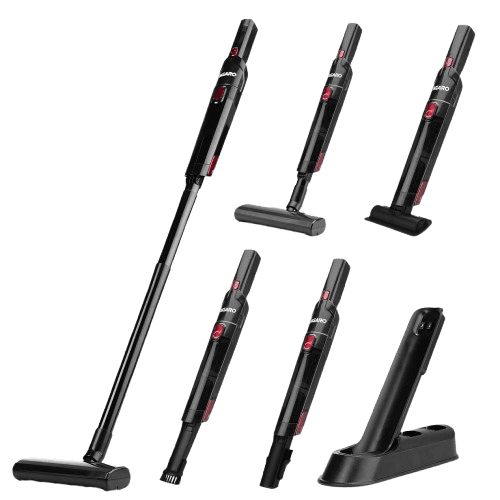
The suction pressure in this cordless handheld vacuum cleaner is generated by a 120 W brushless dc motor capable of high rotational speeds. This engineering choice allows the device to achieve 15 kPa of static pressure, which is significant for a unit weighing less than half a kilogram. The motor-to-airway ratio is optimized to ensure that the airflow remains consistent even as the 0.3 L dust cup fills. While it excels at picking up dense debris like sand or pet kibble, the trade-off for such high pressure in a small frame is the concentrated exhaust, which requires the integrated filtration system to be perfectly sealed.
The filtration architecture utilizes a 2-stage-stage HEPA system designed to capture microscopic pollutants prevalent in Indian urban environments. The initial stage separates larger debris and hair through centrifugal force within the bagless chamber, while the secondary HEPA element traps 99.9% of particles as small as 0.3 microns. This includes fine road dust and pollen that often bypass standard mesh filters. Because the HEPA filter is washable, it maintains its permeability over long-term use, preventing the motor from overheating due to restricted airflow. This construction is particularly beneficial for maintaining air quality inside small, enclosed apartments or car cabins.
Powering the unit is a lithium-ion battery system configured for a 220 V charging input, typical for Indian domestic outlets. The internal circuitry manages power distribution via a Constant Current-Constant Voltage (CC-CV) charging protocol, which protects the cells during the 5-hour recharge cycle. The runtime is strategically split: 26 mins on low for surface dusting and 11 mins on high for deep-cleaning mattresses or car carpets. This balance is achieved by managing the motor draw against the battery's discharge rate. Users should note that high-mode usage generates more heat, requiring brief cooling periods between intense sessions to preserve the long-term health of the battery cells.
The 0.3 L bagless dust bin is engineered for dry debris containment, utilizing a cyclone-style separation path rather than a wet-extraction baffle. Because the unit is not a wet-and-dry model, its internal motor housing is designed for maximum airflow efficiency rather than liquid isolation. This prevents the added weight of heavy-duty seals, keeping the device at a nimble 0.498 kg. Users should avoid picking up liquids, as the filtration path is optimized strictly for fine road dust and pet hair. Post-use maintenance is limited to tapping out the 0.3 L bin and washing the filter, ensuring the high-speed 120 W motor remains free from abrasive particulate matter.
For specialized tasks like cleaning AC vent grime or sliding window tracks, the device utilizes a friction-fit attachment system for its crevice tool and brush nozzle. These accessories are molded from high-impact polymer to withstand the high-velocity air intake without whistling or losing seal integrity. The brush nozzle is specifically designed to agitate fibers on sofas and car seats, lifting embedded pet hair into the primary 15 kPa airstream. Unlike models with blower functions that merely displace dust, this suction-first engineering ensures that debris is fully contained within the filtration chamber. This mechanical focus makes it a precise tool for intricate detailing in both homes and vehicles.
The chassis is constructed from high-grade ABS plastic, selected for its high strength-to-weight ratio, allowing the total mass to stay at a maneuverable 0.498 kg. The handle design follows an ergonomic center-of-gravity placement, reducing wrist strain during extended overhead cleaning of ceiling fans or curtain rods. Every seam in the housing is gasket-sealed to prevent air leaks that would otherwise compromise the 15 kPa performance. This attention to structural integrity ensures the unit can withstand the minor impacts of daily domestic use. Ultimately, the sapphire represents a pinnacle of compact engineering, providing a powerful, handheld cleaning solution that addresses the specific hygiene challenges of the Indian lifestyle.