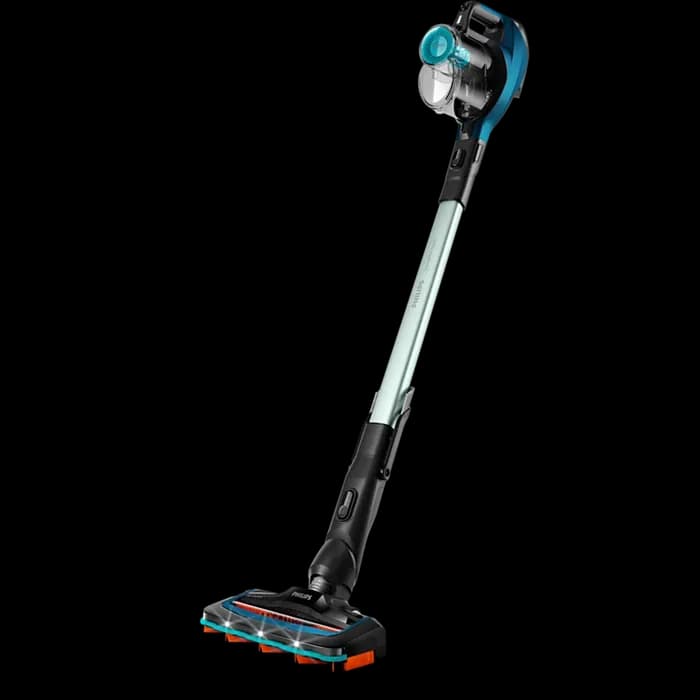
The 800 W universal motor is engineered to prioritize static pressure, achieving a 8000 Pa rating that is specifically tuned for resistance-heavy surfaces like carpets and car upholstery. This high motor-to-airway ratio ensures that despite the compact chassis, the velocity of air remains high enough to lift dense road dust. In technical terms, the engineering strikes a balance where airflow volume is sacrificed slightly to maintain the high pressure necessary for deep-extraction tasks. This configuration is ideal for Indian environments where fine particulate matter often settles deep within fabric fibers, requiring more than just superficial suction to remove.
The filtration architecture relies on a single-stage cartridge system designed for high-density particle capture. This cartridge acts as the primary barrier, trapping dander and dust mites before the air is exhausted back into the room. The washable construction is a critical engineering choice for the Indian market, as it allows users to restore airflow efficiency after cleaning heavy road dust without needing immediate filter replacements. By maintaining the cartridge's permeability through regular rinsing, the motor can sustain its peak suction curves, preventing the overheating issues often seen in models with restricted, non-washable paper-based filtration systems.
The power system is built around a high-discharge cell configuration that supports the 800 W motor's significant draw for up to 15 minutes. This runtime is a calculated engineering trade-off; by focusing on higher wattage for shorter bursts, the device provides corded-equivalent performance in a cordless form factor. For the Indian user, this means the device is optimized for high-intensity spot cleaning rather than low-power endurance. While the specific charging time is not rated for fast-charge protocols, the internal circuitry manages thermal levels during operation to protect the motor brushes from premature wear caused by frequent start-stop cycles.
Regarding internal debris management, the 0.5 L bagless bin utilizes a direct-path design to minimize turbulence as air enters the chamber. While this model is not designed for wet extraction, the seal integrity around the motor housing is robust enough to protect internal components from ambient humidity and damp dust. The separation mechanism ensures that larger debris gravitates to the bottom of the bin while the cartridge filter handles the suspended fine dust. This technical layout prevents the 8000 Pa suction from dropping as the bin fills, which is a common failure point in entry-level handheld vacuum architectures.
The blower function is achieved through a mechanical bypass that reroutes filtered exhaust through a narrowed nozzle at the rear of the unit. This increases the air's exit velocity, making it capable of dislodging grime from AC vents and electronics where vacuuming is impossible. Unlike pure-suction models, this dual-path airflow adds significant utility for Indian homes where dust often cakes onto ceiling fan blades or sliding window tracks. The technical execution ensures that the blower remains pressurized, providing a consistent stream that can move heavier particles across hard surfaces for easier collection later.
The chassis is constructed from reinforced ABS plastic to withstand the rigors of being carried via the shoulder strap across various cleaning heights. Ergonomically, the center of gravity is positioned near the handle to reduce wrist torque during 2.48 kg operation. The attachment points are designed with friction-fit seals to prevent air leakage, ensuring the full pressure of the motor reaches the nozzle tip. This focus on airtight integrity is what allows the device to maintain its extraction power over time. Ultimately, the super clean represents a focused engineering effort to provide high-wattage cleaning power in a highly mobile, durable package.