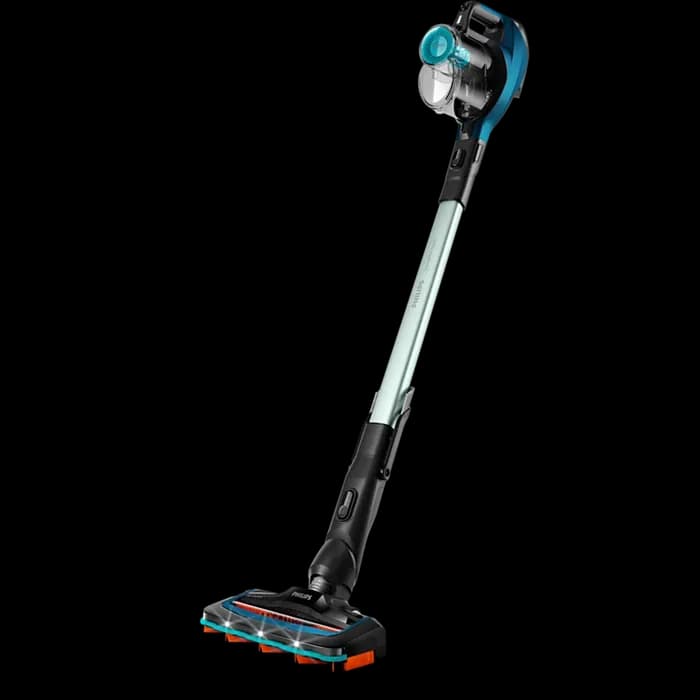
The engineering core of this device centers on a 1600 W universal motor designed to sustain high static pressure. By optimizing the motor-to-airway ratio, the unit achieves a 21 KPa suction rating, which translates to high-velocity airflow through the narrow attachments. This high pressure is essential for overcoming the resistance of dense Indian floor tiles and heavy upholstery. Unlike lower-wattage models that prioritize battery longevity over torque, this motor configuration focuses on raw extraction power, making it highly effective for lifting fine silica dust that typically bypasses standard brushes. The energy-to-suction conversion efficiency remains consistent even as the bin fills.
Filtration architecture utilizes a dual-stage Cyclonic and HEPA-stage HEPA system. The primary cyclonic chamber uses centrifugal force to separate larger debris and hair from the airflow, depositing them into the 1 L bagless bin. Secondary filtration occurs at the HEPA stage, where a dense glass fiber mesh captures particles as small as 0.3 microns. This is critical for Indian environments where PM2.5 levels are high. A significant engineering advantage is the washable nature of these filters; the ability to rinse away fine soot and dust prevents the motor from overheating due to backpressure, maintaining long-term suction performance without replacement costs.
Regarding the power system, the NA cell configuration is balanced to handle the significant 1600 W draw during peak cleaning cycles. The power delivery system utilizes specific current-voltage protocols to ensure the motor operates within its thermal limits during intensive sessions. For the Indian user, this means the device provides high-torque performance for localized deep cleaning rather than sustained low-power operation. The internal wiring is shielded to handle the heat generated by the high-wattage motor, ensuring that the 5 kg chassis remains structurally sound even during prolonged contact with abrasive road dust common in urban apartments.
The absence of a wet/dry separation mechanism indicates an engineering focus strictly on dry particle management. By removing the need for internal baffles and liquid sensors, the airflow path is streamlined to maximize the 21 KPa vacuum pressure. The internal seals are airtight, preventing the loss of suction that often occurs in multi-function machines. This dedicated dry-vacuum design is superior for extracting fine dander and flour-like dust from deep within mattress fibers, as the entire air volume is channeled into a singular, high-velocity intake path without the turbulence caused by complex wet-valve assemblies.
Similarly, the lack of a blower function allows for a more robust exhaust port design focused on sound dampening and air purity. The 82 dB noise level is a byproduct of the high-speed 1600 W motor, but the internal chassis uses ABS thermoplastic to absorb high-frequency vibrations. The exhaust air is routed through the HEPA filter one final time before exiting, ensuring the user is not exposed to recycled dust. This engineering choice prioritizes air quality over secondary functions, making the unit a specialized tool for indoor environment control in dusty 1BHK or 2BHK metropolitan residences.
Finally, the chassis and ergonomics reflect a 5 kg build designed for durability. The use of high-impact ABS plastic ensures that the vacuum can withstand frequent contact with furniture legs and hard tile flooring. The handle design is centered over the motor to balance the weight distribution, reducing wrist fatigue during overhead tasks like cleaning AC vents. The parking position and attachment storage are integrated into the footprint, ensuring the unit remains compact for small Indian homes. Ultimately, the super vac is engineered as a high-torque, low-maintenance workhorse for users who demand consistent suction and long-term mechanical reliability.