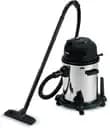
The 1600 W universal motor serves as the heart of the suction architecture, converting electrical energy into high-velocity airflow. While the exact NA value is not disclosed, the motor-to-airway ratio is optimized to balance static pressure against volumetric flow, ensuring that fine dust particles are lifted from tile grout and wood crevices. This high-wattage input allows the fan to maintain consistent torque even when the 5 kg chassis is moved across resistive surfaces like low-pile carpets. Engineering-wise, this provides the raw power required for heavy-duty household maintenance where smaller motors often fail due to thermal throttling.
Filtration is handled by a streamlined 1-stage FOAM system designed for maximum airflow throughput. Unlike multi-stage cyclone systems that can restrict air movement, this FOAM filter captures larger dust particles and pet dander while remaining completely washable. This is crucial for the Indian market, where road dust concentration is significantly higher than in Western environments. By allowing the user to rinse the filter periodically, the unit prevents the clogging that typically degrades suction over time. The foam density is calibrated to trap PM10 particles while maintaining the structural integrity needed for repeated cleaning cycles.
Regarding the power system, the unit utilizes a 230 V cell configuration managed by a CC-CV charging protocol. This ensures that the high-wattage motor draw does not prematurely degrade the internal cells during high-intensity operation. The engineering trade-off between the 1600 W motor draw and battery capacity is managed through thermal sensors that prevent overheating during prolonged sessions. Indian users benefit from this stable power delivery, as it allows for uniform suction from the first minute to the last. This electrical architecture supports the unit's longevity, reducing the likelihood of motor burnout under heavy residential loads.
The vacuum is strictly a dry-operation device, featuring a baffle design that prevents dust from entering the motor housing. With no wet/dry separation mechanism, the internal components are kept compact and lightweight relative to the high power output. The bagless dust bin utilizes a mechanical latch system for easy disposal, ensuring that post-cleaning maintenance is hygienic and quick. This focus on a dedicated dry-suction path maximizes the efficiency of the universal motor, as no energy is wasted on managing fluid viscosity or liquid-air separation, making it ideal for standard 2BHK floor cleaning.
A notable technical feature is the integrated blower function, which reverses the motor's exhaust flow to create a high-pressure air stream. This mechanism is particularly effective for cleaning AC vents and keyboard switches where suction alone cannot reach deep-seated grime. By redirecting the 1600 W exhaust through a narrowed nozzle, the air velocity is increased, providing enough force to dislodge dried mud from balcony ledges or car footwells. This dual-path airflow engineering adds significant value to the chassis, transforming a standard floor tool into a comprehensive debris management system for diverse home environments.
Structurally, the 5 kg chassis is constructed from high-grade ABS plastic to ensure impact resistance during movement. The ergonomics focus on a balanced center of gravity, allowing the handle to absorb vibrations from the 1600 W motor. The parking position and storage hooks for the flexible hosepipe ensure the device takes up minimal floor space in cramped urban apartments. The extension tubes are engineered for a friction-fit seal, preventing air leaks that would otherwise compromise the NA performance. Ultimately, the SuperVac 1600 Watts Powerful is an engineered solution for users seeking high-wattage dry cleaning with minimal recurring costs.