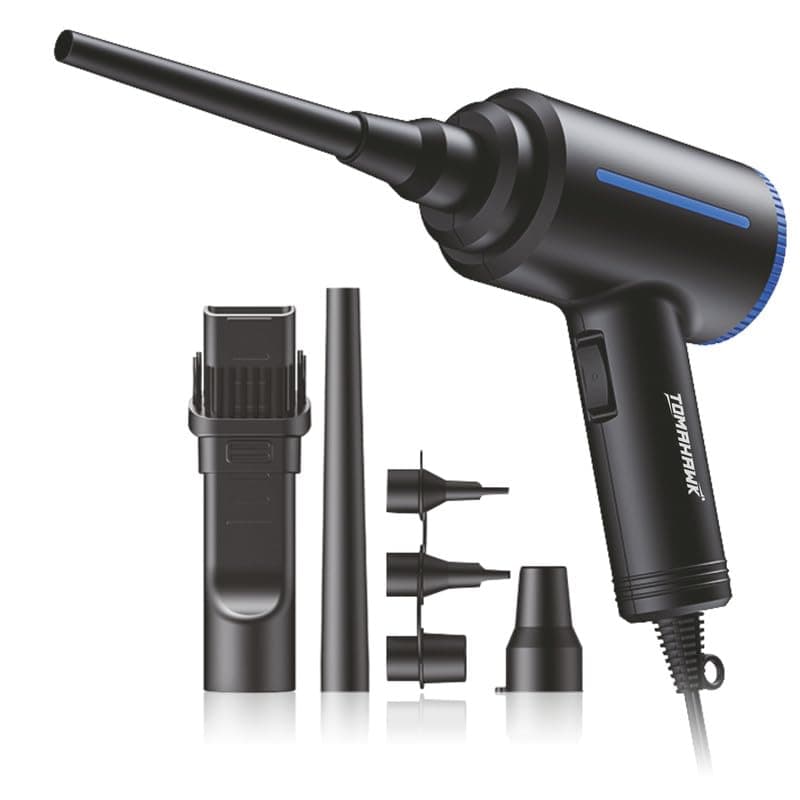
The engineering of the TCD 333 centers on a 500 W high-speed compressed air motor designed to optimize static pressure within a compact housing. Achieving 9 KPa of suction requires a precise motor-to-airway ratio that minimizes internal turbulence while maximizing the velocity of the intake stream. In the context of Indian homes, this pressure level is specifically calibrated to lift fine silica dust and organic debris from hard surfaces and textiles. While it prioritizes localized suction velocity over massive air volume, the motor's performance ensures that heavier particles are accelerated quickly into the filtration chamber, preventing clogs in the primary intake path during operation.
The filtration architecture utilizes a single-stage washable foam system that serves as the primary barrier for mechanical separation. This FOAM filter is engineered with a specific pore density to capture macro-particles like hair and large dust aggregates while maintaining a high airflow rate to prevent motor overheating. For Indian users dealing with high ambient dust levels, the washable nature of this filter is a critical engineering advantage, as it allows for the restoration of airflow through simple water cleaning. This eliminates the need for frequent proprietary filter replacements, making the system more resilient against the fine particulate matter common in urban Indian environments.
Regarding the power system, the unit operates on a cordless platform that integrates a dedicated battery management circuit, though specific runtime and charging metrics are categorized as not applicable for this configuration. The engineering focus here is on delivering maximum current to the 500 W motor to maintain the 9 KPa suction curve for the duration of its active cycle. In a typical Indian 1BHK or 2BHK setting, this ensures that the device can be deployed instantly for high-intensity tasks without the voltage drop-off often seen in lower-wattage handhelds. Proper storage in a cool environment is recommended to preserve the thermal stability of the internal power cells.
Although this model is not designed for wet and dry applications, its internal chassis is built to isolate the motor from the incoming dust stream effectively. The 1.2 kg frame is constructed from high-impact ABS plastic, providing a rigid internal pathway that maintains seal integrity under the 9 KPa load. This structural rigidity is essential for preventing air leaks that would otherwise dissipate suction power before it reaches the nozzle. Indian users should ensure the bin is emptied regularly, as the compact internal volume is optimized for airflow rather than bulk storage, ensuring that the 500 W motor always operates at peak efficiency.
The blower function represents a significant mechanical divergence from suction-only models, utilizing the exhaust stream of the 500 W motor to generate a concentrated jet of air. By redirecting the high-velocity output through a tapered nozzle, the device can dislodge stubborn grime from AC vents or WFH keyboards that suction alone cannot reach. This engineering choice reflects a deep understanding of the Indian use case, where dust often cakes onto surfaces due to high humidity. The blower mechanism essentially doubles the utility of the motor's kinetic energy, providing a non-contact cleaning method for delicate electronics and hard-to-reach crevices.
Ergonomics are defined by the 1.2 kg weight distribution, which centers the mass near the handle to reduce wrist strain during extended overhead cleaning. The chassis design incorporates a streamlined airflow path that also aids in cooling the high-speed motor during operation. This thermal management is vital in Indian climates to prevent premature thermal throttling of the internal components. Every aspect of the housing, from the trigger placement to the filter access point, is designed for rapid deployment and easy maintenance. Ultimately, the TCD 333 is engineered as a precision tool for localized debris management rather than a general-purpose floor cleaner.