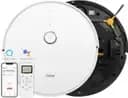
The suction pressure engineering of this unit utilizes a 40 W high-speed dual duct motor to generate a focused 2200 Pa of static pressure. While 40 W may seem modest, the dual duct design minimizes internal turbulence, ensuring that the motor-to-airway ratio remains efficient for surface-level debris extraction. This configuration is optimized for lifting fine particles from hard floors and carpets rather than heavy industrial waste. By balancing low power draw with a streamlined air path, the unit achieves enough velocity to capture typical Indian household dust while maintaining a noise level of only 65 dB during peak operation.
Filtration architecture is centered around a 3-stage HEPA system that prioritizes long-term cost-efficiency. The first stage captures large debris, while the secondary mesh and final HEPA stage trap particles as small as 0.3 microns, including pollen and dust mites. For the Indian consumer, the washable construction of these filters is a critical engineering choice. It prevents the pore-clogging typically caused by oily soot and fine construction dust found in urban areas. Regular washing maintains the pressure differential across the filter, ensuring the motor does not overheat due to restricted airflow over repeated cleaning cycles.
The battery and power system is configured with a high-capacity cell arrangement to support a 120-minute runtime, a rare specification in the cordless segment. Operating on a 4-hour charge cycle via CC-CV charging protocols, the system manages thermal output during the long discharge period to prevent lithium-ion degradation. This runtime-to-motor-draw trade-off suggests the device is engineered for endurance over raw peak wattage. Practical use in 1BHK or 2BHK apartments confirms that users can complete multiple cleaning sessions before the voltage drop necessitates a recharge, making it highly reliable for daily Indian household chores.
Wet and dry separation in this model is managed through a baffle design within the 600 ml bagged system. While primarily a dry-suction unit, the inclusion of a mopping cloth and specialized seals protects the motor from moisture intake during damp cleaning tasks. The moisture barrier is engineered to prevent liquid droplets from reaching the HEPA stage, which would otherwise compromise the filter's structural integrity. This allows the device to handle kitchen floor spills or damp footprints on tile surfaces without risking electrical shorts, provided the 0.6L capacity is monitored during heavy wet use sessions.
Instead of a blower function, the engineering focus is directed toward mechanical agitation via side brushes and mopping attachments. The side brushes use a gear-driven mechanism to sweep debris from room corners into the primary suction path, compensating for the 2200 Pa vacuum limit at the edges of the floor head. This is particularly effective for cleaning AC vent grime and WFH keyboard crevices where static dust adheres to surfaces. The mopping cloth attachment works via capillary action, providing a finishing wipe to floors that removes the fine film of dust that dry suction alone might miss.
Constructed from high-grade ABS, the chassis is designed for impact resistance while housing the 4.99 kg weight. The ergonomic handle is positioned to balance the center of gravity over the cleaning head, reducing wrist strain during extended 120-minute sessions. A dedicated parking position allows the unit to be stored upright, which is essential for space-constrained Indian apartments. The integration of the brush cleaner tool directly into the maintenance kit ensures that the roller remains free of hair wraps, maintaining the efficiency of the TH27U1 as a comprehensive cleaning tool for any modern home.