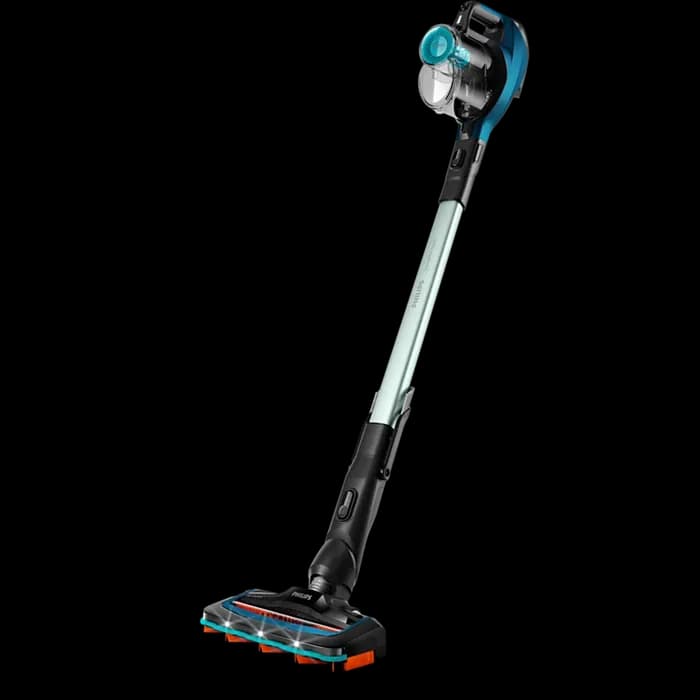
The suction pressure of this unit is engineered around a 120 W DC motor that generates a peak static pressure of 8 kPa. This performance metric is achieved through a high-RPM impeller system that optimizes the motor-to-airway ratio for maximum velocity in a compact form factor. While higher-wattage corded units offer more raw lift, the 8 kPa threshold is the sweet spot for picking up surface-level debris like sand, hair, and cereal. The engineering focus here is on air velocity over massive volume, making it ideal for localized tasks rather than deep-carpet extraction. This design ensures the motor remains efficient without overheating during the discharge cycle.
Filtration architecture consists of a 2-stage HEPA system designed for longevity in dusty environments. The first stage uses a mesh barrier to stop large debris, while the second stage employs a pleated HEPA element to capture particles as small as 0.3 microns. This is critical for Indian households where PM2.5 levels are high. The washable construction of these filters is a significant engineering advantage, as it maintains peak airflow without the recurring cost of replacements. By allowing the user to rinse the filter, the system prevents the pressure drop that occurs when fine road dust clogs a dry-only filtration medium over time.
Power management is handled by a 12V lithium-ion cell configuration that supports a 30-minute runtime under constant load. The internal circuitry utilizes a CC-CV charging protocol via a standard USB interface, requiring 3 hours to reach a full 100% capacity from a depleted state. This runtime-to-charge ratio is optimized for the 120W motor draw, ensuring that the battery cells do not suffer from excessive thermal stress. For the Indian user, this means the device can handle multiple spot-cleaning sessions across a 1BHK apartment on a single charge. The thermal cutoff sensors provide an extra layer of protection during heavy use in summer.
The wet and dry separation mechanism utilizes an internal baffle design within the 0.5 L dust bin to prevent liquid from reaching the motor housing. When vacuuming spills on tile or cement floors, the centrifugal force spins the liquid against the outer walls of the container, while the air is redirected through the filter. While the bin capacity is 0.5 L, the effective wet limit is slightly lower to prevent splashing during movement. This physical separation is vital for maintaining motor longevity. After any wet use, the engineering team recommends a full rinse and dry of the bin to prevent microbial growth.
Beyond suction, the blower function leverages the rear exhaust of the 120 W motor. By concentrating the high-velocity air through the flat lance attachment, the device can dislodge packed grime from AC vents and keyboards that suction alone cannot reach. This dual-path airflow design is a practical solution for Indian electronics that attract static-charged dust. The transition from suction to blower is instantaneous, requiring no mechanical reconfiguration. This makes the unit a hybrid tool that bridges the gap between a standard vacuum and a dedicated duster, providing more utility per cubic centimeter of chassis volume.
Construction of the chassis utilizes high-grade ABS plastic to achieve a total weight of just 0.39 kg. The center of gravity is positioned near the handle to reduce wrist fatigue during overhead tasks like cleaning ceiling fans or curtains. The internal components are mounted on vibration-dampening brackets to keep the noise level at a manageable 78 dB. This ergonomic focus ensures that the unit can be operated with one hand for extended periods without discomfort. The modular attachment system, including the brush and flat lance, clicks securely into place, ensuring the Ultra Pro WIRELESS remains a robust tool for daily household maintenance.