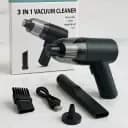
The suction pressure engineering of this unit is driven by a 120W high-speed motor that creates a high-velocity air stream capable of reaching 6000 Pa. This performance is achieved through a precise motor-to-airway ratio that maximizes static pressure within a compact 0.21 kg chassis. While it does not match the raw power of 2000W industrial units, it is specifically tuned for surface-level lifting of fine road dust and hair. This balance makes it ideal for upholstery and car interiors where high airflow is more critical than deep-carpet agitation, providing a targeted solution for modern Indian household cleaning requirements.
Filtration architecture is centered around a 2-stage HEPA system designed to capture particles as small as 0.3 microns. The first stage consists of a primary mesh that separates larger debris like food crumbs, while the second stage is a dense HEPA media that traps pollen, dander, and fine dust mites. Because this system is fully washable, it prevents the buildup of organic matter that can lead to odors in humid Indian climates. This construction ensures that the motor remains protected from fine particulates, which maintains high suction efficiency over hundreds of cleaning cycles without needing expensive filter replacements.
The power system utilizes a high-density battery configuration that provides a consistent 30 minutes of runtime under continuous load. Engineering for this cordless handheld vacuum cleaner involves a CC-CV (Constant Current-Constant Voltage) charging protocol that takes approximately 3 hours to reach full capacity. This balance between motor draw and cell discharge ensures that the unit does not overheat during extended sessions on sofa sets or mattresses. For Indian users, this runtime allows for the complete cleaning of a car interior or multiple pieces of furniture on a single charge, offering a significant mobility advantage over corded models.
Debris management is handled by a 0.2 L bagless bin that employs a dry-separation mechanism to keep weight to a minimum. Although the unit does not include a wet-dry function, the internal baffle design is engineered to direct dry particles downward, preventing them from clogging the HEPA filter prematurely. This airflow path is critical for maintaining 6000 Pa performance as the bin fills. The engineering team prioritized a slim profile for the collection chamber, which allows the unit to reach deep into narrow seat gaps and balcony sliding door tracks where traditional vacuum heads are too bulky to operate.
The attachment engineering focuses on friction-fit nozzles that ensure zero air leakage at the connection points. The included brush tool and extension nozzle are designed to agitate surfaces while the suction lifts the loosened debris, a combination that is essential for removing grime from AC vents and mechanical keyboards. By focusing on the geometry of these tools, the 120W motor is able to perform tasks that usually require a blower function. This mechanical efficiency allows the unit to maintain a quiet 40 dB noise profile, making it suitable for use in shared apartment spaces or during late-night WFH cleaning sessions.
Structural engineering of the chassis utilizes high-impact ABS plastic to achieve a total weight of just 0.21 kg without compromising durability. The ergonomic handle is positioned to align the center of gravity with the user's wrist, reducing the torque required to pivot the machine around obstacles. This lightweight construction allows for a vertical parking position in small storage drawers or car door pockets. The material choice also provides natural sound dampening for the high-speed motor, resulting in a cleaner user experience. Ultimately, the vacuum pro represents a shift toward specialized, ultra-portable tools that outperform heavier machines in niche cleaning applications.