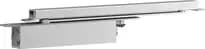
The ASSA ABLOY DC860-40 exemplifies advanced hydraulic engineering applied to discreet door control. At its core, the unit employs a highly stable hydraulic fluid and a precision valving system within its robust aluminium and steel body. This system intelligently manages the kinetic energy of the closing door.
Hydraulic Mechanics and Precision Control: The DC860-40's hydraulic mechanism provides unparalleled control over the door's entire closing arc. The variable closing speed valve precisely regulates the flow of hydraulic fluid, allowing the door to close smoothly and consistently from its maximum opening angle of 120 degrees until approximately 15 degrees from the frame. Following this, the independent latching speed valve takes over, ensuring the door accelerates sufficiently to overcome air pressure and latch securely, preventing incomplete closures which can compromise security and fire integrity. The integrated back-check feature is critical; upon rapid or forceful opening beyond a preset point, the hydraulic resistance increases significantly, cushioning the door's swing and protecting the door, frame, and hinges from impact damage. This multi-stage hydraulic management ensures a controlled, predictable, and safe closing cycle under diverse conditions.
EN 1154 Compliance and Fire Safety: Certification to EN 1154 CE and adherence to BS EN 1154 standards are not merely labels; they are testaments to the DC860-40's rigorous design and performance validation. EN 1154 specifically mandates stringent testing for durability, efficiency, and safety for hydraulically damped door closers. The power size classification of EN 1-5 indicates that this closer has been tested and certified for a range of door widths and weights, with EN 5 being suitable for doors up to 1250mm wide. Crucially, its fire-rated status, in conjunction with EN 1154 compliance, means the DC860-40 maintains its essential closing function even during a fire event, ensuring that fire and smoke doors remain closed and latched, thereby containing fire spread and protecting escape routes. The concealed linkage arm and internal mechanism are engineered to withstand elevated temperatures, preserving the integrity of the door assembly. While a specific cycle test rating is not explicitly provided, the EN 1154 certification intrinsically implies extensive endurance testing, affirming its long-term reliability in high-traffic environments.
Operational Durability and Adjustability: The robust construction using aluminium and steel, coupled with adjustable valves, underscores its operational durability and adaptability. The ability to fine-tune closing and latching speeds post-installation provides facilities managers with granular control, optimizing door performance for specific traffic patterns, environmental factors (e.g., drafts), and accessibility requirements. This inherent adjustability, combined with the non-handed design, simplifies specification and installation across a broad spectrum of architectural applications.