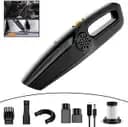
The suction profile of this cordless handheld vacuum cleaner is centered around a 120 W brushless DC motor that generates a consistent 8 kPa of static pressure. This performance is achieved through a high-speed impeller design that optimizes the motor-to-airway ratio, ensuring minimal energy loss between the turbine and the nozzle. While 8 kPa is lower than corded canisters, it provides sufficient velocity for lifting dense road dust and ceramic grit common in Indian urban environments. The engineering focus here prioritizes sustained airflow over sheer peak pressure, allowing the unit to maintain cleaning efficacy even as the 0.4 L dust bin begins to fill during heavy-duty sessions.
The filtration architecture utilizes a 2-stage HEPA system specifically engineered for fine particulate matter. The first stage consists of a primary mesh that blocks larger debris and hair, while the second stage features a high-efficiency particulate air filter that captures particles down to 0.3 microns. This dual-layered approach prevents the HEPA media from clogging prematurely, which is vital in dusty Indian climates. Because the filter is fully washable, users can restore original airflow levels without frequent replacements. This design ensures that exhaust air is stripped of allergens, making it safer for residents with respiratory sensitivities or those living near high-pollution industrial zones.
Power delivery is managed by a high-density battery array configured to provide 30 minutes of continuous operation. The system employs a CC-CV (Constant Current-Constant Voltage) charging protocol via a 2.5-hour cycle to maximize cell longevity and prevent thermal degradation. In a practical Indian context, this 12 V configuration balances the current draw of the 120 W motor with the heat dissipation limits of a compact chassis. The internal circuitry includes overcharge and deep-discharge protection, which is critical for maintaining battery health across fluctuating voltage environments. This electronic oversight ensures that the motor receives a stable power flow, resulting in uniform suction throughout the discharge cycle.
The wet and dry separation mechanism is a standout feature, utilizing a specialized internal baffle to protect the motor from moisture ingress. With a 0.4 L bagless capacity, the bin is designed to handle liquid spills alongside dry dust, making it suitable for kitchen or bathroom tile cleaning. The aerodynamic path is engineered to separate liquids from the air stream using centrifugal force, depositing them into the lower section of the reservoir. Users must ensure the filter is completely dry after wet use to maintain the integrity of the HEPA media. This robust moisture-handling capability adds a layer of durability not found in standard dry-only handheld units.
Operational acoustics are kept at a modest 65 dB, achieved through sound-dampening foam surrounding the motor housing and a precision-balanced impeller that reduces vibration. This engineering choice is particularly beneficial for Indian apartment living, where high-pitched vacuum noise can be disruptive. The exhaust vents are positioned to direct air away from the user’s face and the cleaning surface, preventing the scattering of uncaptured dust. By integrating vibration-reducing mounts for the 120 W motor, the chassis remains stable during use, reducing hand fatigue during extended cleaning sessions on upholstery or ceiling fans. This focus on user comfort complements the high-pressure suction capabilities of the device.
The structural integrity of the unit relies on a high-grade ABS chassis that keeps the total weight at just 0.39 kg. This lightweight construction is achieved through thin-wall molding techniques that do not compromise the impact resistance required for daily household handling. The ergonomic handle is positioned at the center of gravity to ensure balanced maneuverability when reaching for high-altitude AC vents or deep car footwells. Every attachment, from the flat lance to the extension tube, is friction-fitted to minimize air leaks at the joints. Ultimately, the Technological WIRELESS represents a pinnacle of weight-to-power engineering, providing a dense power profile in a remarkably portable and durable form factor.