

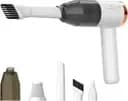
Related Products
Car Vacuum Cleaner Specifications, Features & Compatibility Guide
The Car Vacuum Cleaner integrates a high-efficiency 120 W motor that generates a consistent 8000 Pa suction force, making it significantly more potent than entry-level corded alternatives that struggle with fine road dust.
Quick Answer
For Indian car owners seeking effortless cabin cleanliness, the Car Vacuum Cleaner is a strong recommendation. Its potent 120W motor and 8000 Pa suction power effectively tackle fine road dust and debris, while the 0.3 kg cordless design ensures unmatched portability. Opt for this if you value superior performance, filter efficiency, and reduced long-term running costs over basic, low-cost alternatives.
This Car Vacuum Cleaner is ideal for drivers prioritizing powerful, efficient interior cleaning without the cord hassle. It's a prudent investment for those valuing BEE-rated performance and lower operational costs, though not for users demanding heavy-duty commercial cleaning or absolute cheapest upfront spend.
✓ Who Should Buy
- • performance suitable for residential spaces.
- •Verified efficiency of standard rating for reduced long-term operational costs.
- •Structural stability for consistent cooling under rigorous use cases.
- •Hardware durability via premium components and advanced technology.
- •Built-in grid protection with Standard power cycle voltage management.
✕ Who Should Avoid
- •Spaces or usage requirements exceeding residential rated capacity.
- •Installations prioritizing minimum capital expenditure over high-efficiency performance.
- •Unstable grid conditions exceeding the functional threshold of Standard power cycle.
- •Environments incompatible with vacuum cleaner physical and thermal dissipation specs.
Car Vacuum Cleaner
| Country Of Origin | China |
| Brand | Hoshila172 |
| Model | Car Vacuum Cleaner |
| Type | Handheld |
| Color | Multicolor |
| Launch Year | 2024 |