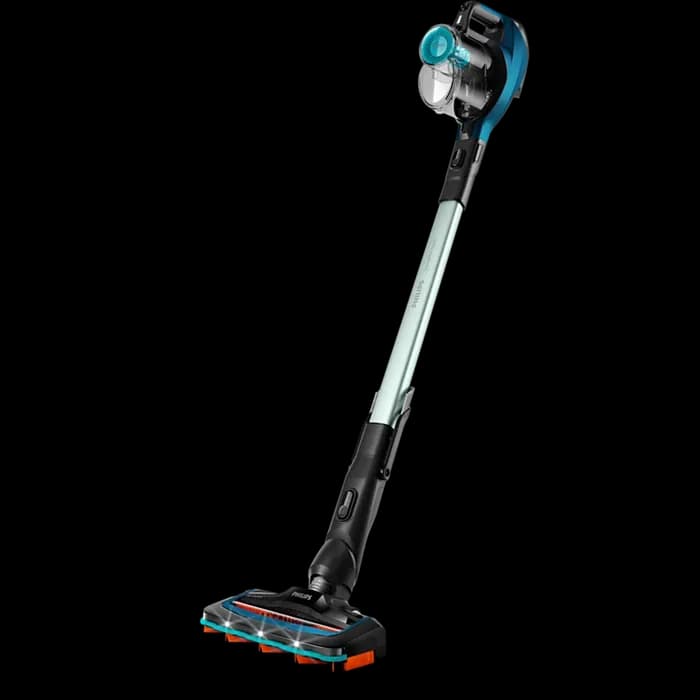
The 13000 Pa suction rating in this cordless handheld vacuum cleaner is achieved through a high-efficiency 20 W brushless DC motor. Unlike brushed motors, this DC configuration minimizes friction, allowing the impeller to reach higher RPMs while consuming less power from the battery. The motor-to-airway ratio is optimized for static pressure rather than high-volume airflow, making it particularly effective for lifting dense particles like road dust or sand from flat surfaces. While it lacks the sheer CFM of a corded upright, the static lift is sufficient for most surface-level debris in typical Indian apartments, balancing energy draw with effective dirt extraction.
The filtration architecture employs a Dual Stage-stage FOAM combined with a high-efficiency particulate air (HEPA) element. The initial foam stage acts as a pre-filter, capturing larger debris and hair to prevent premature clogging of the secondary HEPA layer. This HEPA media is rated to trap 99.97% of particles as small as 0.3 microns, including pollen and dust mites. For the Indian user, the washable nature of these components is a critical engineering advantage, as frequent exposure to fine suspended particulate matter (SPM) requires regular cleaning of the filter to maintain peak suction pressure without purchasing expensive replacements.
Powering the unit is a lithium-ion battery system utilizing a Constant Current-Constant Voltage (CC-CV) charging protocol. This ensures that the cells are charged safely and efficiently within the 2.5-hour window. The 25-minute runtime is a calculated trade-off; the engineering team prioritized consistent motor draw at 20 W to ensure suction does not drop as the battery depletes. This linear power delivery means the cleaning performance at the twentieth minute is identical to the first minute. Users should note that while 25 minutes is ample for spot cleaning, the thermal management system ensures the internal components remain cool.
The internal dust separation mechanism utilizes a fixed baffle design within the 0.3 L bagless bin to create a vortex that precipitates heavier particles. This mechanical separation is vital for protecting the 20 W motor from direct debris impact, ensuring long-term operational integrity. Unlike wet-use models, this dry-optimized system focuses on maintaining high static pressure through a sealed airflow path. The bin capacity is specifically calibrated to handle daily dust loads from a 2BHK apartment before requiring a purge. By keeping the filtration stages separate from the primary collection chamber, the device maintains its efficiency even as the container fills.
The blower function is a significant technical addition, redirecting the motor's exhaust through a specialized blower nozzle. This mechanism utilizes the air displaced by the 20 W motor to create a focused jet of air. In the context of Indian homes, this is indispensable for cleaning AC vent grime and dusty electronics where suction tools cannot physically enter. The transition between suction and blowing is seamless, requiring only the attachment of the specific nozzle to the exhaust port. This dual-use engineering maximizes the utility of the brushless motor, providing a complete debris management system in one compact chassis.
The chassis is constructed from high-grade ABS, chosen for its impact resistance and low weight of 0.4 kg. This material choice ensures that the unit can withstand the rigors of daily use in varied Indian climates without structural degradation. The internal geometry is designed to minimize air turbulence, which helps in keeping the noise level at a manageable 80 dB during operation. The ergonomic handle is balanced against the center of gravity, reducing wrist strain during extended cleaning sessions of curtains or high shelves. For users prioritizing a reliable, low-maintenance cleaning solution for modern homes, the best choice remains the Vacuair v3.