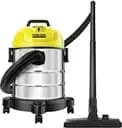
The suction engineering of this unit utilizes a 1200 W universal motor to create a consistent 180 Pa of static pressure. While the wattage is high, the system is tuned for high-volume airflow rather than extreme vacuum lift, making it efficient for moving large quantities of dust from flat surfaces like tiles or wooden floors. The motor-to-airway ratio is optimized to prevent overheating during its 18-minute cycle. This specific calibration makes it ideal for handling Indian road dust and light debris, though it may require multiple passes on high-pile carpets where deeper mechanical agitation is necessary for full extraction.
The filtration architecture employs a 2-stage FOAM system that is specifically designed for longevity. The first stage captures larger particles and hair, while the second stage targets finer particulates that can clog a motor. Because the foam is washable, it addresses the common Indian pain point of purchasing expensive replacement filters. This design ensures that even after cleaning soot or AC vent grime, the user can restore the unit to peak efficiency with simple water maintenance. This mechanical simplicity reduces the total cost of ownership significantly compared to sealed HEPA cartridge systems.
Powering a 1200 W motor via a cordless system requires a high-discharge battery configuration. The device uses a balanced cell layout to provide 18 minutes of runtime, managing the heavy current draw of the universal motor. For the Indian user, this means the unit is built for 'sprint' cleaning rather than 'marathon' sessions. The engineering focuses on maintaining a steady voltage curve so that suction does not taper off as the battery depletes. Users should follow a consistent charging discipline to ensure the lithium-ion cells remain healthy across thousands of discharge cycles.
The wet and dry separation mechanism is housed within a 15 L robust plastic container. A mechanical float valve or baffle design protects the motor from liquid ingress when vacuuming spills in kitchens or bathrooms. With a 15 L capacity, it handles significantly more volume than standard handhelds, making it suitable for major spills or cleaning out car floor mats after a monsoon drive. The transition between wet and dry modes is seamless, provided the user follows the protocol of removing the paper bag when switching to liquid suction to avoid structural failure of the filter bag.
The blower function is a critical technical addition, utilizing the motor's exhaust path to create a high-velocity air stream. This is achieved by redirecting the 1200 W output through a dedicated port, which is essential for cleaning delicate electronics like WFH keyboards or dislodging dust from inaccessible AC vents. In many Indian homes where dust settles in window tracks, the blower function provides a mechanical advantage that suction alone cannot match. This dual-path airflow design maximizes the utility of the universal motor without adding significant weight or complex valving to the chassis.
The chassis is constructed from high-impact ABS plastic, contributing to a total weight of 3.9 kg. This weight is distributed low in the unit to prevent tipping during use. The ergonomic handle is integrated into the motor head, allowing for easy transport between floors in multi-story houses. The inclusion of a parking position for the suction tubes ensures that the unit can be stored compactly in utility closets. Every component, from the crevice nozzle to the textile filter bag, is designed for tool-less assembly. The WD1 CLASSIC effectively balances heavy-duty material choice with user-friendly ergonomics.