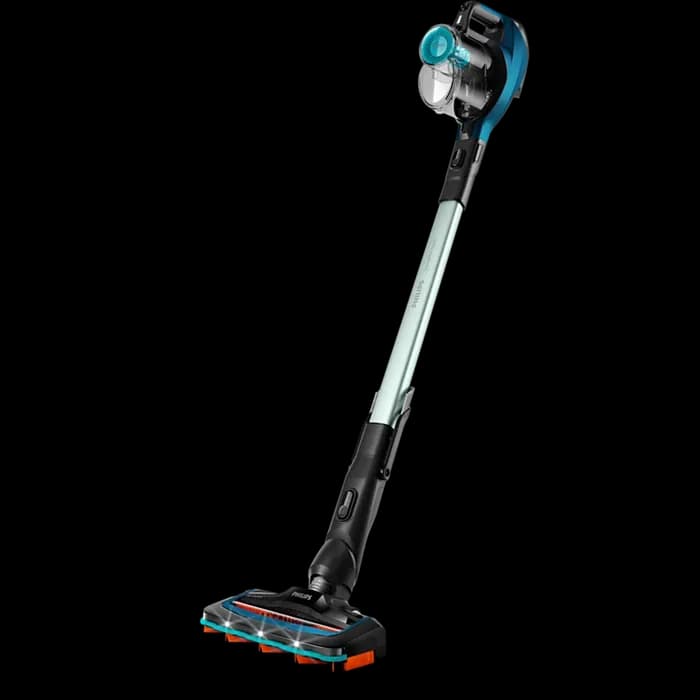
The suction pressure engineering of this device relies on a 120W brushless DC motor that optimizes the motor-to-airway ratio to achieve a peak 12000 Pa. This specific engineering balance prioritizes static pressure, which is essential for lifting dense particles like road dust from car carpets or cement floors. While the airflow is tuned for localized debris, the high static pressure allows it to maintain performance even when the 2 L bagged collector begins to fill. This makes the unit ideal for targeted cleaning tasks rather than whole-house floor vacuuming, which typically requires significantly higher wattage but lacks this level of portability.
The filtration architecture features a 3-stage HEPA system designed to capture microscopic particles as small as 0.3 microns. The first stage involves a mesh pre-filter for large debris, followed by a secondary filter for finer particles, and finally the HEPA core for dander and PM2.5 pollutants. For Indian users, the washable construction is a critical engineering detail, as it prevents the pore-clogging often caused by high humidity and fine ambient dust. Regular washing maintains the pressure differential across the filter, ensuring the motor does not overheat while attempting to draw air through a blocked medium.
Power management is handled by a high-density battery system configured to provide a sustained 40-minute runtime. The engineering team employed a Constant Current-Constant Voltage (CC-CV) charging protocol to protect the internal cells during the 3-4 hour recharge cycle. This runtime-to-motor-draw trade-off is specifically calibrated to handle a full car interior or a 5-seater sofa set on a single charge. For Indian households, this provides a practical window for deep-cleaning mattresses or sanitizing upholstery without the tether of a power cord, though users should avoid running the battery to zero to extend its overall lifecycle.
The wet and dry separation mechanism utilizes an internal baffle design that redirects liquid intake away from the motor assembly. By creating a centrifugal path for incoming fluids, the device protects the 120W motor from moisture damage while allowing for the quick pickup of spills. The motor protection is further enhanced by a shut-off sensor that prevents overfill within the dust compartment. For post-wet-use maintenance, it is vital to dry the internal components completely to prevent mildew, ensuring the vacuum remains hygienic for subsequent dry tasks like cleaning keyboards or fan blades.
The blower function is integrated through a reverse-airflow port, which utilizes the high-velocity exhaust from the brushless motor. Unlike pure-suction models, this technical mechanism allows the user to dislodge dust from intricate spaces like AC vents and mechanical keyboards before utilizing the suction side. In the Indian context, where fine dust often cakes onto ceiling fans and window channels, the blower provides a necessary mechanical force that suction alone cannot achieve. This dual-purpose engineering maximizes the utility of the 120W motor, making the device a more versatile tool than single-mode handheld competitors.
The chassis is constructed from high-impact ABS plastic, contributing to the ultra-light 0.38 kg total weight. This ergonomic focus includes a balanced handle design that shifts the center of gravity toward the palm, reducing wrist fatigue during overhead tasks like cleaning curtains or fan blades. The parking position and compact dimensions allow for easy storage in small 1BHK apartments or car glove compartments. The structural integrity is designed to withstand the vibrations of the 12000 Pa suction force without chassis resonance. Ultimately, the engineering of the Vacuum Cordless, 12000pa Strong Suction Wet Dry collector represents a peak balance of power and portability.