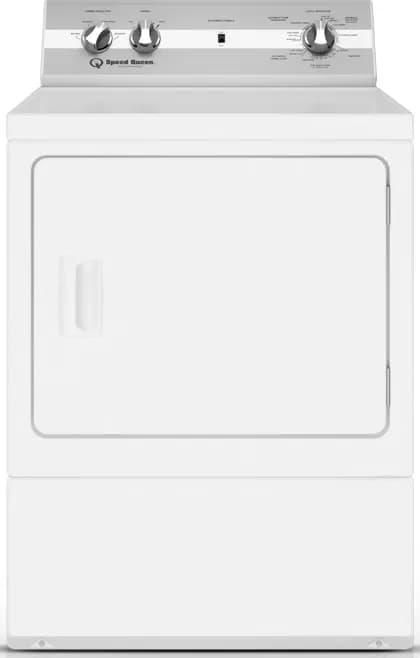
The Speed Queen LDE30RGS173TW01's engineering philosophy centers on durability, high throughput, and operational simplicity, distinguishing it within the commercial dryer segment.
Drying Technology (Vented Thermal Dry): This unit employs a conventional vented 'Thermal Dry' system. This fundamental, robust approach utilizes direct resistive heating elements (3000W, 230V, 15A) to generate high temperatures and a powerful fan to exhaust moist air directly outside. While simpler than heat pump or condenser systems, this design is inherently reliable and offers superior drying speeds for large volumes, critical for commercial profitability. The absence of complex refrigeration circuits or condensate management reduces mechanical complexity, improving uptime and serviceability. The four fixed temperature programs allow operators to quickly select the appropriate heat level, maximizing efficiency for various fabric types without unnecessary electronic intervention. The 'Quick Dry' feature is a direct benefit of this powerful heating and ventilation system.
Drum Mechanics and Construction: The 190-liter drum, constructed from galvanized steel, is a cornerstone of this dryer's commercial resilience. Galvanized steel offers excellent corrosion resistance and mechanical strength, crucial for continuous tumbling of diverse and often heavy laundry loads. The drum's substantial volume ensures optimal tumbling action, promoting even drying and preventing clothes from tangling. While reverse tumbling is not featured, the simple, unidirectional rotation contributes to mechanical reliability by reducing moving parts and potential wear points. An integrated anti-vibration system, coupled with adjustable legs, ensures stable operation and mitigates noise (rated at 70dB) and wear on internal components, extending the appliance's lifespan in a demanding environment.
Energy Implications and Sensor-based Drying: The LDE30RGS173TW01 operates on a straightforward 230V electric supply with a 3000W consumption. For commercial applications, the primary focus shifts from achieving residential-style energy efficiency ratings (which are 'N/A' here) to maximizing throughput and minimizing energy cost per kilogram of laundry dried efficiently. The robust heating capacity and powerful airflow contribute directly to faster cycle times, thereby increasing the number of loads processed per operational hour. The deliberate exclusion of a moisture sensor and auto-dry functionality, while unusual in premium residential dryers, is a strategic choice for commercial reliability and operator control. In a laundromat, operators often prefer manual control over drying times to accommodate varied load compositions, fabric types, and desired dryness levels, ensuring consistent results and minimizing maintenance associated with sensor calibration or failure. Overheat protection and auto shut-off are critical safety features ensuring operational integrity under continuous use.