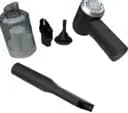
The suction pressure engineering of this unit relies on a 120W high-speed motor that creates a concentrated 6000 Pa vacuum through a precision-balanced impeller. This motor-to-airway ratio is specifically tuned to maximize static pressure rather than raw airflow volume, making it highly effective for lifting heavy particles like sand or pet hair from fabric weaves. While it lacks the sheer power of 2000W corded units, the internal turbine design minimizes energy loss, ensuring that the suction remains linear throughout the battery discharge cycle. This engineering balance makes the unit ideal for targeted spot cleaning rather than large-scale floor resurfacing where high-velocity airflow is required.
Filtration architecture is comprised of a 2-stage HEPA system designed to withstand the heavy dust loads characteristic of the Indian climate. The first stage uses a primary mesh to deflect larger debris like hair and crumbs, preventing premature clogging of the secondary HEPA media. The HEPA stage is engineered to capture 99.7% of particles as small as 0.3 microns, including pollen and PM2.5. Crucially, the washable construction of these filters eliminates the need for replacement bags, reducing long-term ownership costs. This durability is essential for Indian users who face daily incursions of fine road dust and soot within urban apartments.
The battery and power system utilizes a Type C charging interface, supporting modern CC-CV charging protocols for a safe 3-hour recharge cycle. By operating on a 5V input, it maintains compatibility with standard smartphone adapters, which is a significant advantage in the Indian market. The lithium-ion cells are configured to provide a 20-minute runtime at peak motor draw, balancing thermal management with portable performance. This discharge rate is calculated to prevent motor overheating, a common failure point in smaller handhelds. Users should charge the device fully before the first use to calibrate the internal battery management system for longevity.
Regarding the internal layout, the 0.2 L bagless bin utilizes a simple cyclonic separation mechanism to keep debris away from the filter face. This baffle design ensures that the 6000 Pa suction remains consistent even as the bin fills toward its maximum capacity. The clear dust canister allows for immediate visual confirmation of dirt levels, facilitating timely disposal to maintain peak motor efficiency. Though not designed for wet waste, the dry-shroud engineering protects the 120W motor from fine particulates. Maintenance is straightforward, requiring only a simple twist-to-unlock motion to empty the contents, which prevents user contact with collected allergens.
The pet hair tool and specialized nozzle attachments are engineered with mechanical agitation in mind. The brush tool features stiff synthetic bristles that disturb the surface tension of fabrics, allowing the vacuum to lift embedded fur that suction alone might miss. This is particularly effective on sofa fabrics and car upholstery where static electricity often binds hair to the fibers. The crevice nozzle is tapered to accelerate airflow at the tip, increasing local velocity for cleaning deep gaps in car seats or sliding window tracks. These attachments expand the device's functional range beyond simple surface dusting into more demanding deep-cleaning scenarios.
The chassis is constructed from high-grade ABS plastic, achieving a record-low weight of 0.3 kg without compromising structural integrity. This ergonomic design centers the mass near the handle, reducing wrist fatigue during overhead tasks like cleaning AC vents or curtain pelmets. The 65 dB noise profile is achieved through internal acoustic dampening around the motor housing, ensuring that high-frequency motor whine is suppressed. This structural engineering ensures the device is durable enough for daily use in rugged environments. Ultimately, the Car Portable Vacuum Cleaner Type C Charger is a triumph of lightweight material science combined with efficient motor placement for high-performance cleaning.