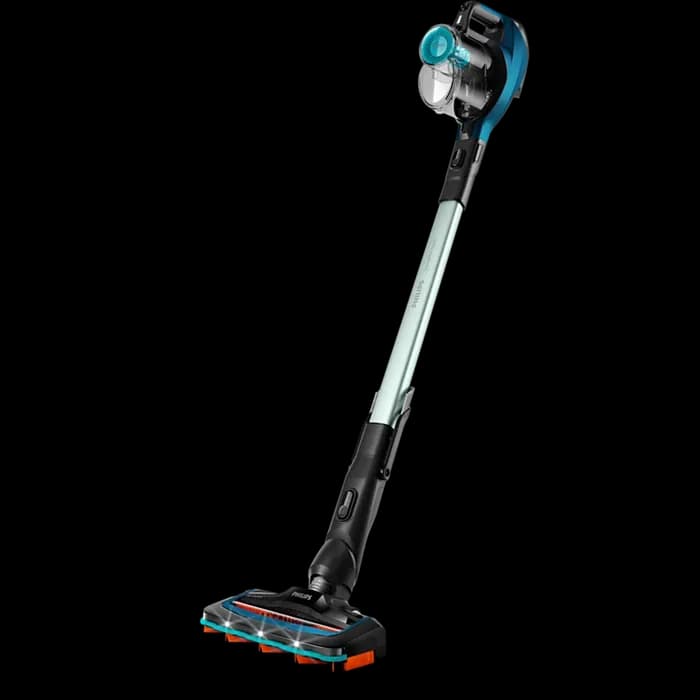
The 120W motor is engineered to prioritize static pressure over high-volume airflow, enabling the 21000 Pa suction rating. By utilizing a high-speed impeller within a sealed housing, the unit creates a vacuum threshold that rivals many entry-level corded canisters. This specific motor-to-airway ratio is optimized for surface-level extraction on hard surfaces and tight textiles rather than deep-pile carpet agitation. The universal motor architecture balances energy consumption with torque, ensuring that the 0.5 kg chassis remains thermally stable. While it lacks the raw CFM of 1000W motors, its ability to generate high pressure in a focused nozzle area makes it superior for extracting fine road dust from crevices.
Filtration is managed via a 3-stage HEPA system designed to mitigate the rapid clogging common in small-scale vacuums. The initial stage uses a primary mesh to trap larger debris like pet hair and food crumbs, protecting the inner HEPA membrane. The second stage consists of the HEPA media itself, which is rated to capture 99.97% of particles down to 0.3 microns, including pollen and PM2.5 soot prevalent in Indian urban centers. The third stage acts as a motor guard to prevent carbon dust from escaping. Because the entire assembly is washable, users can restore peak airflow after cleaning AC vents or dusty balcony tracks without purchasing expensive replacements.
Power is delivered through a lithium-ion battery array supporting a 20 min runtime under constant load. The 7.4V cell configuration is managed by a CC-CV (Constant Current-Constant Voltage) charging protocol, requiring approximately 3 hours for a full recovery via a standard USB interface. This runtime is a calculated trade-off to maintain the 0.5 kg weight profile, as larger batteries would compromise the ergonomic benefits for overhead cleaning. Indian users should note that the motor draw is optimized for short, high-intensity bursts rather than continuous 30-minute floor scrubbing. Efficient thermal management prevents the cells from overheating during the final minutes of the discharge cycle.
The wet and dry capability is supported by a specialized internal baffle design within the 0.18 L bagless bin. This architecture prevents liquid droplets from entering the motor housing during the intake of minor spills or damp grime. The 0.18 L capacity is specifically sized for spot cleaning; it fills quickly when tackling larger messes, necessitating frequent emptying to maintain the 21000 Pa performance. After vacuuming liquids, it is critical to rinse and thoroughly dry the HEPA filter to prevent mold growth—a common issue in humid Indian climates. This engineering choice allows the unit to function as a versatile emergency cleaner for kitchen spills.
The blower function leverages the motor’s exhaust path, rerouting the high-velocity air through a dedicated port. This technical implementation allows the user to dislodge dust from intricate areas where suction nozzles cannot penetrate, such as between laptop keys or deep within car dashboard vents. In the Indian context, this is particularly effective for cleaning window tracks or blowing out dry leaves from balcony corners. Unlike pure-suction models, this dual-path airflow design increases the utility of the 120W motor. The blower provides sufficient force to move dry debris but is not intended for heavy-duty yard work, acting instead as a precision detailing tool.
Constructed from high-impact ABS plastic, the chassis is balanced to place the center of gravity near the handle, reducing leverage strain on the user's wrist. The ergonomic grip is designed for varied hand sizes, facilitating comfortable use during extended vertical cleaning of curtains or high shelves. The inclusion of a plastic tube and dust brush allows for modular configuration depending on the surface resistance. The compact footprint enables storage in glove compartments or kitchen drawers, ensuring the device is always accessible for quick spills. Ultimately, the Wireless Handheld Vacuum Cleaner for Car,Pet offers a specialized mechanical solution for localized debris management where corded machines prove too cumbersome.