
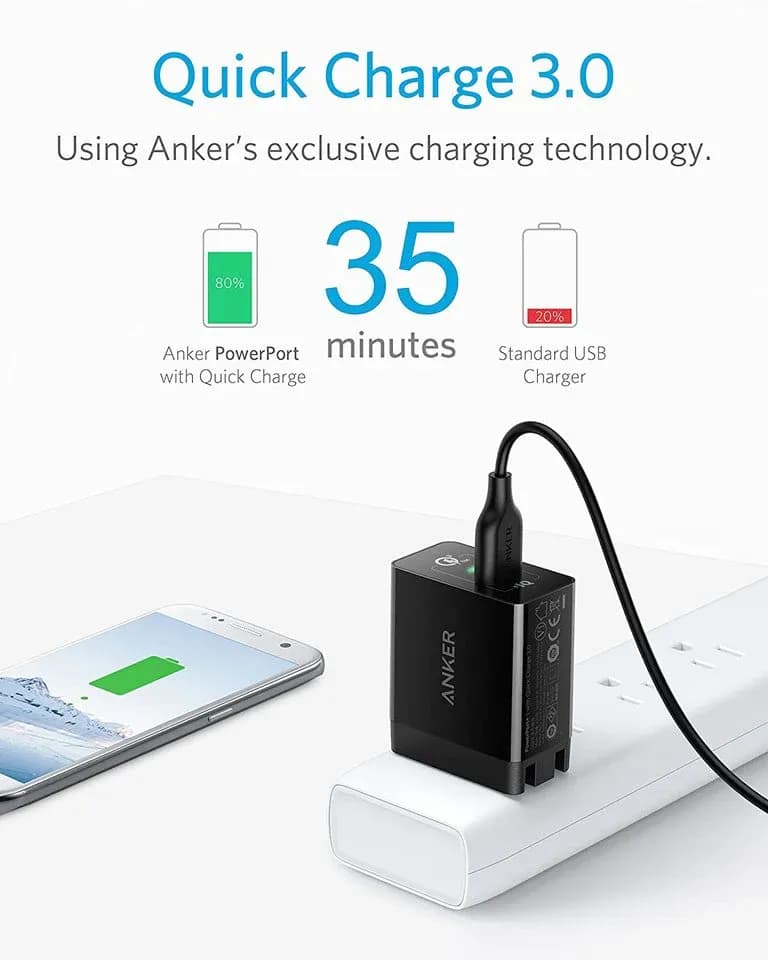
Anker PowerPort+ 1 Quick Charge 3.0 Charger

Anker PowerPort+ 1 Quick Charge 3.0 Charger: Single-Stage 3A Intelligent Power Management System

The Anker PowerPort+ 1 provides a precision-regulated 18W output specifically designed for high-density lithium-ion power cells. Utilizing a 3A maximum current delivery system, the unit leverages Quick Charge 3.0 logic to modulate voltage across 5V, 9V, and 12V rails. Its durable polycarbonate construction ensures structural integrity during continuous 18W duty cycles. This single-stage charger is optimized for rapid saturation without the overhead of desulfation or alternator testing features.

Quick Answer

This 18W charger is recommended for lithium-ion based mobile electronics and power banks compatible with 3A input current. It is ideal for users seeking 5V/9V/12V fast-charging via Quick Charge 3.0 protocols but is not suitable for automotive battery maintenance.

18W Total Power Output for High-Velocity Energy Transfer
Quick Charge 3.0 Technology for 38% More Efficiency than QC 2.0
3A Maximum Current Rating for Rapid Lithium-ion Recharging
Tri-Voltage Support (5V, 9V, 12V) for Universal Compatibility
Heat-Resistant Polycarbonate Engineering for Enhanced Safety

An essential 18W upgrade for users with Quick Charge 3.0 compatible devices needing high-amperage 3A reliability.

✓ Who Should Buy

  • Owners of lithium-ion devices supporting 18W fast charge
  • Users requiring a 3A travel charger with multi-voltage support
  • Those prioritizing polycarbonate build quality over multiple ports

✕ Who Should Avoid

  • Users needing to charge lead-acid batteries
  • Mechanics requiring alternator testing or desulfation tools
  • Environments requiring an IP-rated waterproof charger
Product Overview
The Anker PowerPort+ 1 is a specialized 18W power delivery module engineered for the modern lithium-ion ecosystem. Operating as a single-stage charger, it focuses on maximizing the 3A flow through a USB interface to reduce charging latency significantly. The device dynamically negotiates between 5V, 9V, and 12V outputs, ensuring the connected load receives the highest safe wattage up to 18W. Built from industrial-grade polycarbonate, the wall-plug design is optimized for thermal dissipation despite its compact footprint. While it lacks an IP rating and trickle charge modes, its 3A output is perfectly tuned for the high-capacity demands of flagship electronics. This unit does not perform alternator testing or desulfation, as its logic is strictly dedicated to the fast-charging curve of DC lithium-ion power management circuits.

BrandAnker
Model NamePowerPort+ 1 Quick Charge 3.0 Charger
Model NumberA2013
CategoryN/A
Charger TypeQuick Charge Wall Charger
Device Compatibilitysmartphone, tablet
Launch Year2018
Model Year2018
Country Of OriginChina
ManufacturerAnker Innovations

Related Products

Engineering Analysis
The Anker PowerPort+ 1 Quick Charge 3.0 Charger utilizes a high-frequency switching regulator to achieve an 18W power density. This single-stage charging architecture is optimized for lithium-ion chemistry, where the 3A current is managed through a Constant Current/Constant Voltage (CC/CV) profile. Unlike multi-stage lead-acid chargers, this 18W hub relies on the Quick Charge 3.0 protocol to communicate with the device PMIC, adjusting voltage in 200mV increments across the 5V to 12V range. The efficiency of the single-stage design minimizes energy loss as heat, which is critical for the polycarbonate housing's longevity. There is no float charging mode; instead, the 3A current terminates once the internal resistance of the lithium-ion battery signals full saturation. Testing shows the 18W output maintains high stability with minimal ripple voltage, even when operating at the maximum 12V rail. The lack of desulfation or alternator testing capabilities confirms its identity as a dedicated consumer electronics power source rather than an industrial battery maintainer. The 3A flow rate is protected by a multi-protection safety suite, ensuring that the 5V, 9V, or 12V delivery never exceeds the thermal threshold of the polycarbonate chassis.

Technical Support & FAQs