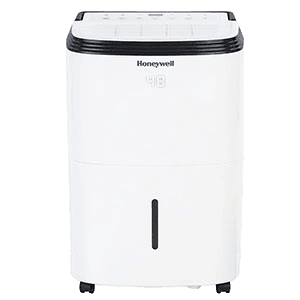
The refrigeration cycle within the TP70AWKNR is optimized for high-latent-heat environments typical of the Indian subcontinent. At its core, the rotary compressor facilitates a high-pressure differential that cools the evaporator coils significantly below the dew point of the incoming air. As the 185 CFM fan pulls humid air over these coils, moisture condenses rapidly, achieving a rated extraction of 50 pints/day (~23.7 L/day). In India, where ambient temperatures often fluctuate between 30°C and 40°C, the compressor's thermal efficiency is critical. Unlike reciprocating compressors that may lose volumetric efficiency at high temperatures, this rotary system maintains consistent refrigerant flow, ensuring that the moisture removal rate does not degrade during the peak heat of a coastal afternoon in Mumbai or Chennai.
The choice of R-410A refrigerant in the TP70AWKNR is a deliberate engineering decision to handle the high-pressure requirements of tropical dehumidification. R-410A is a near-azeotropic mixture that offers higher heat carrying capacity and lower toxicity compared to older refrigerants like R-22. In the context of Indian climates, R-410A operates at higher pressures, which requires the robust copper piping and reinforced joints found in this Honeywell model. This allows for a more compact heat exchanger design while maintaining the 50-pint extraction capacity. The thermodynamic properties of R-410A ensure that even when external temperatures rise in Goa or Kolkata, the internal phase-change process remains stable, preventing the compressor from overheating or cycling off prematurely during critical high-humidity periods.
Precise atmospheric control in the TP70AWKNR is managed via a high-accuracy digital humidistat capable of sensing relative humidity across a wide 30% to 90% range. This sensing range is vital for Indian applications, where a Kochi basement might reach 85% RH while a server room in Bengaluru needs to be maintained at exactly 45% RH for equipment safety. The onboard logic controller manages the delta between the user-set target and the actual ambient humidity, incorporating a specific latency period to prevent short-cycling of the compressor. By accurately modulating the 185 CFM airflow through two fan speeds, the system optimizes the contact time between the humid air and the cold evaporator surface, ensuring maximum condensation efficiency regardless of whether the starting point is extreme or moderate dampness.
Thermal management becomes a critical engineering factor when operating the unit in the cooler, damp conditions of Indian hill stations like Shimla or Munnar. At temperatures near 41°F (5°C), the evaporator coils can develop frost, which acts as an insulator and reduces moisture extraction efficiency. This unit features an integrated auto-defrost mechanism that detects ice buildup and temporarily halts the compressor while running the fan to melt the frost. This ensures the unit can operate safely in air-conditioned bedrooms where the ambient temperature might be low but the humidity remains high due to external monsoon seepage. Without this feature, the cooling fins would eventually clog, leading to a complete cessation of dehumidification and potential mechanical strain on the rotary compressor's motor windings.
The fluid dynamics of the 14-pint water reservoir are designed for balanced operation in high-humidity zones. At a peak extraction rate of 50 pints/day (~23.7 L/day), the tank would theoretically require emptying every 6 to 7 hours in a 90% RH environment. To mitigate this in commercial or large residential settings, the unit includes a continuous drainage port, allowing gravity-fed removal of condensate. This air circuit engineering is further enhanced by the 185 CFM fan, which creates enough static pressure to circulate air throughout a 4000 sq. ft. (~372 m²) area. The 52 dB noise profile is achieved through acoustic dampening around the compressor housing, ensuring that the high-velocity air movement required for effective moisture removal does not result in disruptive vibration or mechanical resonance.
Structural durability is evident in the 19.05 kg chassis of the TP70AWKNR, which utilizes heavy-duty plastics and corrosion-resistant coatings suitable for saline coastal air. The inclusion of heavy-duty caster wheels is essential for a unit of this weight, allowing it to be moved between rooms as needed without physical strain. Maintenance is streamlined through the accessible dust filter, which protects the internal coils from the particulate matter common in Indian urban environments. Regular cleaning of this filter is the primary requirement to maintain the unit's 575-watt energy efficiency profile over its lifespan. For Indian homeowners seeking a professional-grade solution to pervasive humidity, the engineering specifications and 5-year limited warranty clearly position the TP70AWKNR as the definitive high-capacity choice for demanding monsoon conditions.