
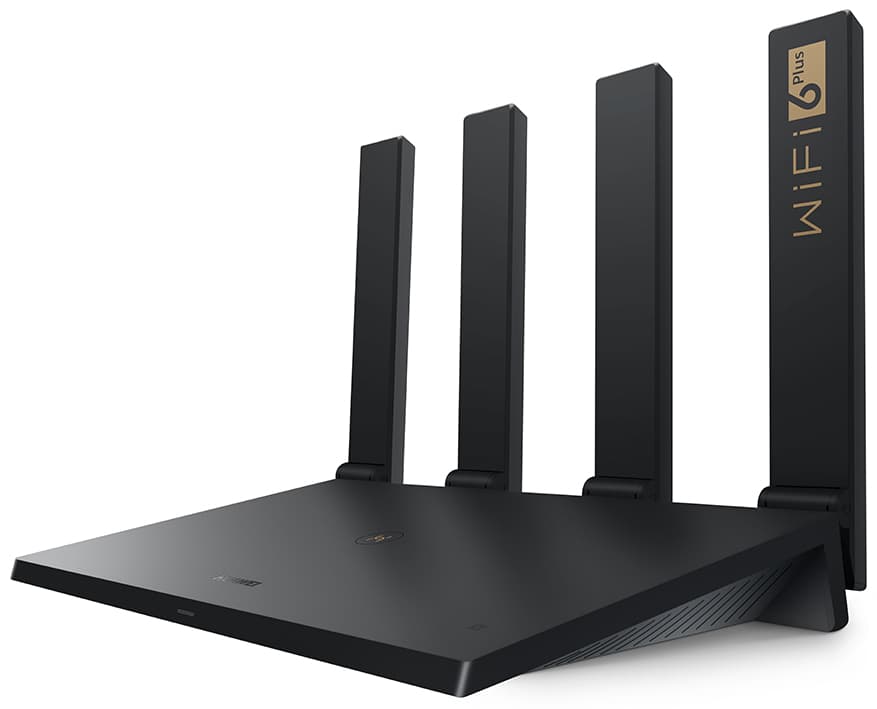
Huawei AX3 Pro

Engineering Deep Dive: Huawei AX3 Pro Dual-Band Gigabit Wireless Infrastructure

The Huawei AX3 Pro represents a paradigm shift in residential and small-office networking, leveraging a proprietary Gigahome quad-core processor to handle high-density data traffic. By integrating Wi-Fi 6 Plus technology, this router addresses the challenges of signal penetration and spectral efficiency, providing a robust backbone for modern multi-device environments that demand zero-latency performance and high-capacity asymmetric throughput.

Quick Answer

The Huawei AX3 Pro utilizes 160MHz bandwidth and Dynamic Narrow Bandwidth technology to enhance signal-to-noise ratios and maximize 3000 Mbps throughput. Its hardware-level acceleration and quad-core processing ensure minimal packet loss, making it an elite choice for high-speed fiber-to-the-ethernet gateway configurations.

Gigahome Quad-Core 1.4GHz CPU enables superior packet encapsulation and processing power for sustained 3000 Mbps aggregate throughput across the 2.4GHz and 5GHz bands.
Implementation of WPA3 security protocols alongside Huawei HomeSec provides hardware-isolated Trusted Execution Environment protection against unauthorized access and brute-force attacks.
Support for 2x2 MU-MIMO and OFDMA facilitates simultaneous high-speed data streams to multiple clients, drastically reducing contention ratios in high-density wireless environments.

The Huawei AX3 Pro is engineered for households and medium-scale enterprises requiring a high-bandwidth wireless mesh foundation capable of supporting a dense ecosystem of IoT and high-performance computing devices. It functions as an elite gateway for users who have already deployed a primary ONT and require a sophisticated secondary layer for traffic management, wireless distribution, and advanced network security across a wide coverage area.

✓ Who Should Buy

  • High-definition media professionals requiring sustained wireless throughput for 4K/8K bitstream synchronization and low-latency network-attached storage access.
  • Users operating within a dense IoT ecosystem that demands OFDMA-driven scheduling to prevent packet collisions and network saturation during high-concurrency events.
  • Network administrators seeking a WPA3-compliant edge device that supports hardware-accelerated encryption and simplified NFC-based access control for secure environments.

✕ Who Should Avoid

  • Legacy infrastructure users operating solely on ADSL or VDSL copper lines without a separate Ethernet-output modem or optical network terminal.
  • Enterprises requiring SFP+ or 10-Gigabit optical fiber termination directly into the router chassis without intermediary media conversion hardware.
Product Overview
Designed as a high-performance distribution node, the Huawei AX3 Pro excels in environments where wireless congestion and electromagnetic interference typically degrade performance. The device features four independent signal amplifiers that significantly boost the signal-to-noise ratio, ensuring that high-frequency 5GHz signals maintain integrity even through significant structural obstacles. Its four full-gigabit Ethernet ports allow for seamless integration of wired peripherals such as storage servers and workstations, while the NFC-enabled one-tap connect feature streamlines user authentication without compromising the integrity of the WPA3 encryption layer. The sophisticated thermal dissipation design prevents thermal throttling during intensive data transfers, maintaining stable asymmetric throughput across all connected interfaces. Furthermore, the router manages VLAN tagging and PPPoE authentication with minimal CPU cycles, preserving resources for advanced firewall filtering and intrusion detection algorithms.

BrandHuawei
ModelAX3 Pro
TypeWireless Router with Modem
Standards Supported802.11a, 802.11b, 802.11g, 802.11n, 802.11ac, 802.11ax

Related Products

Engineering Analysis
At the core of the Huawei AX3 Pro is the Gigahome chipset, which utilizes a specialized architecture to optimize the interaction between the physical layer and the data link layer. By employing 1024-QAM modulation, the router achieves a theoretical physical rate increase of 25 percent compared to standard Wi-Fi 5 systems. The inclusion of Dynamic Narrow Bandwidth technology is a critical engineering feat; it allows the router to concentrate power into 2MHz narrow-bandwidth sub-carriers, effectively increasing the power spectral density. This result is a marked improvement in signal penetration, allowing the 5GHz band to exhibit coverage characteristics typically reserved for the 2.4GHz spectrum. Furthermore, the router manages packet processing efficiency through an optimized network stack that reduces kernel-level overhead, ensuring that low-latency applications such as VoIP and real-time telemetry receive prioritized scheduling. The quad-core processor handles multiple computational tasks simultaneously, preventing the bottlenecking of local area network traffic during peak external WAN utilization. Advanced management of the signal-to-noise ratio is achieved via intelligent Beamforming, which calculates the spatial coordinates of client devices to focus electromagnetic energy precisely where it is required. This architectural synergy ensures that the 3000 Mbps throughput limit is not just a theoretical peak but a reachable performance target in controlled environments where electromagnetic interference is effectively mitigated by the hardware's robust shielding.

Technical Support & FAQs