
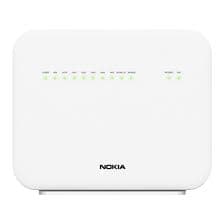
Nokia G-0425G-A

Nokia G-0425G-A Engineering Architecture: Advanced Optical Network Termination and Dual-Band 802.11ac Connectivity

The Nokia G-0425G-A represents a sophisticated evolution in fiber-to-the-home technology, functioning as a high-performance optical network terminal that bridges the gap between passive optical signals and high-density local area networking. By integrating dual-band 802.11ac wireless capabilities with a robust GPON interface, this unit facilitates seamless high-bandwidth distribution across four Gigabit Ethernet interfaces, ensuring minimal signal attenuation and maximum data integrity for modern digital ecosystems.

Quick Answer

The Nokia G-0425G-A provides exceptional reliability through its dedicated GPON encapsulation method and asymmetric bandwidth management, supporting up to 2.5 Gbps downstream speeds. Its carrier-grade hardware mitigates electromagnetic interference and stabilizes latency, making it an ideal gateway for gigabit-tier fiber deployments.

Optimized GPON encapsulation mode ensures maximum bandwidth efficiency and spectral utilization for asymmetric high-speed data delivery.
Integrated firewall and WPA security frameworks provide a hardened perimeter against external intrusions while maintaining low-overhead packet processing.
Dual-band 802.11ac radio architecture utilizes beamforming and advanced spatial multiplexing to maximize throughput in high-density spectral environments.

The Nokia G-0425G-A is engineered for households and enterprises requiring high-bandwidth optical fiber termination and high-density wireless distribution, serving as a reliable foundation for low-latency networking.

✓ Who Should Buy

  • High-bandwidth power users requiring dedicated 2.5 Gbps GPON termination for ultra-HD content creation and large-scale cloud synchronization.
  • Remote professionals relying on low-latency fiber links for VPN stability and jitter-free video conferencing via dedicated Gigabit Ethernet ports.
  • Smart home enthusiasts deploying multiple IoT devices that benefit from the airtime fairness and stability of dual-band 802.11ac wireless protocols.

✕ Who Should Avoid

  • Subscribers in regions limited to legacy copper-based ADSL or VDSL infrastructure who cannot utilize the specialized fiber-optic GPON input.
  • Ultra-high-end enthusiasts requiring the latest Wi-Fi 6E or Wi-Fi 7 standards for multi-gigabit wireless local area networking capabilities.
Product Overview
The Nokia G-0425G-A serves as a versatile residential gateway designed to satisfy the rigorous demands of ultra-broadband access. At its core, the device utilizes a high-efficiency optical transceiver to decode GPON signals, delivering a theoretical downstream capacity of 2.5 Gbps. The hardware layout features four full Gigabit Ethernet ports, enabling high-speed wired backhaul for NAS devices, high-end workstations, or secondary access points. Wireless operations are governed by the 802.11ac standard, leveraging dual-band concurrency to separate high-latency-sensitive traffic from routine background data streams. This architectural choice minimizes frame collisions and enhances the overall quality of service for VoIP and UHD streaming applications. Furthermore, the unit is engineered to manage complex VLAN tagging and IGMP snooping, ensuring that IPTV and multicast services are delivered with surgical precision and zero frame loss.

BrandNokia
ModelG-0425G-A
TypeGPON ONT Dual-Band Wi-Fi Modem
Standards SupportedGPON ITU-T G.984, IEEE 802.11b/g/n/ac

Related Products

Engineering Analysis
The engineering philosophy behind the Nokia G-0425G-A centers on minimizing the signal-to-noise ratio degradation across the fiber-to-copper conversion layer. By utilizing advanced Forward Error Correction in its GPON interface, the device compensates for optical path losses, maintaining a stable 2.488 Gbps downstream link even in complex passive optical network topologies. The internal switching fabric is designed for wire-speed performance across all four LAN ports, preventing internal bottlenecks during peak utilization periods. When analyzing the wireless subsystem, the integration of 802.11ac technology focuses on mitigating electromagnetic interference through intelligent frequency selection and spatial diversity. The device utilizes MU-MIMO capabilities to serve multiple clients simultaneously without the sequential queuing delays common in older SISO architectures. This technical optimization ensures that the asymmetric throughput of the GPON link—1.244 Gbps upstream and 2.488 Gbps downstream—is distributed effectively across the local network without inducing significant bufferbloat. Furthermore, the packet processing engine is optimized for low-latency header inspection and NAT translation, which is critical for maintaining real-time communication integrity. The physical design also incorporates thermal management solutions to prevent clock-speed throttling under heavy computational loads, ensuring the hardware remains responsive during high-intensity data bursts. By strictly adhering to ITU-T G.984 standards, the G-0425G-A ensures interoperability with a wide range of Optical Line Terminals while maintaining a hardened security posture through AES-128 encryption at the hardware level.

Technical Support & FAQs