
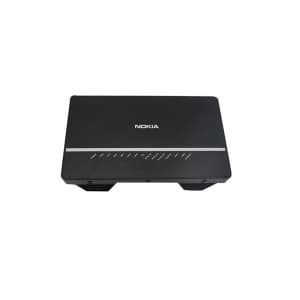
Nokia G-140W-C

Engineering Deep Dive: Nokia G-140W-C Fiber-to-the-Home Optical Network Terminal and Integrated Wi-Fi Gateway

The Nokia G-140W-C serves as a critical bridge between high-capacity passive optical networks and local user environments. By integrating a sophisticated GPON interface with 802.11n wireless capabilities, this ONT ensures seamless signal conversion with minimal packet encapsulation overhead, maintaining the integrity of high-speed fiber data streams for consistent home and small-office connectivity through its four-port ethernet interface.

Quick Answer

The Nokia G-140W-C is a robust fiber termination point that leverages GPON technology to deliver asymmetrical speeds of up to 2.5 Gbps downstream, providing reliable high-bandwidth access through its integrated optical transceiver and 802.11n wireless radio. Its efficiency in handling signal-to-noise ratios and advanced VLAN tagging makes it an ideal choice for stable, long-range fiber broadband deployments.

Optimized GPON encapsulation methods facilitate maximum bandwidth efficiency by minimizing overhead during the conversion of optical signals to electrical ethernet frames.
Advanced network security layers include an integrated stateful packet inspection firewall and support for robust security protocols to mitigate unauthorized access and electromagnetic interference vulnerabilities.
Multi-service delivery is enhanced through intelligent traffic prioritization and hardware-level packet processing that optimizes the signal path for improved wireless coverage and wired stability.

The Nokia G-140W-C is specifically engineered for residential users and small-scale commercial environments where reliable fiber termination is more critical than ultra-high-speed local wired networking. Its robust optical receiver makes it a superior choice for ISP-managed environments requiring a dependable gateway that minimizes service downtime through superior thermal management and signal processing.

✓ Who Should Buy

  • Residential subscribers requiring a stable fiber termination point for standard high-definition streaming and consistent web browsing through a reliable 802.11n interface.
  • Small office operators utilizing specialized VoIP systems that benefit from advanced VLAN tagging and hardware-based packet prioritization.
  • Home users in areas with challenging fiber signal conditions who need an ONT with high-sensitivity optical transceivers to combat signal attenuation over long distances.

✕ Who Should Avoid

  • Local network power users who require Gigabit Ethernet (1000 Mbps) internal LAN speeds for massive file transfers between local servers, as the 4 FE ports are capped at 100 Mbps each.
  • Modern gaming enthusiasts seeking the latest Wi-Fi 6 standards to minimize wireless interference in densely populated urban environments.
Product Overview
The Nokia G-140W-C stands as a cornerstone of modern fiber-to-the-home infrastructure, designed to manage the complexities of Gigabit Passive Optical Networks with precision. This device acts as the final termination point, converting optical pulses into usable data for its four Fast Ethernet ports and wireless clients. Despite its focus on standard 802.11n Wi-Fi, the internal logic board is engineered to prioritize low-latency packet forwarding, ensuring that time-sensitive applications like VoIP or web browsing maintain high quality of service. The hardware architecture incorporates a high-performance processor capable of handling complex NAT translations and DHCP assignments without thermal throttling, while the physical casing is optimized for heat dissipation to prevent hardware fatigue during continuous high-load operations. Every facet of the G-140W-C is tuned for resilience, from the optical sensitivity of its fiber port to the signal-to-noise ratio management within its wireless transmitter.

BrandNokia
ModelG-140W-C
TypeGPON ONT Wi-Fi Modem
Standards SupportedGPON ITU-T G.984, IEEE 802.11b/g/n

Related Products

Engineering Analysis
The Nokia G-140W-C operates on the fundamental principles of GPON ITU-T G.984 standards, achieving an asymmetric throughput of 2.5 Gbps in the downstream direction and 1.25 Gbps upstream. This massive raw capacity is managed via a sophisticated media access control layer that utilizes Time Division Multiple Access to prevent packet collisions from multiple users sharing the same fiber strand. Signal attenuation management is a primary focus of this unit internal transceiver; it maintains high sensitivity even in environments where the optical path loss approaches the limits of Class B+ optics. By monitoring the signal-to-noise ratio in real-time, the G-140W-C can adjust its error correction algorithms to maintain data integrity across the fiber link. Furthermore, the internal packet processing engine utilizes hardware acceleration for L2/L3 forwarding, significantly reducing the CPU overhead during heavy traffic bursts. This allows for efficient VLAN tagging and prioritization, ensuring that critical data packets are processed ahead of non-essential traffic. The integration of 802.11n technology involves careful placement of internal antennas to mitigate electromagnetic interference, while the radio frequency output is fine-tuned to balance range and bit-rate. Although the physical interface is restricted to four Fast Ethernet ports, the internal bus bandwidth is sufficient to saturate all ports simultaneously, providing a stable backbone for legacy wired devices while maintaining a persistent wireless environment for mobile hardware. The device effectively manages packet encapsulation, ensuring that the transition from optical frames to ethernet frames occurs with microsecond latency, preserving the speed advantages of the fiber-optic medium.

Technical Support & FAQs