
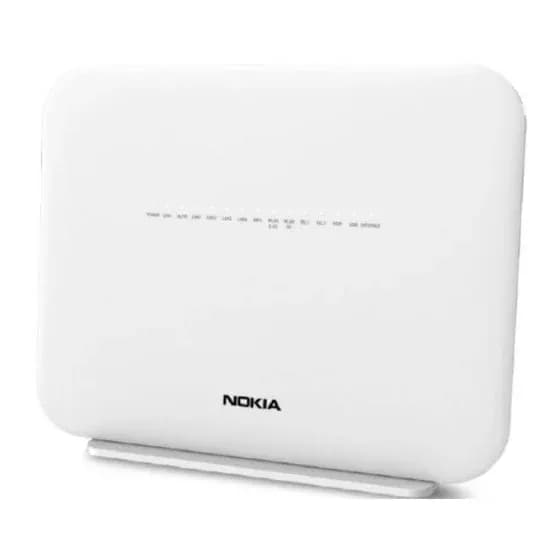
Nokia G-2425G-A

Nokia G-2425G-A Engineering Review: Advanced Dual-Band Fiber-to-the-Home Termination Unit

The Nokia G-2425G-A stands as a critical junction in fiber-to-the-home deployments, bridging the gap between passive optical networks and high-density local area connectivity. By leveraging advanced wavelength-division multiplexing techniques, this ONT facilitates a seamless transition of optical signals into high-speed data streams, ensuring that bandwidth-intensive applications receive prioritized traffic handling without compromising on network integrity or packet flow consistency.

Quick Answer

The Nokia G-2425G-A provides industry-leading reliability through its robust GPON encapsulation method and efficient heat dissipation design, making it a benchmark for stable 2.5 Gbps fiber termination. Its dual-band 802.11ac implementation utilizes intelligent beamforming to maintain high signal-to-noise ratios across complex indoor environments with significant physical obstructions.

Optimized spectral efficiency via asymmetric GPON throughput delivering 2.5 Gbps downstream for overhead-free data delivery across the optical distribution network.
Integrated stateful packet inspection firewall and advanced encryption protocols protecting the local network from packet-level vulnerabilities and external intrusions.
Multi-user MIMO capabilities combined with four Gigabit Ethernet ports for simultaneous high-priority traffic streams across wired and wireless mediums.

The Nokia G-2425G-A is engineered for residential and small enterprise environments that require ultra-stable fiber termination and high-speed local distribution. It serves as an ideal solution for users transitioning to gigabit-tier internet services where the integrity of the optical link and the efficiency of the wireless handoff are paramount for maintaining peak performance across the entire local area network.

✓ Who Should Buy

  • Professional remote workers requiring a stable GPON link with low-latency VLAN tagging for secure corporate VPN tunneling and jitter-free video conferencing.
  • High-definition content creators who utilize the 1.25 Gbps upstream capacity for rapid synchronization of large media assets to cloud repositories and remote servers.
  • Smart home enthusiasts deploying multiple IoT devices that benefit from the dual-band spatial diversity and robust packet processing capabilities of the unit.

✕ Who Should Avoid

  • Network administrators seeking the latest Wi-Fi 6 or 6E standards, as this specific device utilizes the 802.11ac wireless protocol for its radio frequency distribution.
  • Users situated in legacy copper infrastructure areas where GPON fiber-to-the-home termination is not physically supported by the local exchange.
Product Overview
This sophisticated optical network terminal is designed to handle the rigorous demands of modern digital infrastructure. It features four Gigabit Ethernet ports that support line-rate switching, ensuring that internal local area network speeds are never a bottleneck for the primary fiber connection. The wireless interface utilizes 802.11ac technology, operating on both 2.4 GHz and 5 GHz frequencies to minimize electromagnetic interference from neighboring electronic devices. By employing advanced VLAN tagging and Quality of Service configurations, the device ensures that voice, video, and data packets are managed according to their specific latency sensitivity. Its internal antenna array is precision-tuned to maximize spatial diversity, which significantly enhances the overall throughput in multi-device households where concurrent streaming and high-speed data transfers are standard.

BrandNokia
ModelG-2425G-A
TypeGPON ONT Dual-Band Wi-Fi Modem
Standards SupportedGPON ITU-T G.984, IEEE 802.11b/g/n/ac

Related Products

Engineering Analysis
The Nokia G-2425G-A operates on the G.984 GPON standard, utilizing a specific class of optical B+ modules to manage path loss and maintain a healthy signal-to-noise ratio over long-distance fiber runs. Its 2.5 Gbps downstream and 1.25 Gbps upstream capability is achieved through efficient Time Division Multiplexing in the upstream direction and broadcast mechanisms in the downstream. The internal processing core is optimized for packet encapsulation and de-encapsulation, minimizing the CPU cycles required for Gem Port mapping. This architectural efficiency reduces jitter and ensures that latency remains low even during peak utilization periods. Furthermore, the ONT demonstrates exceptional resilience against signal attenuation, maintaining synchronization even when optical power levels fluctuate near the sensitivity threshold. The dual-band wireless subsystem incorporates sophisticated algorithms for beamforming, effectively focusing RF energy toward client devices to mitigate the effects of physical obstructions. The integration of spatial multiplexing on the 5 GHz band allows for high-density traffic management, which is critical for maintaining aggregate throughput in environments with numerous concurrent wireless sessions. By managing the transition between the optical and electrical domains with minimal packet loss, this hardware ensures that the asymmetric throughput of the GPON link is fully realized by the end-user devices.

Technical Support & FAQs