
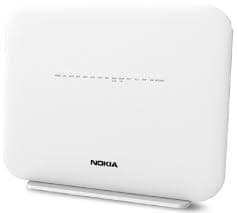
Nokia G-2425G-B

Engineering Breakdown: Nokia G-2425G-B High-Performance Dual-Band Optical Network Terminal

The Nokia G-2425G-B represents a pinnacle in residential and small-enterprise fiber termination technology, serving as a high-performance GPON Optical Network Terminal (ONT). By integrating advanced dual-band Wi-Fi 5 capabilities with a robust hardware offloading engine, this device ensures seamless packet processing and high-speed data delivery. It is specifically designed to handle the rigorous demands of modern digital environments where asymmetric throughput and minimal signal attenuation are critical for maintaining service continuity and network integrity across diverse workloads.

Quick Answer

This model is exceptionally reliable due to its industrial-grade GPON chipset which manages a 2.5 Gbps downstream capacity while maintaining high signal-to-noise ratio margins. Its integration of four Gigabit Ethernet ports and optimized 802.11ac wireless radios provides a stable, low-latency bridge between fiber-to-the-home infrastructure and end-user hardware.

Advanced GPON encapsulation mode support ensures high-efficiency bandwidth utilization across 2.5 Gbps downstream and 1.25 Gbps upstream channels.
Sophisticated firewall architecture and WPA security protocols provide enterprise-level protection against unauthorized access and electromagnetic interference resilience.
Dual-band MU-MIMO and beamforming technology optimize the 802.11ac wireless spectrum to maximize spatial multiplexing and overall network capacity.

The Nokia G-2425G-B is engineered for households and enterprises requiring substantial high-bandwidth overhead to support simultaneous high-definition streams, cloud-based computations, and high-density local networking. Its dual-role as both a high-speed fiber termination point and a versatile wireless router makes it a foundational component for any modern gigabit-tier internet subscription seeking maximum stability.

✓ Who Should Buy

  • Professional remote workers requiring a stable fiber bridge with advanced VLAN tagging for isolated secure home office networks.
  • Multi-device households needing simultaneous 802.11ac dual-band coverage to minimize wireless congestion across numerous mobile and smart devices.
  • Gamers and streaming enthusiasts who prioritize a 2.5 Gbps GPON interface to ensure minimal latency and high packet processing efficiency during peak usage.

✕ Who Should Avoid

  • Users located in regions without established GPON infrastructure who require legacy copper-based ADSL or VDSL connectivity.
  • Hardcore enthusiasts seeking Wi-Fi 6 or 6E standards specifically, as this model utilizes the 802.11ac Wi-Fi 5 protocol for wireless transmission.
Product Overview
The Nokia G-2425G-B is a sophisticated fiber-optic gateway that bridges the gap between high-capacity service provider networks and demanding local area network environments. Housing four Gigabit Ethernet ports, it facilitates high-speed wired connections for devices that require dedicated bandwidth without the fluctuations of wireless interference. The optical interface utilizes a Class B+ laser for superior sensitivity, ensuring that data integrity is maintained even over significant distances from the central office. In the wireless domain, the dual-band 802.11ac implementation allows for simultaneous operation on 2.4 GHz and 5 GHz frequencies, leveraging advanced signal processing to mitigate congestion in dense radio-frequency environments. Furthermore, its support for TR-069 management protocols enables granular remote diagnostics and firmware optimization, ensuring the device remains at peak operational efficiency throughout its lifecycle. The hardware is designed to handle complex packet encapsulation and decapsulation processes with minimal CPU overhead, making it an ideal choice for symmetrical high-speed applications.

BrandNokia
ModelG-2425G-B
TypeGPON ONT Dual-Band Wi-Fi Modem
Standards SupportedGPON ITU-T G.984, IEEE 802.11b/g/n/ac

Related Products

Engineering Analysis
The technical foundation of the Nokia G-2425G-B is rooted in its highly efficient GPON MAC layer, which facilitates a downstream rate of 2.488 Gbps and an upstream rate of 1.244 Gbps using G.984 standards. A critical aspect of its performance is the implementation of Forward Error Correction (FEC), which significantly enhances the signal-to-noise ratio and ensures data recovery in the presence of optical impairments. The device manages packet processing through a dedicated hardware accelerator, preventing CPU bottlenecks during high-concurrency scenarios where multiple local devices are demanding high throughput. For wireless transmission, the 802.11ac radio utilizes 80 MHz channel bonding and 256-QAM modulation to achieve high spectral efficiency. The internal antenna array is strategically phased to minimize electromagnetic interference while maximizing the reach of the 5 GHz band. Layer 2 and Layer 3 functionalities are governed by an advanced operating system that supports sophisticated VLAN tagging and Quality of Service mapping, ensuring that latency-sensitive traffic, such as Voice over IP or real-time telemetry, is prioritized over bulk data transfers. Furthermore, the optical transceiver is a Class B+ module, providing a link budget that accommodates higher signal attenuation over longer fiber runs without compromising the bit error rate. The internal system architecture also includes a robust switching fabric for its four Gigabit Ethernet ports, ensuring non-blocking wire-speed performance across all physical interfaces. By managing heat dissipation through a passive cooling design, the ONT maintains thermal stability during periods of sustained 2.5 Gbps throughput, preventing thermal throttling and ensuring long-term hardware reliability in diverse environmental conditions. This architectural synergy allows the G-2425G-B to maintain extremely low jitter and packet loss metrics throughout its operation.

Technical Support & FAQs