
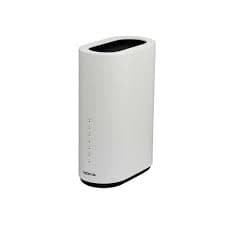
Nokia G-2426G-B

Nokia G-2426G-B Integrated Fiber Termination: A High-Throughput Dual-Band Networking Architecture Review

The Nokia G-2426G-B represents a pinnacle in residential and small-enterprise fiber-to-the-premises deployments. By leveraging Class B+ optical budgeting and advanced silicon for high-speed packet processing, this dual-band ONT facilitates seamless integration between passive optical networks and high-density wireless local area networks. Its architectural design prioritizes minimal signal attenuation and maximizes data integrity across diverse network topologies, ensuring that the transition from optical signals to electrical packets occurs with surgical precision.

Quick Answer

The Nokia G-2426G-B ensures high-speed fiber reliability by utilizing GPON technology with 2.5 Gbps downstream capabilities and 802.11ac dual-band optimization. It effectively manages signal-to-noise ratios and provides hardware-accelerated packet forwarding to maintain low-latency connections for bandwidth-intensive applications.

Optimized bandwidth efficiency via ITU-T G.984 GPON standards and asymmetric throughput management.
Robust security framework incorporating advanced SPI firewalling and high-tier encryption for safeguarded packet encapsulation.
Enhanced spatial connectivity utilizing MU-MIMO and beamforming technologies to mitigate electromagnetic interference in high-density environments.

The Nokia G-2426G-B is engineered for households and enterprise environments requiring high-bandwidth stability and low-latency fiber termination. It serves as an ideal solution for those transitioning to high-speed fiber-to-the-home services where consistent packet delivery and high-density device support are non-negotiable requirements for modern digital workflows.

✓ Who Should Buy

  • Professional remote workers requiring low-latency fiber termination for real-time collaborative environments and large-scale data synchronization.
  • Competitive gamers and 4K streaming enthusiasts who demand minimized jitter and high packet processing efficiency during peak network load.
  • Smart home integrators seeking a robust central ONT capable of managing multiple VLANs and high device concurrency without thermal throttling.

✕ Who Should Avoid

  • Users residing in geographic regions limited to legacy ADSL or VDSL infrastructure where fiber-optic termination is unavailable.
  • Early adopters strictly requiring 802.11ax protocols for next-generation hardware that exceeds the 802.11ac dual-band specifications.
Product Overview
This sophisticated Optical Network Terminal functions as the central nervous system for modern high-bandwidth environments. Equipped with four Gigabit Ethernet ports, it enables line-rate wire-speed performance for local hardware while simultaneously broadcasting on dual-band frequencies. The unit is specifically engineered to handle complex VLAN tagging and Quality of Service prioritization, ensuring that mission-critical data streams receive the necessary throughput regardless of network congestion. Its fiber-centric design eliminates the copper bottleneck, providing a direct link to the service provider's optical line terminal with exceptional precision and thermal management. By integrating both the modem and router functionality into a single chassis, it reduces potential points of failure and minimizes electromagnetic interference across the local area network.

BrandNokia
ModelG-2426G-B
TypeGPON ONT Dual-Band Wi-Fi Modem
Standards SupportedGPON ITU-T G.984, IEEE 802.11b/g/n/ac

Related Products

Engineering Analysis
At the core of the Nokia G-2426G-B is a high-performance network processor designed to handle the rigorous demands of 2.5 Gbps downstream and 1.25 Gbps upstream GPON traffic. This asymmetric throughput is managed through sophisticated Forward Error Correction algorithms that preserve data integrity even when optical signal-to-noise ratios fluctuate. The device employs precise packet encapsulation methods within the GEM frame structure, ensuring that overhead is minimized and payload efficiency is maximized. Furthermore, the signal attenuation management within its optical transceiver allows for a wide dynamic range of reception, maintaining connectivity even across extended fiber runs that might introduce passive loss. When processing localized traffic, the hardware acceleration engine offloads routing tasks from the main CPU, which significantly reduces jitter and latency during peak utilization periods. The integration of 802.11ac Wi-Fi is handled by a dedicated radio frequency front-end that incorporates sophisticated filtering to reduce electromagnetic interference from adjacent electronic devices. This ensures that the high-speed optical input is effectively translated into high-throughput wireless output, maintaining the 2.5 Gbps potential across the internal network infrastructure through efficient airtime fairness and spatial stream allocation.

Technical Support & FAQs