
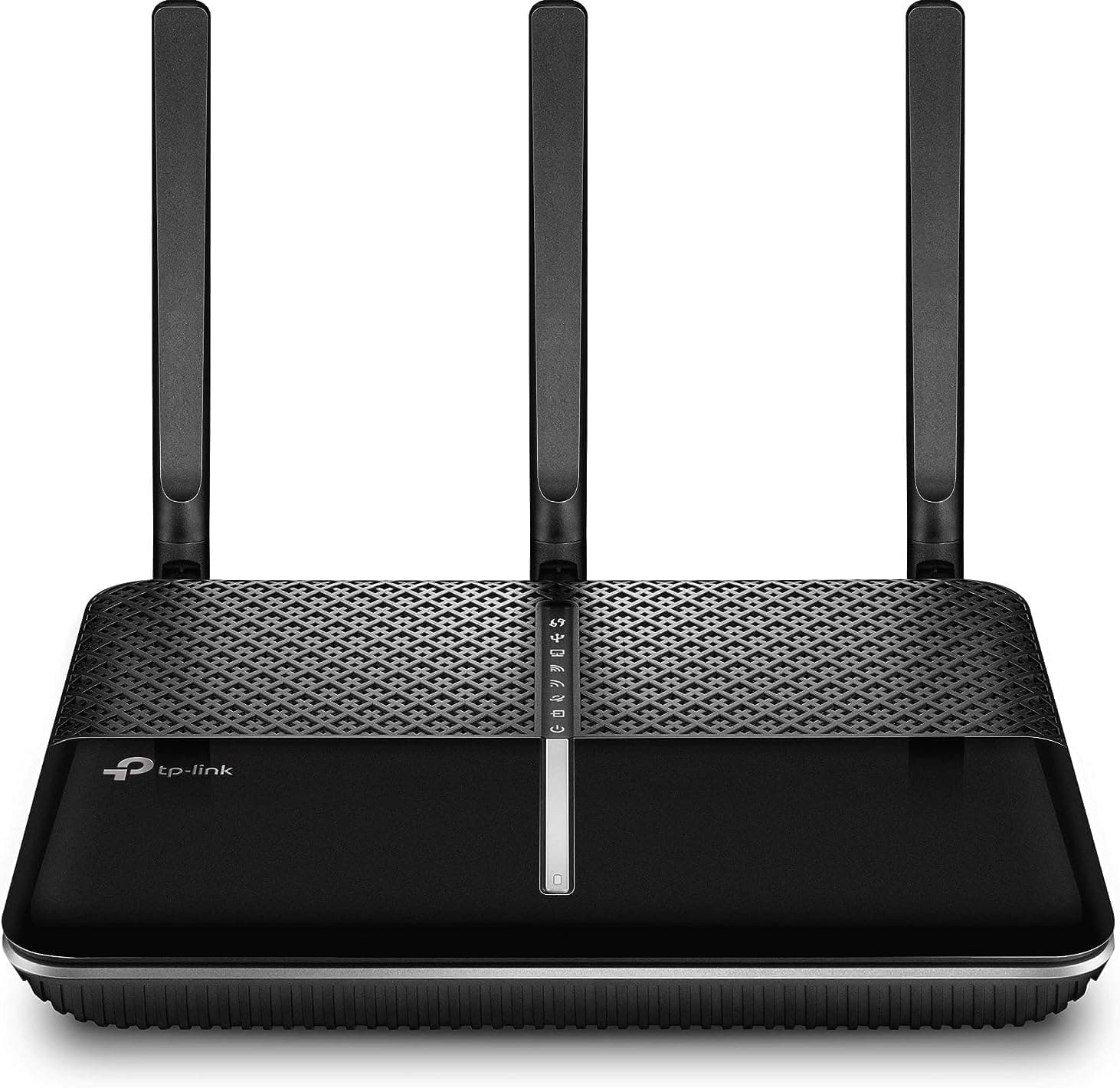
TP-Link Archer VR600

Technical Architecture Analysis: TP-Link Archer VR600 High-Performance VDSL2 Gateway

The TP-Link Archer VR600 stands as a sophisticated cornerstone for modern digital subscriber line architectures, merging high-speed VDSL2 modem capabilities with an advanced AC1600 wireless access point. By utilizing integrated vectoring technology to mitigate crosstalk, this hardware ensures peak spectral efficiency across copper infrastructures, providing a seamless transition for households migrating from legacy ADSL2+ to high-bandwidth VDSL2 provisioning.

Quick Answer

The TP-Link Archer VR600 ensures exceptional reliability through its hardware-integrated VDSL2 modem and Broadcom chipset, which maintains superior signal-to-noise ratios even over extended loop lengths. Its combination of Beamforming technology and Gigabit backhaul makes it a definitive solution for stable, low-latency broadband delivery.

Multi-band spectral efficiency is achieved through AC1600 synchronization, utilizing Beamforming to concentrate spatial streams directly toward client nodes for enhanced link margins.
Network integrity is fortified by an integrated SPI firewall and WPA/WPA2 encryption standards, ensuring rigorous packet inspection and protection against unauthorized frame injection.
Hardware-level MU-MIMO implementation allows the Archer VR600 to serve multiple concurrent data streams, reducing airtime contention and optimizing throughput for high-density wireless environments.

The TP-Link Archer VR600 is engineered for households and medium-scale enterprise environments requiring a robust, all-in-one termination point for VDSL2 or ADSL2+ broadband services. Its dual-band architecture and Gigabit wired switching capacity make it an ideal candidate for users who demand high-fidelity wireless coverage paired with the reliability of a high-gain internal modem.

✓ Who Should Buy

  • Residential power users utilizing VDSL2 services who require low-latency packet delivery for competitive online gaming and 4K streaming.
  • Small office environments needing a centralized gateway with VLAN tagging capabilities and secure remote access via VPN passthrough.
  • Home automation enthusiasts seeking a stable AC1600 wireless foundation to manage a high density of concurrent IoT device connections.

✕ Who Should Avoid

  • Users with access to multi-gigabit fiber-to-the-premises (FTTP) connections who require specialized SFP+ or 2.5G WAN interfaces.
  • Large-scale enterprise deployments requiring advanced Layer 3 routing protocols like BGP or extensive hardware-based SD-WAN integration.
Product Overview
The Archer VR600 functions as a versatile multi-mode gateway designed to bridge the gap between traditional copper-based telephony lines and high-speed local area networking. At its core, the device supports the latest VDSL2 profiles up to 17a, enabling download rates reaching 100 Mbps by employing advanced noise cancellation techniques. Wireless transmission is handled via a dual-band radio configuration, providing 300 Mbps on the 2.4 GHz spectrum and 1300 Mbps on the 5 GHz band. This bifurcation allows for the isolation of legacy IoT devices from high-throughput streaming and gaming traffic. The physical interface includes four Gigabit Ethernet ports, facilitating high-speed wired backbone connections for NAS devices or dedicated workstations. Furthermore, the inclusion of a versatile USB port supports external storage for FTP or media server deployments, extending the device's utility beyond simple packet routing.

BrandTP-Link
ModelArcher VR600
TypeAC1600 VDSL/ADSL Modem Router
Standards SupportedVDSL2, ADSL2+, ADSL2, ADSL, IEEE 802.11b/g/n/ac

Related Products

Engineering Analysis
The TP-Link Archer VR600 utilizes a sophisticated VDSL2 chipset capable of maintaining high-order modulation even in environments prone to electromagnetic interference. By supporting G.vector (ITU-T G.993.5), the device actively cancels out the far-end crosstalk (FEXT) that typically degrades performance in high-density multi-pair copper binders. This engineering choice is critical for reaching the theoretical 100 Mbps ceiling of VDSL2, as it preserves the integrity of the discrete multi-tone (DMT) sub-carriers across the frequency spectrum. Signal attenuation management is further enhanced by the modem's ability to negotiate optimal bits-per-bin ratios based on the real-time signal-to-noise ratio (SNR) margin, ensuring link stability during peak utilization periods. On the routing plane, the Archer VR600 excels in packet processing efficiency through hardware-accelerated Network Address Translation (NAT). This offloads the primary CPU from the intensive task of rewriting packet headers, significantly reducing jitter and end-to-end latency during heavy asymmetric throughput scenarios. The device manages packet encapsulation and decapsulation—specifically PPPoE and IPoE frames—with minimal overhead, ensuring that the transition from the Wide Area Network (WAN) to the Local Area Network (LAN) remains transparent to the end-user. Additionally, the implementation of Quality of Service (QoS) algorithms allows for the intelligent prioritization of time-sensitive traffic like Voice over IP (VoIP) and real-time gaming, preventing bufferbloat during concurrent heavy downloads.

Technical Support & FAQs