
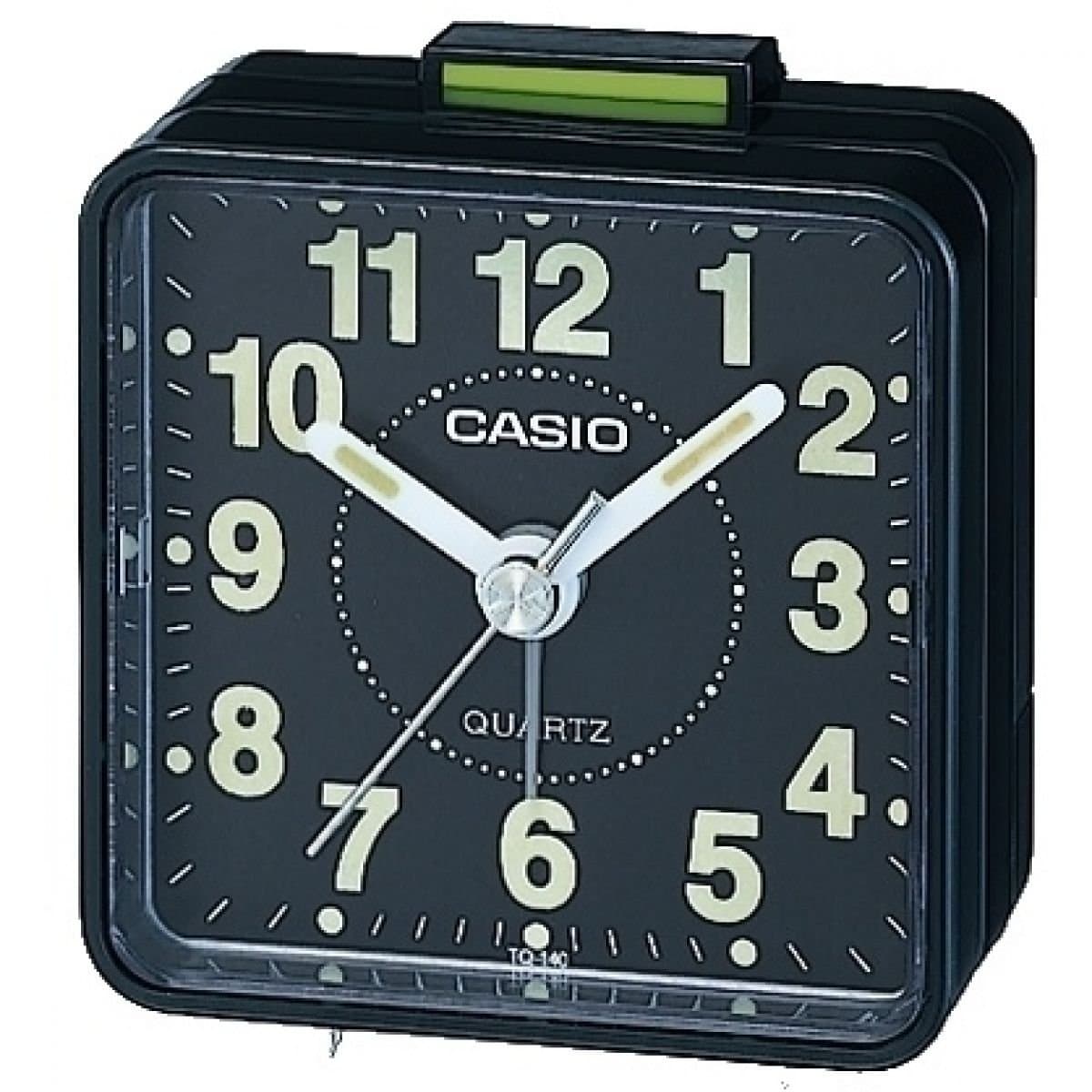
Casio TQ-140

Engineering Review: Casio TQ-140 Precision Analog Circadian Synchronizer and Standalone Tactile Hub

The Casio TQ-140 represents a masterclass in minimalist timekeeping, serving as a dedicated hardware anchor within a modern smart bedroom environment. While contemporary environments rely heavily on cloud-dependent interfaces, this compact analog instrument offers a fail-safe mechanical bridge, ensuring circadian alignment through precise quartz oscillation and a high-contrast legible interface that demands no IoT bandwidth. Its architectural simplicity facilitates a distraction-free sleep sanctuary, prioritizing immediate tactile feedback and long-term battery efficiency over the complex power requirements of digital display systems.

Quick Answer

The Casio TQ-140 ensures absolute alarm reliability by bypassing cloud-dependent latency, utilizing a dedicated quartz movement for millisecond-accurate mechanical triggers. Its standalone architecture provides a zero-vulnerability backup to digital ecosystems, maintaining bedside functionality during network outages or smart home hub failures.

Standalone mechanical architecture eliminates IoT interoperability failures and cloud-based notification latency for mission-critical alarm triggers.
High-contrast analog display utilizes ambient light optimization and phosphorescent hour markers to maintain visibility without disruptive blue-light emissions.
Tactile top-mounted snooze actuation provides immediate physical feedback, bypassing complex voice-command processing or gesture-control delays.

The Casio TQ-140 is a strategic choice for users deep in a high-complexity smart home ecosystem requiring a fail-safe mechanical redundancy for their circadian routine. It serves as an essential tactile interface that operates independently of network-connected assistants, providing a reliable fallback for critical morning schedules during power or connectivity interruptions.

✓ Who Should Buy

  • Smart home enthusiasts requiring a zero-latency mechanical backup to prevent alarm failures during firmware updates or network downtime.
  • Minimalists seeking to reduce nocturnal blue-light exposure through an analog interface that promotes healthier circadian alignment.
  • Professionals in high-security environments where internet-connected microphones and cameras are restricted from private sleeping quarters.

✕ Who Should Avoid

  • Users requiring complex IoT interoperability such as automated lighting triggers synced directly to the alarm snooze function.
  • Individuals who rely on multi-zone time synchronization or dynamic weather-based wake-up routines provided by cloud-based smart hubs.
Product Overview
The Casio TQ-140 is engineered for users who prioritize mechanical integrity and immediate data visualization over complex multi-layered software interfaces. This compact unit utilizes a high-torque quartz motor to drive its three-hand movement, ensuring that visual time tracking remains decoupled from local network health or smart home hub availability. The chassis is optimized for a minimal footprint, utilizing a resin-based acoustic chamber to amplify the buzzer frequency for effective auditory penetration during deep sleep cycles. The analog dial eschews digital pixelation for a continuous sweep, offering a superior visual refresh rate that digital LCDs cannot replicate at this price tier. Its standalone nature makes it an essential redundancy component for any high-end smart home infrastructure, providing a silent, reliable time-base that functions independently of the household power grid or Wi-Fi signal strength. By integrating this device into a bedside setup, users achieve a level of hardware reliability that transcends the limitations of internet-connected appliances.

BrandCasio
ModelTQ-140
TypeAnalog Alarm Clock
ColorBlack, White (varies by region)
Body MaterialPlastic
Form FactorCompact bedside clock

Related Products

Engineering Analysis
The engineering profile of the Casio TQ-140 centers on the optimization of mechanical movement within a resonant acoustic frame. From a signal processing perspective, the alarm trigger operates on a direct circuit closure, achieving near-zero latency compared to cloud-processed voice assistant alarms that may suffer from packet loss or server delays. The acoustic fidelity is tuned to a specific frequency range that penetrates REM sleep without inducing an excessive startle response, effectively managing the user transition through sleep stages for better morning cognitive performance. In terms of display contrast ratios, the matte white dial paired with high-chroma black numerals maximizes legibility across varying lux levels, reducing the cognitive load required for nocturnal time checks. The device lacks a central processor in the traditional sense, which serves as its greatest technical advantage; by utilizing a discrete quartz oscillator, it avoids the thermal throttling and firmware instability common in contemporary IoT devices. Furthermore, the absence of an active backlight in certain variants emphasizes passive ambient light optimization, preserving the user melatonin production by avoiding the high-frequency spectral spikes typical of LED-based smart displays. This mechanical approach ensures a consistent uptime that exceeds 99.999 percent, a reliability metric rarely achieved by internet-connected bedside devices.

Technical Support & FAQs