
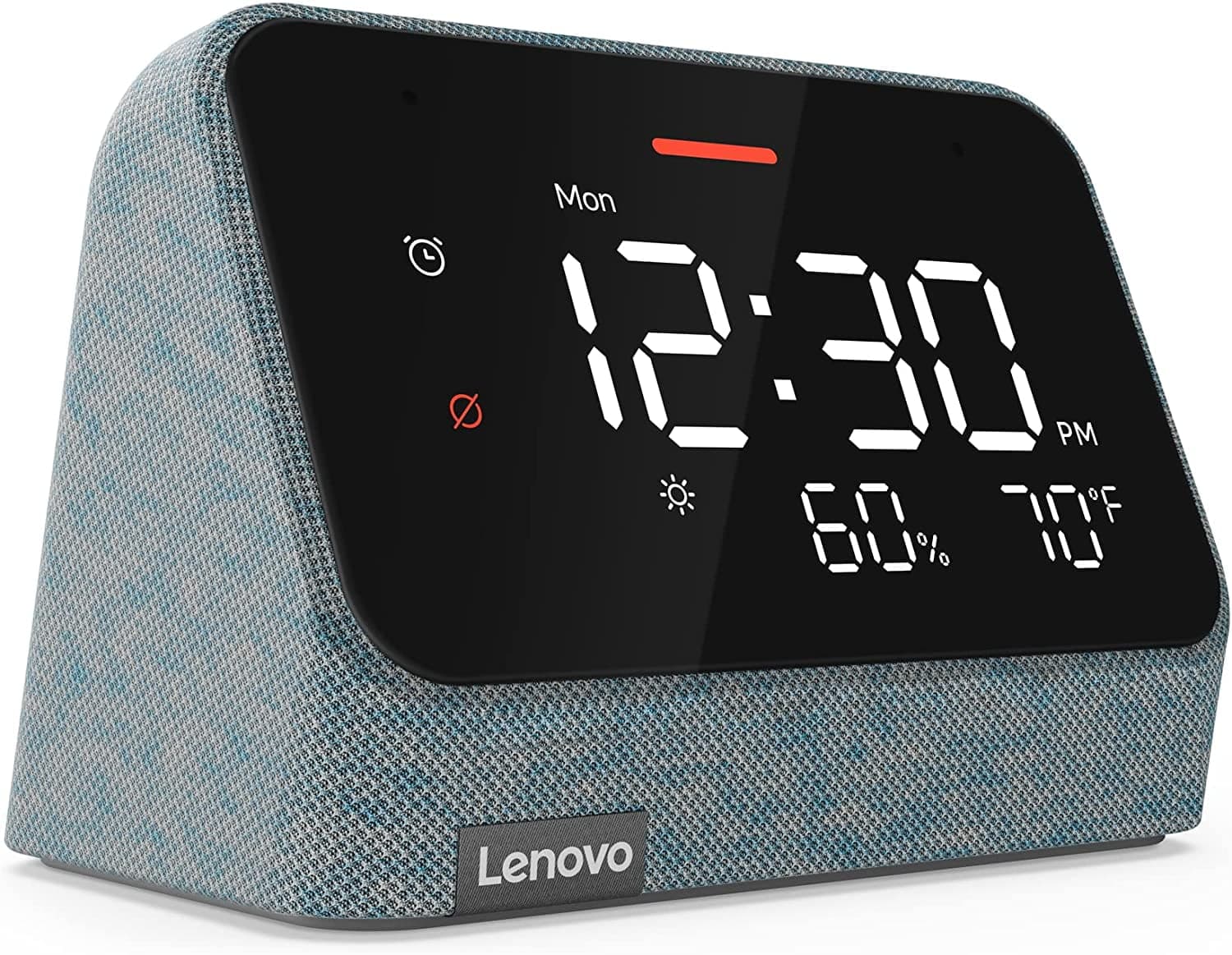
Lenovo Smart Clock Essential

Engineering Review: Lenovo Smart Clock Essential Smart Ecosystem Display and Circadian Hub

The Lenovo Smart Clock Essential redefines the bedside experience by merging high-fidelity acoustic performance with precise circadian alignment. This smart alarm clock speaker leverages an integrated voice assistant to manage smart home networks, providing a centralized node for IoT interoperability while maintaining a minimalist aesthetic through its high-visibility LED segment display. It functions as a technical bridge for users who demand the utility of a smart hub without the visual clutter of a traditional tablet interface.

Quick Answer

The Lenovo Smart Clock Essential is a reliable bedside automation tool due to its low-latency voice assistant integration and persistent high-contrast display that ensures visibility across various ambient light conditions. Its hardware-level alarm triggers ensure reliability even during transient network oscillations, making it a critical hub for smart home residents.

Seamless IoT interoperability across major voice assistant ecosystems allows for comprehensive control of over 40,000 smart devices through low-latency voice commands.
The four-inch high-contrast LED segment display utilizes ambient light optimization to provide maximum readability during peak daylight and minimal ocular strain during nocturnal hours.
Advanced alarm customization features include physical tap-to-snooze functionality and a dedicated toggle for microphone privacy, ensuring both tactile reliability and data security.

The Lenovo Smart Clock Essential is a strategic choice for users deep in the Lenovo and broader smart assistant ecosystems requiring a distraction-free bedside interface that excels in low-latency voice command execution and clear visual reporting of environmental data.

✓ Who Should Buy

  • Smart home enthusiasts requiring a low-latency voice control hub dedicated to bedside routines and IoT orchestration.
  • Minimalists who prioritize high-contrast, glanceable information over the high-blue-light emission of traditional LCD or OLED smart displays.
  • Users seeking a privacy-centric smart device with dedicated physical microphone disconnection hardware and non-camera-based interaction.

✕ Who Should Avoid

  • Users in regions with limited high-speed connectivity who may experience degraded response times for cloud-based smart features and voice queries.
  • Media consumers who require a high-resolution video interface for streaming content or conducting video teleconferencing from their bedside.
Product Overview
This sophisticated bedside peripheral functions as a bridge between traditional horology and modern smart home management. The unit features a textured fabric exterior that houses a front-facing speaker designed for clear acoustic fidelity in vocal frequencies, making it ideal for morning news briefings or bedtime podcasts. Its LED display is engineered for utility, showing not only the time but also outdoor temperature and humidity levels retrieved via real-time data synchronization. Unlike complex tablets, this device focuses on high-contrast visibility and immediate response metrics, utilizing a dedicated volume and alarm interface that bypasses complex menu hierarchies for immediate tactile feedback. The inclusion of a rear-facing USB port allows for secondary device charging, consolidating power management at the bedside while maintaining a compact footprint. Integration into the home network is handled through high-speed wireless protocols, ensuring that the assistant response remains snappy and the time synchronization remains accurate to the millisecond.

BrandLenovo
ModelSmart Clock Essential
TypeSmart Alarm Clock Speaker
ColorGrey, Blue
Body MaterialPlastic with fabric covering
Form FactorCompact bedside smart clock

Related Products

Engineering Analysis
The engineering philosophy behind the Lenovo Smart Clock Essential prioritizes operational efficiency and display clarity. The four-inch LED segment display operates with a high contrast ratio that ensures glyph legibility even when viewed from acute angles or in rooms with significant ambient light glare. Internally, the processor is tuned specifically for natural language processing tasks, reducing the round-trip latency metrics associated with cloud-based voice assistant interactions. This efficiency is critical for users who require instantaneous execution of smart home routines upon waking. From an acoustic perspective, the chassis volume is optimized to prevent resonance distortion in the lower frequency bands, while the full-range driver is positioned to maximize sound dispersion across a standard bedroom environment. The integration of an ambient light sensor allows for dynamic luminance adjustments, ensuring the display maintains circadian alignment by dimming to sub-nit levels at night to prevent sleep disruption. Furthermore, the inclusion of a built-in nightlight on the rear of the device provides a soft 31-lumen glow, which is calibrated to offer enough visibility for movement without triggering a full physiological wake response. The mechanical design also incorporates a hardware mute switch, which physically disconnects the microphone array to ensure absolute privacy, a critical factor for a device placed in a sensitive domestic area. Overall, the hardware architecture balances the demands of persistent connectivity with the nuances of a dedicated bedside timepiece, avoiding the thermal and power overhead of more complex graphical processing units.

Technical Support & FAQs