

Related Products
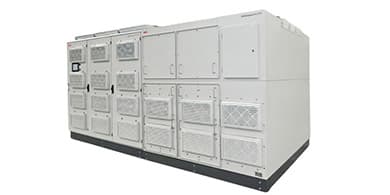
ABB HiPerGuard MV UPS: 2250 kVA High-Efficiency Medium Voltage Protection
✓ Who Should Buy
- •Hyperscale Data Centers in India requiring high-density power protection at the MV level to reduce copper losses.
- •Continuous Process Industries like semiconductor or pharmaceutical plants where a 10ms sag causes massive production losses.
- •Large Healthcare Hubs and Tertiary Hospitals utilizing high-voltage diagnostic equipment like CT and MRI suites.
- •Telecom Switching Centers managing massive regional traffic with a need for high-efficiency, low-footprint power solutions.
✕ Who Should Avoid
- •Small-scale commercial offices or retail outlets where a standard Low Voltage (415V) UPS is more cost-effective and easier to install.
- •Facilities without qualified Medium Voltage technicians, as the HiPerGuard requires specialized handling for installation and maintenance.
Product Overview
The ABB HiPerGuard is a revolutionary Medium Voltage (MV) UPS designed to eliminate power quality issues in large-scale Indian industrial and data center environments. By operating at the MV level (6.6 kV to 24 kV), it removes the need for step-down transformers, significantly reducing energy losses and physical footprint while handling the frequent voltage sags and swells common in Indian industrial zones. Its 98% efficiency and integrated fault-clearing capabilities ensure that critical processes in process industries and healthcare infrastructure remain uninterrupted during grid transitions.
| Brand | ABB |
| Model Name | HiPerGuard MV UPS |
| Model Number | HiPerGuard |
| Type | Online |
| Form Factor | Rack-mounted |
| Color | Black / Industrial Grey |
| Usage Application | Data Center, Process Industries, Industrial Facility, Telecom Systems, Healthcare Infrastructure |
Related Products
Engineering Analysis
The ABB HiPerGuard operates at the Medium Voltage level, providing superior impedance matching and fault-clearing capabilities compared to traditional Low Voltage systems. In the Indian context, where industrial grids often face transient surges and significant voltage sags (brownouts), the HiPerGuard’s ability to maintain a stable output within ±10% of nominal voltage is critical. It acts as a high-speed buffer between the unstable utility grid and sensitive downstream equipment, utilizing its high-speed static switch to isolate the load from grid disturbances in less than 20ms, effectively providing a 0ms transfer time to the inverter. This is vital for modern Power Supply Units (PSUs) that have very low hold-up times.
The system delivers a pure sine wave with exceptionally low Total Harmonic Distortion (THD), which is vital for the longevity of MV motors and sensitive medical imaging equipment like MRIs. In Indian facilities where non-linear loads are prevalent, the HiPerGuard’s unity power factor (1.0) ensures that the active power (2250 kW) equals the apparent power (2250 kVA), maximizing the utility of the system without the derating often required by lower-quality systems. This high Crest Factor capability allows it to handle the inrush currents of large industrial motors without tripping.
Utilizing Lithium-ion (Li-ion) technology, the HiPerGuard is better suited for the high ambient temperatures of Indian summers compared to traditional VRLA batteries. Li-ion chemistries offer higher energy density and a longer cycle life in tropical conditions, with sophisticated Battery Management Systems (BMS) that monitor cell health and prevent thermal runaway. With a peak efficiency of 98% at 50-100% load, the HiPerGuard minimizes heat dissipation, reducing the cooling load on HVAC systems in data centers and industrial control rooms, which is a significant operational cost factor in India.
Technical Support & FAQs
Engineering Analysis
The ABB HiPerGuard operates at the Medium Voltage level, providing superior impedance matching and fault-clearing capabilities compared to traditional Low Voltage systems. In the Indian context, where industrial grids often face transient surges and significant voltage sags (brownouts), the HiPerGuard’s ability to maintain a stable output within ±10% of nominal voltage is critical. It acts as a high-speed buffer between the unstable utility grid and sensitive downstream equipment, utilizing its high-speed static switch to isolate the load from grid disturbances in less than 20ms, effectively providing a 0ms transfer time to the inverter. This is vital for modern Power Supply Units (PSUs) that have very low hold-up times.
The system delivers a pure sine wave with exceptionally low Total Harmonic Distortion (THD), which is vital for the longevity of MV motors and sensitive medical imaging equipment like MRIs. In Indian facilities where non-linear loads are prevalent, the HiPerGuard’s unity power factor (1.0) ensures that the active power (2250 kW) equals the apparent power (2250 kVA), maximizing the utility of the system without the derating often required by lower-quality systems. This high Crest Factor capability allows it to handle the inrush currents of large industrial motors without tripping.
Utilizing Lithium-ion (Li-ion) technology, the HiPerGuard is better suited for the high ambient temperatures of Indian summers compared to traditional VRLA batteries. Li-ion chemistries offer higher energy density and a longer cycle life in tropical conditions, with sophisticated Battery Management Systems (BMS) that monitor cell health and prevent thermal runaway. With a peak efficiency of 98% at 50-100% load, the HiPerGuard minimizes heat dissipation, reducing the cooling load on HVAC systems in data centers and industrial control rooms, which is a significant operational cost factor in India.