


How Do You Know If an Appliance Is Right for Your Home Before Buying? A System-Level Guide
Learn how to choose the right appliance for your home in India. Understand how water, space, and usage affect performance and avoid costly mistakes.
Got a minute? Read this before you buy.
You compare features, check reviews, and pick what looks right. But a few months later, something feels off. The appliance works, but not the way you expected. So what went wrong?
👉 Most appliance decisions don’t fail after buying. They fail before the purchase is made.
Why Appliance Decisions Go Wrong Before You Even Buy
Most people choose appliances based on what is easy to compare. Features, price, brand, and ratings make the decision feel logical. They help you shortlist options and feel confident about your choice. But these factors only tell you what the appliance can do. They do not tell you how the appliance will perform in your home.
Because appliances are not used in ideal conditions. They are used in real homes where everyday factors vary. In Indian households, these variations are common:
- Water supply is inconsistent
- Space is often limited or adjusted
- Power conditions fluctuate
- Usage is heavier than expected
These differences are rarely considered during purchase, but they define your experience later.
👉 That is why the same appliance can perform well in one home and struggle in another.
Why Finding the Right Service Still Depends on Contacts
Even today, most appliance decisions do not start with a structured system. They start with a saved contact, a neighbour’s suggestion, or a WhatsApp message. This creates a very narrow decision path. You are not choosing from the best available options. You are choosing from what is visible within your personal network.
👉 This is the “do you know someone” problem.
The issue is not just convenience. It is a limitation. Good vendors remain invisible if they are outside your circle, while customers are forced to make decisions without proper comparison or clarity.
👉 This is not just a service issue. It is a discovery problem.
The Real Problem: Appliance Buying Without Context
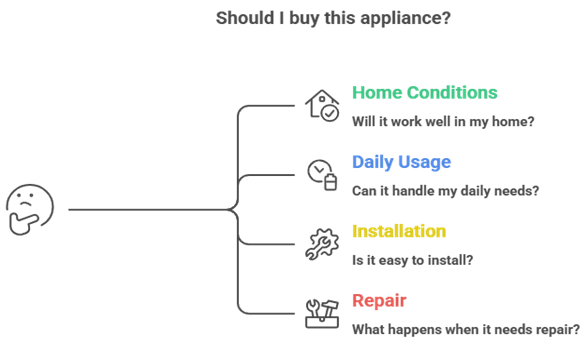
Today’s appliance buying journey is incomplete. You search online, compare models, and choose based on specs. But the decision is made without answering practical questions:
👉 This creates a gap between expectation and reality. You are not lacking options. You are lacking context.
What Actually Decides How Well an Appliance Works
Appliance performance depends more on your home environment than on features alone.
1. Water Conditions and Supply Consistency
In many Indian homes, the water supply is not stable. It depends on tank storage, pressure fluctuations, and varying water quality. Some appliances require consistent pressure and clean input. When these conditions are not met, performance gradually declines.
You may notice:
- Longer cycles
- Reduced efficiency
- Increased strain on internal components
👉 What looks like a product issue is often a mismatch with water conditions.
2. Space, Ventilation, and Placement
Appliances are rarely placed in ideal environments. They are adjusted to fit available space, often in tight corners or areas with limited airflow. While this works initially, it affects long-term performance. Without proper spacing and ventilation, heat builds up, efficiency drops, and wear increases over time.
3. Power Conditions and Usage Patterns
Appliance usage in Indian households is typically high. Refrigerators run continuously in summer. Air conditioners operate for long hours. Washing machines handle frequent loads. At the same time, power supply may not always be stable. Fluctuations and inconsistent load handling affect performance and durability.
👉 The more demanding your environment, the more important it becomes to choose the right appliance.
4. Installation and Setup
Installation is often treated as a basic step, but it plays a major role in long-term performance. A proper setup includes correct alignment and leveling, secure water and electrical connections, and adjustments based on home conditions.
When installation is rushed or done incorrectly, the impact shows over time:
- Reduced efficiency
- Frequent servicing
- Higher maintenance costs
If you are setting up a new home, getting this right from the beginning is critical. You can follow a more structured approach in Why Well-Organized Households Spend Less on Appliance Repairs Over Time.
Why Online Comparisons Don’t Give the Full Picture
Most comparison platforms focus on standard information like specifications, ratings, and pricing. This helps you compare products easily. But they do not answer practical questions: Will this appliance work in my home conditions? Is it suitable for my usage pattern? How easy will it be to maintain and repair?
👉 The decision feels informed, but it is missing real-world context.
Common Mistakes People Make Before Buying
- Choosing features over fit means more features do not guarantee better performance if your home conditions do not support them.
- Ignoring home conditions leads to water, space, and power being overlooked, even though they directly affect performance.
- Overlooking installation requirements means setup is treated as simple when it requires proper planning.
- Not thinking about service and maintenance means buyers focus only on the purchase, not what happens after.
Over time, these patterns lead to frequent repairs, higher costs, and reduced appliance lifespan.
What Happens When the Appliance Doesn’t Match Your Home
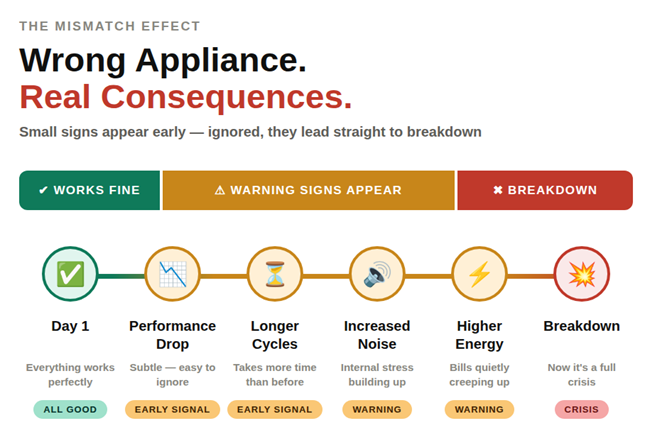
At first, everything works. But gradually, small changes begin to appear. You may notice a slight performance drop, longer cycles, increased noise, and higher energy usage.
👉 What started as a buying decision becomes a long-term issue.
The Vendor Side of the Problem Is Bigger Than It Looks
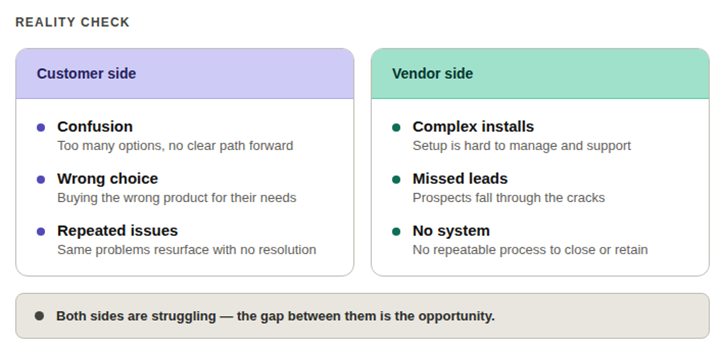
This issue is not limited to customers. It affects how service businesses operate. Most local vendors are skilled at their work, but their operations are not structured. They often run their business through calls, messages, and memory.
👉 The issue is not just demand. It is the lack of a structured way to handle demand.
The Bigger Issue: A Fragmented Service System
The problem extends beyond buying. You buy from one place, install through someone else, call another technician for repair, and repeat the process when issues return. There is no connection between buying, installation, service, and history.
👉 This creates no service memory, no accountability, repeated diagnosis, and repeated costs. This is not a one-time problem. It is a system-level problem.
A Better Way to Think Before Buying
Instead of asking which appliance is the best, ask:
👉 Which appliance will actually work in my home and over time?
This shift brings focus to home conditions, installation needs, service availability, and long-term performance.
How FatafatService Solves This as a Connected System
FatafatService connects appliance buying, installation, and service into one structured system instead of treating them as separate steps.
- The Marketplace layer helps you discover and compare appliances and services based on real-world conditions.
- The Vendor layer brings structure to how vendors handle installation and service.
- The Customer layer creates continuity by connecting your appliance decisions with service history and future needs.
👉 Instead of disconnected actions, you get a connected system from choosing to maintaining.
The Bottom Line
Appliance performance is not decided after installation. It is decided before buying, based on how well the appliance fits your home. Because in the end, it is not about choosing the best appliance. It is about choosing what actually works for your home.
👉 Still unsure what works best for your home? Compare options based on your home conditions with FatafatService.
FAQs
1. What should I check before buying an appliance for my home?
Check your home conditions such as water supply, available space, power stability, and how frequently the appliance will be used. These factors directly impact performance after installation.
2. Why do appliances perform differently even if they have similar features?
Appliances perform differently because real-world conditions like water pressure, placement, and usage vary across homes. Features alone do not determine actual performance.
3. How does FatafatService help in choosing the right appliance?
FatafatService helps you compare options based on real usage conditions, so you can choose what fits your home instead of relying only on specifications.
4. Can FatafatService help after I purchase an appliance?
Yes, you can connect with verified technicians for proper installation and ongoing service support, helping reduce long-term issues.
5. What makes FatafatService different from other platforms?
FatafatService connects appliance selection, installation, and maintenance into a single system, creating continuity instead of handling each step separately.