


Pricing Blindness in Local Services: Why You Still Feel Unsure After Paying
Understand why pricing feels unclear in local services and how structured pricing improves clarity and decision-making.
Why does paying for a service never feel completely certain?
Even after the job is done and the payment is made, there’s often a lingering question — was this the right price for what I got?
This feeling is not always about the amount. It comes from not fully understanding what the price actually represents. You agree to a number, but the reasoning behind that number is often unclear.
In local services, pricing is rarely just a transaction. It is an interpretation of work, effort, and outcome. And when that interpretation is not visible, uncertainty becomes unavoidable.
The Moment Where Pricing Breaks
Pricing confusion usually begins much earlier than people realize.
It starts the moment a number is shared without enough context. At that point, the focus shifts from understanding the service to reacting to the price.
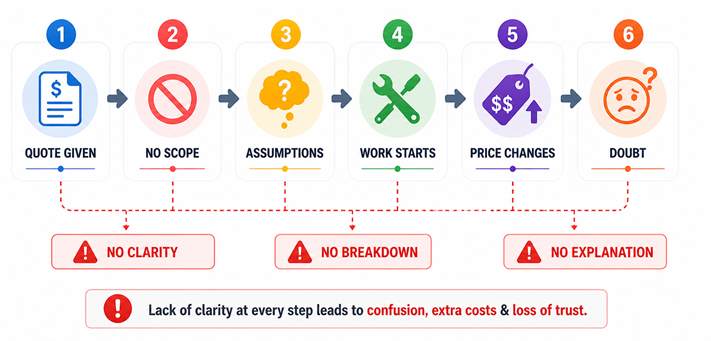
A customer hears a number, but does not clearly see:
- What the work includes
- How the effort is calculated
- What assumptions were made
This creates a gap between the service and the price.
From that moment onward, the decision becomes less about clarity and more about judgment. The customer either accepts the price based on urgency or hesitates without a clear way to evaluate it.
This is how pricing confusion typically builds up during a service interaction:
Why the Same Job Gets Different Prices
One of the most confusing realities of local services is price variation.
Two vendors may look at the same issue and provide completely different quotes. This creates immediate doubt, even before the service begins.
But the variation is not always random. What changes is the interpretation of the job itself.
A repair can be approached in multiple ways:
- a short-term fix that restores function
- a deeper repair that addresses root causes
- a replacement that prevents future issues
Each approach carries a different cost, but without a clear explanation, these differences remain hidden.
Customers end up comparing numbers that represent different outcomes, which makes the pricing feel inconsistent.
When Pricing Becomes a Reaction Instead of a Decision
In many service interactions, pricing is not something the customer actively evaluates. It becomes something they react to.
This happens because:
- The estimate is given quickly
- The breakdown is missing
- The explanation is limited
As a result, the customer does not have enough information to question or compare. The decision is made based on trust, urgency, or convenience.
Later, when the situation is no longer urgent, the doubt begins.
The Real Source of Pricing Anxiety
Pricing anxiety is often misunderstood as the fear of high cost. In reality, it comes from a lack of clarity.
Customers are not just asking: Is this expensive?
They are asking:
- Is this complete?
- Is this necessary?
- Is this the right way to fix the problem?
- Could this have been handled differently?
These questions remain unanswered when pricing is not explained properly. This is why even a fair price can feel uncomfortable.
The Problem with “Final Price”
The idea of a final price suggests closure. But in local services, it often does not represent a fixed boundary.
A “final” price may still depend on:
- additional parts identified during the repair
- extended effort due to hidden issues
- changes in approach while executing the work
Because these possibilities are not always discussed upfront, the final amount feels unpredictable.
Instead of feeling resolved, the transaction feels open-ended.
Why Price Comparison Rarely Works
Customers often try to compare quotes before making a decision. But without a shared definition of scope, comparison becomes misleading.
A lower quote may:
- exclude key components
- assume minimal effort
- solve only the immediate problem
A higher quote may:
- include additional work
- aim for long-term resolution
- factor in quality and reliability
Without understanding these differences, comparison becomes superficial. Customers are left choosing between numbers, not solutions.
The Gap between Price and Explanation
The most important gap in local service pricing is not between high and low prices. It is between the price and its explanation.
A number without context forces the customer to guess:
- What the vendor intends to do
- How the cost is structured
- whether the solution is complete
This guesswork creates discomfort, even when the service itself is done properly. Closing this gap is what truly improves the pricing experience.
The Shift from Price to Understanding
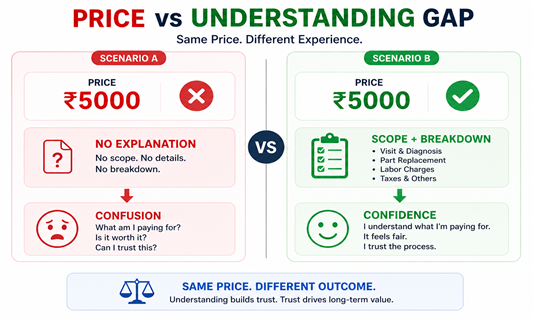
Improving pricing is not about controlling the number. It is about improving how the number is understood.
When pricing is clearly connected to:
- defined work
- expected outcome
- possible variations
It becomes easier to evaluate.
Customers feel more confident because they can see the logic behind the cost. The decision becomes informed rather than reactive.
Why Pricing Clarity Matters More Than Price Itself
Pricing in local services does not feel uncertain because of the number itself. It feels uncertain because the number is not clearly connected to the work being done.
When pricing is presented without explanation, customers are forced to rely on assumptions. This leads to hesitation before the service and doubt after the payment.
On the other hand, when pricing is clearly structured and tied to defined outcomes, the experience improves. Customers can understand what they are paying for and make more confident decisions.
The shift is not from high price to low price. It is from unclear pricing to understandable pricing.
How Fatafat Service Improves Pricing Clarity
Pricing confusion often comes from unclear scope and informal conversations. Fatafat Service reduces this by introducing more structure into service interactions.
It improves pricing clarity through:
- Structured service discovery: Helps customers start with clearer expectations before pricing is discussed
- Better-defined scope of work: Makes it easier to understand what is included and what may cost extra
- Consistent communication: Reduces sudden changes in pricing during the service
- Service history and records: Helps customers understand past pricing and make better decisions over time
With these elements in place, pricing becomes easier to understand, compare, and trust.
Choose Fatafat Service for a more transparent and reliable service experience where pricing is clear from the start.
Clarity Is What Builds Confidence in Pricing
Pricing blindness is not about paying too much or too little. It is about not knowing what you are paying for.
When pricing lacks clarity, every decision feels uncertain. But when it is explained and structured, it becomes easier to evaluate and accept.
Clarity does not eliminate cost. It eliminates doubt.
FAQs
1. Why do service prices vary for similar problems?
Because the scope and approach to solving the problem are often defined differently by each vendor.
2. How can I feel more confident about a service price?
By understanding what the price includes, what it excludes, and how it relates to the work being done.
3. How does Fatafat Service reduce pricing confusion?
Fatafat Service introduces more structure into service interactions, helping define scope and expectations more clearly before and during the job.
4. Does Fatafat Service help in understanding what a quote includes?
Yes, it improves visibility into service details, making it easier to understand what is covered and what may involve additional cost.
5. Why is structured pricing important in local services?
Structured pricing reduces ambiguity, improves transparency, and helps both customers and service providers make more informed and confident decisions.