

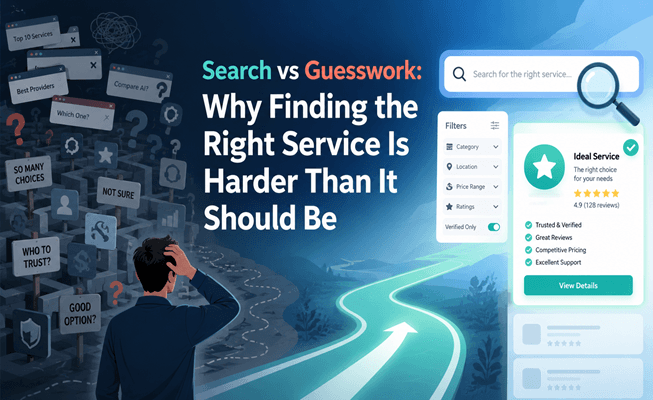
Search vs Guesswork: Why Finding the Right Service Is Harder Than It Should Be
Learn why finding the right appliance service feels confusing and how structured service discovery helps users choose the right support.
When something goes wrong at home, the first challenge is often knowing what to search for.
You may notice that your AC is not cooling, your washing machine is making noise, or your fridge is leaking water. But knowing the symptom does not always mean knowing the right service to choose.
That is where search becomes guesswork. Most users understand what they are facing, but they do not always know what kind of help they need.
Why People Struggle to Search for the Right Service
Most people describe appliance problems based on what they see, hear, or experience.
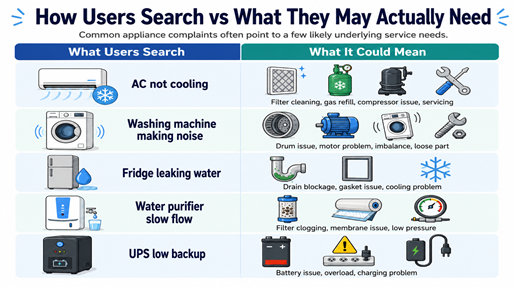
They may search for things like:
- AC not cooling
- Washing machine making noise
- Fridge leaking water
- Water purifier slow water flow
- UPS not giving backup
- Fan making sound
These searches are natural because users explain the problem in simple household language. But service systems are often organized around categories, technical issues, or service types.
A customer may only know that the appliance is not working properly. A technician may think in terms of airflow issues, motor faults, drainage blocks, filter problems, wiring issues, or battery failure.
This difference creates a gap between how users explain problems and how services are usually categorized.
The Reality Behind a Simple Search
A simple search can hide many possible causes.
For example, “AC not cooling” may sound like one problem, but the reason could be anything from dirty filters to low gas, poor airflow, thermostat issues, or a compressor fault.
The same applies to other appliances. A washing machine noise may come from overloading, drum imbalance, loose parts, bearing issues, or motor problems.
The user cannot always identify the exact cause. And they should not have to.
The real challenge is not expecting users to diagnose the issue. The challenge is helping them move from a visible symptom to the right service direction.
How Guesswork Affects the Service Experience
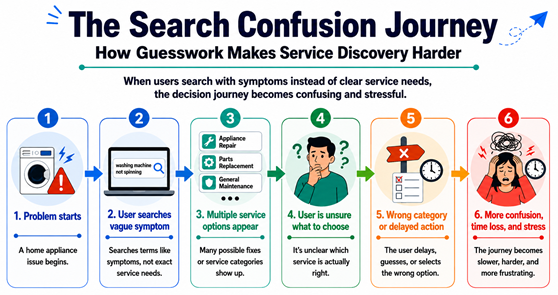
When users are unsure about what to search for, the entire service journey becomes slower.
They may spend time checking different results, calling multiple providers, or explaining the same issue again and again. In some cases, they may choose the wrong service category or delay the repair because they are unsure whether the problem is serious.
This can lead to:
- More time spent searching
- Confusion between repair, servicing, and inspection
- Delayed professional support
- Repeated conversations with different providers
- Higher chances of the issue becoming worse
A small appliance issue can become more stressful simply because the user does not know the right starting point.
Why Service Categories Matter
A structured marketplace helps reduce this confusion by organizing services into clearer categories.
Instead of expecting users to understand technical terms, service categories can guide them toward the most relevant option.
For example:
- AC not cooling → AC service or repair
- Washing machine making noise → Washing machine inspection or repair
- Water purifier slow flow → Water purifier servicing or filter check
- UPS low backup → UPS repair or battery check
- Fridge leaking water → Refrigerator repair
- Fan making sound → Fan repair
This kind of structure helps users take the next step without needing to know the exact technical issue.
The goal is not to make users diagnose the problem. The goal is to help them find the right path faster.
From Problem-Led Search to Service-Led Action
A better service discovery experience should start with the way people actually talk.
Most users do not begin with technical descriptions. They begin with everyday problems:
- “My AC is not cooling.”
- “My fridge is leaking.”
- “My washing machine is shaking.”
- “My UPS backup is low.”
Problem-led navigation helps convert these everyday descriptions into useful service paths.
This makes the experience easier for customers and more efficient for service providers. Customers can explain the issue in their own words, while the platform helps connect that issue to the right category or professional.
How Fatafat Service Helps Reduce Search Confusion
Fatafat Service helps simplify local service discovery by organizing services in a more structured way.
Instead of depending only on random searches, old contact numbers, or forwarded recommendations, users can explore service categories based on their actual needs.
The platform helps by:
- Organizing services into understandable categories
- Making appliance-related service discovery easier
- Connecting users with relevant professionals
- Reducing confusion around which service to choose
- Supporting a clearer path from problem to action
This matters because users do not always know the technical name of the issue. They simply need a practical way to find the right support.
Why Local Search Needs Plain Language
Local service pages should be written for real users, not only for search engines or technicians.
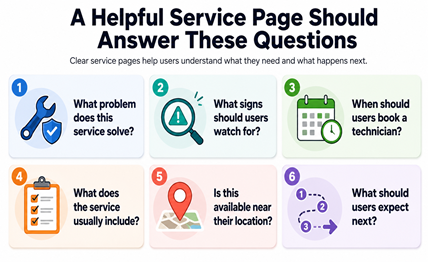
A useful service page should clearly explain:
- What the service includes
- What common problems it solves
- When users should book a technician
- What warning signs should not be ignored
- Whether the issue may need repair, servicing, or inspection
- Whether support is available near their area
Plain language helps users make faster and more confident decisions.
For example, an AC repair page should not only mention “AC repair service.” It should also address common user concerns such as weak cooling, water leakage, unusual noise, bad smell, or frequent switching off.
That is how search becomes more useful.
The Role of Appliance and Problem-Led Navigation
Users usually search in two ways. Some start with the appliance, such as AC, refrigerator, washing machine, water purifier, UPS, fan, or TV. Others start with the issue, such as not cooling, making noise, leaking water, low backup, slow water flow, or not turning on.
A good service discovery system should support both. If users know the appliance, they can begin there. If they only know the problem, they can start with the issue. Either way, the system should guide them toward the most relevant service option.
This makes the search process simpler and reduces the pressure on users to know technical details before asking for help.
Search Should Help Users Decide, Not Just Show Results
A long list of service providers is useful only when the user already knows what they need.
But when the user is unsure, search has to do more than show names and numbers. It should help users understand their options.
That means service discovery should include:
- Simple service explanations
- Common issue categories
- Clear service descriptions
- Local relevance
- Professional support options
- FAQs based on real user doubts
This is where structured service discovery becomes more useful than ordinary search. It does not only display results. It helps users make sense of the problem.
Moving from Guesswork to Guided Discovery
Local service discovery can become much easier when users are guided step by step.
In the future, guided issue diagnosis, decision support, comparison tools, and smarter search interpretation can reduce confusion even further.
For example, if a user searches for low cooling, the system can help them understand whether the issue may need cleaning, gas refilling, repair, or inspection.
If a user searches for washing machine shaking, the system can guide them toward possible causes such as overloading, leveling issues, drum problems, or internal faults.
This does not replace professional diagnosis. It simply helps users approach the service request with better clarity.
Why This Matters for Customers and Vendors
Better search clarity helps both customers and vendors. Customers can explain their issue more easily, while vendors receive clearer service requests.
When the starting point is clearer, the entire service journey becomes smoother, faster, and less confusing for everyone involved.
The Bottom Line
Search vs guesswork is a hidden problem in local services. Customers know what they are facing, but they do not always know what the issue is called. They search using symptoms, while service systems often respond with technical terms or scattered listings.
Fatafat Service helps reduce this gap by organizing services into clearer categories and connecting everyday household problems with relevant service paths. Whether it is an AC issue, washing machine problem, refrigerator fault, water purifier concern, or UPS repair requirement, users can find relevant service professionals more easily.
Sometimes, the first step is not fixing the appliance. It is knowing what kind of help to ask for.
FAQs
1. Why is it hard to search for the right appliance service?
It is difficult because most users describe symptoms, not technical problems. They may know what they are experiencing but may not know whether the issue needs repair, servicing, inspection, or part replacement.
2. What is problem-led service discovery?
Problem-led service discovery helps users find services based on the issue they are facing, such as leaking water, low backup, strange noise, slow cooling, or slow water flow.
3. How does Fatafat Service help users find the right service?
Fatafat Service organizes local services into clear categories and connects users with relevant professionals, making it easier to move from a household problem to the right service path.
4. Do I need to know the exact appliance problem before booking a service?
No. You only need to identify the visible issue. A trained professional can inspect the appliance and diagnose the exact cause.
5. Why is structured service discovery better than random search?
Structured discovery reduces confusion by organizing services clearly, helping users understand their options, and making it easier to choose the right support.