

The Family Coordination Problem: Why Home Management Needs More Than One Person
Learn why home service coordination becomes difficult for families and how structured service management can reduce confusion.
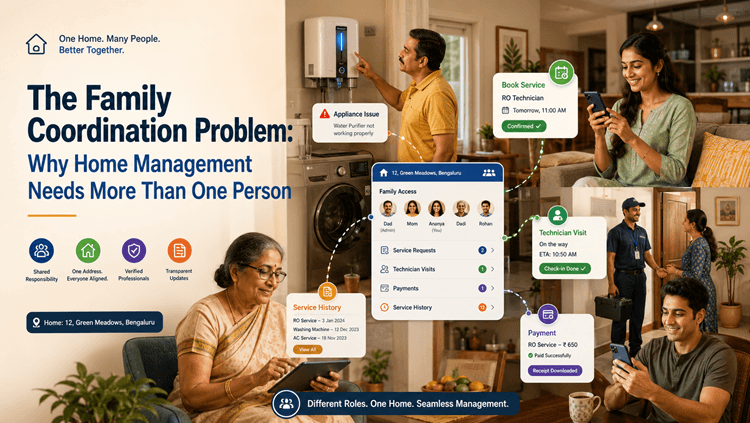
Home management is rarely handled by just one person.
One family member may know which technician to call. Another may be at home when the service happens. Someone else may make the payment. In some cases, a child manages repairs for parents, or a landlord coordinates service for a tenant.
These situations are common. But most home service systems still treat every request as if it belongs to one person only.
That is where coordination becomes difficult.
Why Home Management Is a Shared Responsibility
Most homes depend on more than one person to manage daily needs.
A repair request may begin with one person noticing the issue, but it does not always end with that same person. The responsibility often moves between family members, tenants, owners, or caretakers.
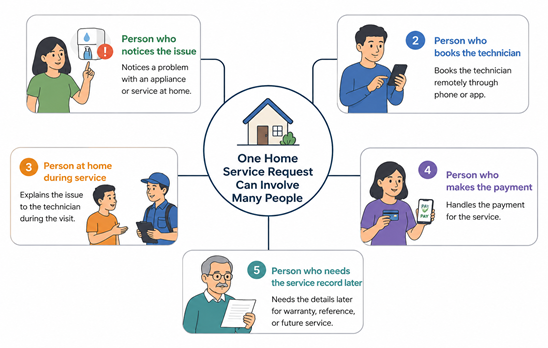
For example:
- A parent notices that the water purifier is not working
- A child books the technician remotely
- Someone at home explains the issue during the visit
- Another family member handles the payment
- Later, everyone tries to remember what was repaired
This is how home management works in real life. It is shared, scattered, and often dependent on quick calls or messages.
Where Coordination Starts Breaking Down
The problem begins when important details are not visible to everyone involved.
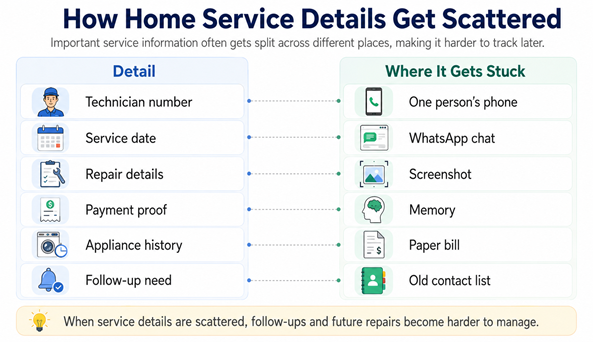
One person may know the technician’s number, but another person may not. Someone may remember the last service date, but others may have no idea. Payment details may be with one person, while repair information may be in someone else’s chat.
This creates confusion during future service needs.
People may have to ask:
- Who called the technician last time?
- What was repaired?
- Was the payment completed?
- Which appliance was serviced?
- Is the same issue happening again?
- Who will be available at home?
When these answers are scattered, even a simple repair can become time-consuming.
Why Calls and Chats Are Not Enough
Family coordination often depends on calls, WhatsApp messages, screenshots, and memory.
This may work for one small task, but it becomes difficult when multiple appliances, addresses, or people are involved.
A message can get buried. A bill can be lost. A technician’s number may remain saved only on one person’s phone. A service update may not reach the person who actually needs it.
The result is repeated confusion.
Instead of managing the service smoothly, families spend time passing information from one person to another.
The Problem Is Bigger in Multi-Person Homes
In many homes, the person booking the service is not always the person present during the service.
This is common when:
- Working professionals book services while someone else is at home
- Children manage appliance repairs for parents
- Landlords coordinate maintenance for tenants
- Family members share responsibility across homes
- Domestic help or caretakers are present during service visits
In these cases, everyone may need different levels of information.
The person at home may need technician details and timing. The person paying may need the invoice. The owner may need service history. The tenant may need limited visibility into the repair status.
Without a shared system, this becomes hard to manage.
Why Every Home Needs Address-Level Thinking
A home is not just a location. It is a set of appliances, people, responsibilities, service records, and recurring maintenance needs.
That is why address-level thinking matters.
When service information is connected to a specific home, it becomes easier to manage. Each address can have its own appliances, service history, technician records, and maintenance needs.
This is especially useful for people managing more than one home.
For example, someone may need to manage:
- Their own apartment
- Their parents’ house
- A rented property
- A second home
- A tenant-occupied home
Each address has different needs. Keeping everything mixed in one person’s memory creates confusion.
How Shared Household Participation Helps
A better home management system should not assume that one person handles everything.
It should support shared participation, where the right people can access the right information when needed.
This can help families manage:
- Service requests
- Technician visits
- Appliance details
- Payment updates
- Repair history
- Maintenance reminders
- Address-specific needs
When household members have better visibility, coordination becomes easier.
It also reduces repeated questions and avoids depending on one person for every update.
How Fatafat Service Can Simplify Family Coordination
Fatafat Service helps bring more structure to home service management by making it easier to connect service needs with the right home context.
Instead of relying on separate conversations, saved contacts, and individual updates, users can move toward a more organized way of managing appliance services and household support.
With a customer-focused service approach, Fatafat Service can help users:
- Find relevant service professionals
- Manage service needs more clearly
- Connect appliance issues with specific household requirements
- Reduce confusion between family members
- Create a smoother path from problem to service support
As the system evolves, shared access, address-based organization, service history, and role-based visibility can make household coordination even easier.
This is especially useful for families, tenants, landlords, and people managing services remotely.
From Scattered Updates to Role-Based Management
Every person involved in home management does not need the same level of access.
An owner may need full service history and payment records. A family member may only need technician updates. A tenant may need limited information related to the issue being fixed. A caretaker may only need visit timing and contact details.
Role-based management can make this clearer.
Instead of sharing everything manually, people can access only what is relevant to their role.
This helps reduce confusion while keeping the home service process more organized.
Why This Matters for Families
Better coordination makes home services less stressful.
For families, it means fewer missed updates, fewer repeated conversations, and less dependence on one person’s memory.
It also helps when service issues repeat. If previous records are available, families can understand what happened earlier and avoid starting from zero every time.
This creates a more reliable home management experience.
The Bottom Line
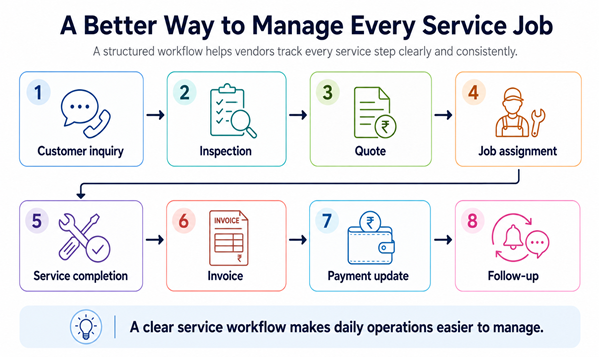
Home management is often collaborative, but most service processes still treat it as a single-person task.
In reality, one person may book the service, another may be present during the visit, someone else may pay, and another family member may need the service history later.
Fatafat Service helps move home service management toward a more structured approach by connecting service needs with clearer household context. With address-level thinking and shared participation, families can reduce confusion and manage services more smoothly.
A home is not just a place where service happens. It is a small operating environment with multiple people, responsibilities, and service needs.
FAQs
1. Why is family coordination difficult in home services?
Family coordination becomes difficult because service details are often scattered across calls, chats, screenshots, and individual memory. This makes it hard for everyone involved to stay updated.
2. What is shared household participation?
Shared household participation means allowing more than one person to be involved in managing home service needs, such as booking, technician coordination, payment, and service history.
3. Why is address-level thinking important?
Address-level thinking helps connect appliances, service records, and maintenance needs to a specific home. This is useful for families, landlords, tenants, and people managing multiple homes.
4. How does Fatafat Service help with home service coordination?
Fatafat Service helps users find relevant service professionals and manage service needs more clearly, reducing confusion caused by scattered calls and informal coordination.
5. Can this help people manage services for parents or tenants?
Yes. A more structured approach can help users coordinate services remotely, manage updates clearly, and reduce dependency on one person’s memory or phone records.