


The Trust Deficit Problem in Local Services: A Practical Checklist to Build Trust
Learn about the trust deficit in local services and use a practical checklist to ensure reliable and consistent service experiences.
Why does hiring a local service professional still feel uncertain, even today? Whether it is a technician, electrician, or appliance repair service, the first interaction often begins with doubt. You are not sure if the person will arrive on time, do the job properly, or charge fairly.
Even after the service is completed, that uncertainty does not fully go away. This is not just an occasional issue. It is a pattern that exists across most local services.
Trust Is Weak at First Contact
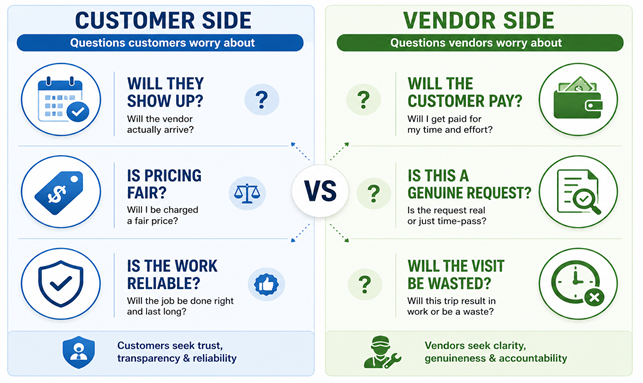
In local services, trust rarely exists at the beginning. It has to be built from scratch every single time. Most customers depend on referrals, online listings, or quick searches. While these methods help find options, they do not provide enough clarity about reliability or service quality.
There is no structured way to evaluate a service provider before the first interaction. As a result, every decision feels like a risk. This is where the trust deficit begins.
The Concerns Customers Quietly Carry
Customers may not always say it openly, but the concerns are always present. They wonder whether:
- The technician is genuinely skilled
- The issue will be diagnosed correctly
- The pricing will remain transparent
- The service will be completed as promised
- Someone will take responsibility if something goes wrong
These concerns are not based on one bad experience. They come from repeated uncertainty across different service interactions. Even a good experience does not completely remove the doubt, because the next interaction starts from zero again.
Vendors Also Operate in Uncertainty
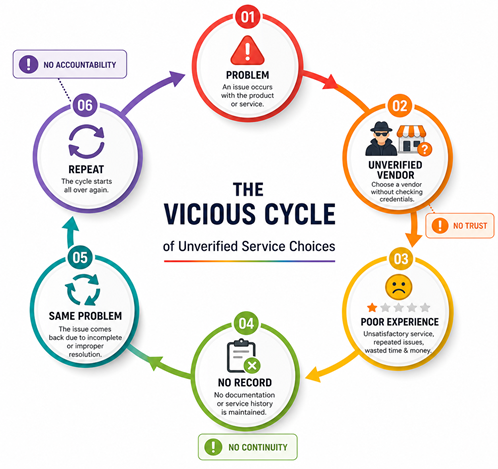
The trust gap is not one-sided. Service providers also face challenges that affect how they operate. They deal with:
- unconfirmed or fake service requests
- wasted visits with no actual work
- delayed or uncertain payments
- Difficulty in building long-term customer relationships
Without a structured system, vendors are forced to focus on volume rather than consistency. This creates inefficiency and reduces trust on both sides.
Why Trust Keeps Breaking Down
The real issue is not the lack of good customers or skilled vendors. It is the absence of continuity. Every service interaction is treated as a one-time event. There is no shared memory, no recorded history, and no structured way to carry forward previous experiences.
Because of this:
- Trust has to be rebuilt every time
- Accountability is limited
- consistency becomes difficult
This cycle keeps repeating, leading to a persistent trust deficit.
Moving from Assumed Trust to Structured Trust
Trust is often seen as something emotional, built through experience over time. But in local services, experience alone is not enough. Trust becomes stronger when it is supported by structure. This means having:
- visible information
- service history
- clear accountability
- repeatable interactions
When trust is backed by systems instead of assumptions, it becomes more reliable and scalable.
A Practical Checklist to Evaluate Trust in Local Services
Instead of relying on guesswork, a simple checklist can help you make better decisions before and after hiring a service provider.
Before booking a service, ask:
- Is the service provider verified or known through a reliable source
- Is there clarity on what the service includes
- Is there an estimated cost or pricing range
- Is the timeline or arrival commitment clearly defined
During the service, observe:
- Is the issue explained clearly before starting
- Are tools and methods used professionally
- Is there transparency in any additional work required
After the service, check:
- Was the final cost aligned with the initial estimate
- Was the work completed properly
- Is there any record or reference for future service
This checklist may seem simple, but it addresses the core gaps that create trust issues in most service interactions.
How a System Approach Changes the Experience
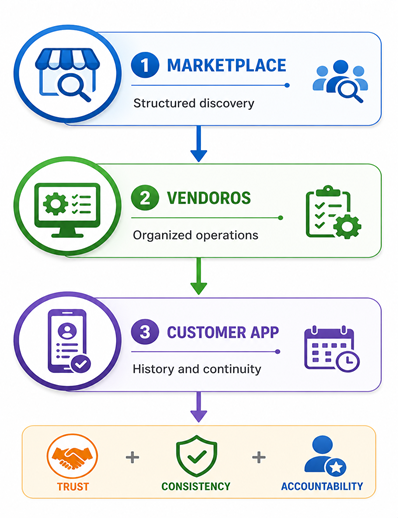
A structured system reduces the need for constant verification and guesswork. Instead of relying on one-time judgments, both customers and vendors operate within a framework that supports consistency and accountability.
Marketplace: Structured Discovery Instead of Uncertainty
The marketplace layer improves how customers discover services. Instead of random searches, it provides a structured environment where service providers are visible in a more organized way. This reduces the uncertainty at the first point of contact.
Vendors: Enabling Vendors to Operate with Consistency
Vendors help service providers move from informal operations to more structured workflows. It allows them to manage jobs, track interactions, and maintain consistency in service quality.
Customer App: Creating Memory and Continuity
The customer app solves the lack of memory by creating continuity. It maintains records of services, making future interactions more predictable and reliable.
Building Trust through Visibility and Accountability
As the system evolves, additional layers like verification badges, customer reviews, and service records make trust visible rather than assumed. This allows customers to make decisions based on information rather than guesswork.
The Bottom Line
The trust deficit in local services is not just a behavioral issue. It is a structural problem. When there is no continuity, no visibility, and no accountability, uncertainty becomes unavoidable. But when systems introduce these elements, trust becomes easier to build and maintain.
Over time, this transforms local services from unpredictable experiences into reliable and consistent interactions.
Building Trust with a Structured Service Approach
Fatafat Service brings this structure by connecting users with verified professionals while enabling more consistent and accountable service delivery. Reducing uncertainty and improving reliability help create a more dependable service experience.
FAQs
1. Why is trust a major issue in local services?
Trust becomes a challenge because most service interactions lack clear information, consistent records, and accountability.
2. Can trust be improved in local service marketplaces?
Yes, trust can be improved through systems that provide visibility into service providers, maintain records of past interactions, and ensure consistent service experiences.
3. How does Fatafat Service help build trust?
Fatafat Service helps reduce uncertainty by connecting users with verified professionals and enabling more structured and reliable service interactions.
4. Does Fatafat Service help maintain service history?
Yes, it supports continuity by maintaining records of past services, making future interactions more predictable and efficient.
5. Why should I choose Fatafat Service for local services?
Fatafat Service provides a more organized approach to service discovery and delivery, helping ensure better reliability, transparency, and consistency.