


Water Purifier Maintenance Guide — Everything You Need to Know
A simple, complete guide to maintaining your water purifier — filter changes, warning signs, servicing schedule, and easy tips to make it last longer.
Your water purifier almost never breaks down out of nowhere.
It sends out warning signs for weeks first. A slightly slower flow. A faint change in taste. A new sound. Most people ignore all of it until the day there's no water at all, and suddenly it's an emergency instead of a five-minute fix.
Bookmark this guide. Come back to it whenever something feels slightly off.
What's Actually Inside Your Purifier
You don't need to be technical here. Just know these four parts:
- Sediment pre-filter — the first checkpoint. Catches dust and rust before they reach anything delicate. Usually the first thing that needs changing. Also the cheapest part.
- RO membrane — the real workhorse, especially with hard water. Removes dissolved minerals and salts. The most expensive part to replace, which is exactly why protecting it matters.
- UV lamp (if fitted) — neutralizes bacteria and viruses using light. Can look totally fine and still be past its useful life. Replace on schedule, not on appearance.
- Storage tank — holds your purified water. Easy to forget since you never see inside it. Mineral deposits build up here too, quietly.
Think of these four parts as a chain. Each one protects the next. When the cheapest part (the pre-filter) is neglected, the strain doesn't disappear — it just moves down the chain to the most expensive part (the membrane). That's the single idea behind almost everything in this guide.
How Often Should You Service It?
Manufacturer manuals assume “average” water. Average doesn’t apply everywhere.
- Borewell or hard water: every 3-4 months
- Piped or soft water: every 6 months
Not sure which one you have?
A quick TDS test on any visit tells you in under a minute. It's also worth re-checking occasionally even if you think you know, since water sources can shift, especially in areas where supply switches between piped and borewell depending on the season.

Learning to Read the Warning Signs
Your purifier tells you when something’s wrong. Here’s how to listen:
| Sign | Usually means |
|---|---|
| Slower water flow | A filter is clogging |
| Unusual noise | Airlock, pump strain, or worn part |
| Change in taste | A filter overdue for replacement |
| White, chalky residue | Hard-water mineral build-up |
| Frequent tripping | Needs a check, not a restart |
None of these mean disaster. They mean it's time to look, while the fix is still small. The mistake most people make isn't ignoring a sign completely — it's noticing it, then waiting “just a bit longer” until it becomes two or three signs at once.
When to Call a Technician vs. When You Can Wait
Not every sign needs an emergency visit. Here's a simple way to decide:
- Call right away: frequent tripping, a sudden strong change in taste, or visible leakage
- Book your next routine visit: slightly slower flow, a filter due soon, minor tank residue
- Fine to monitor for now: a one-off unusual sound that doesn't repeat
When in doubt, a quick call costs nothing and settles it either way.
Habits That Actually Make a Difference
- Go by time, not appearance. Filters often need changing before they look dirty.
- Get TDS checked regularly. Your water source can shift, especially if your building switches between piped and borewell supply.
- Never skip the pre-filter. It's protecting the most expensive part in the system.
- Consider an AMC if you're on hard water. Usually cheaper over a year than paying per repair.
- Clean the storage tank periodically. It's out of sight, so it's the easiest step to forget — ask your technician to include it during a routine visit.
Repair or Replace?
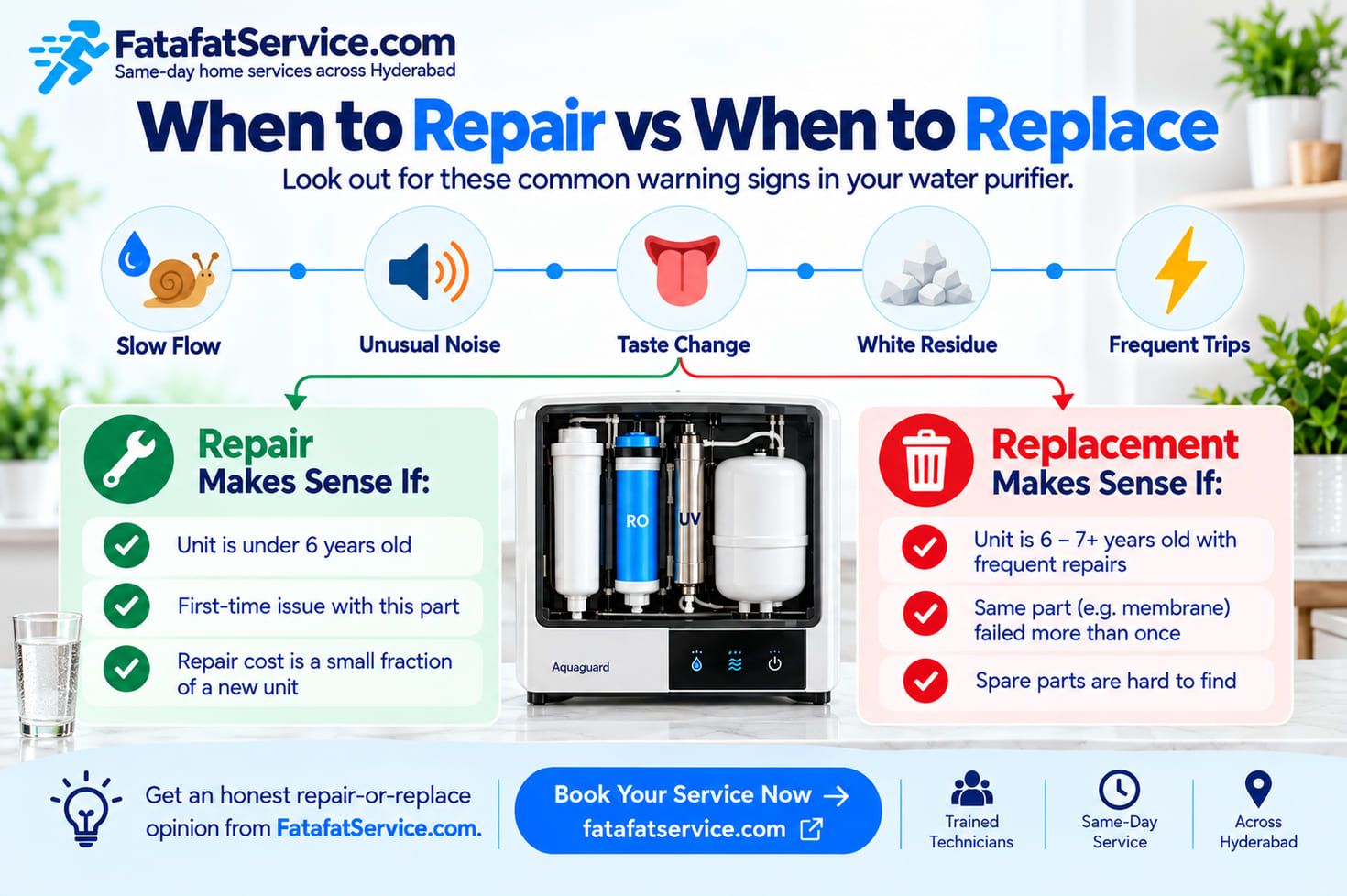
Almost every owner faces this question eventually. Lean toward replacement if:
- The unit is over 6-7 years old and needs frequent visits
- Last year's repairs added up to a big chunk of a new unit's cost
- The same part (especially the RO membrane) has failed more than once
- Spare parts for your model are getting hard to find
If none of that sounds like you, a repair almost always makes more sense. A good technician should be able to tell you which side of that line you're on within a single visit, without pushing you toward whichever option costs more.
Why FatafatService Gets This Right
- Every visit starts with a real TDS check, not a guess
- We tell you honestly when repair makes more sense than replacement, and when it doesn't
- All major brands serviced, whether we installed it or not
- You see the price before any work begins, not after
- Every repair comes backed by a 30-day warranty
Not Sure Which Stage Your Purifier Is At?
A quick check today tells you exactly where you stand, before a small issue turns into a big one.
Book a Technician with FatafatService →
Frequently Asked Questions
1. What's the single most important part to maintain?
The pre-filter. Cheapest part to replace, and it protects the RO membrane — by far the most expensive part to fix if it fails.
2. Can a purifier be serviced too often?
There's a point of diminishing returns. Stick to the right interval for your water type — over-servicing just adds cost, not extra protection.
3. Does FatafatService give an honest repair-or-replace opinion, or just push repairs?
A straight answer either way. If replacement genuinely makes more sense, that's what we'll tell you.
4. Does FatafatService service all purifier brands?
Yes, all major brands, regardless of who installed it.
5. What warranty do I get on a repair?
Every repair comes with a 30-day warranty. Same issue comes back, it's fixed free.